

396
WORLD ATLAS OF CORAL REEFS
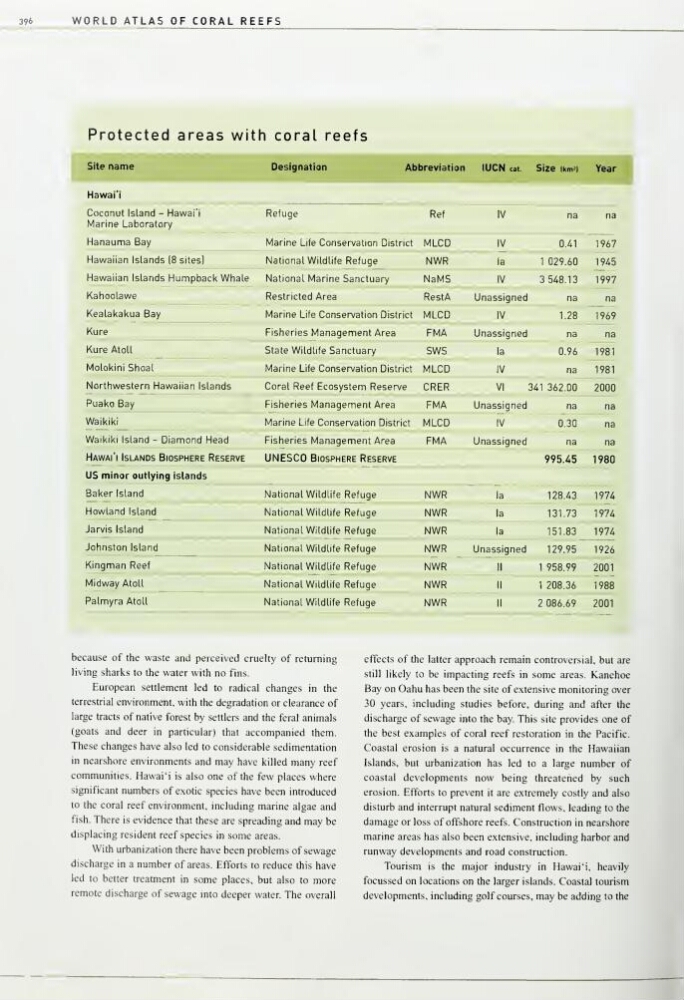
Protected areas with coral reefs
Site name
Designation
Hawai'i
Abbreviation
lUCN cat.
Size ikm'i
Year
Coconut Island - Hawai'i
Marine Laboratory
Refuge
Ref
IV
na
na
Hanauma Bay
Marine Life Conservation District MLCD
IV
0.41
1967
Hawaiian Islands 18 sites)
National Wildlife Refuge
NWR
la
1
029.60
1945
Hawaiian Islands Humpback Whale
National Marine Sanctuary
NaMS
IV
3 548.13
1997
Kahoolawe
Restricted Area
RestA
Unassig ned
na
na
Kealakakua Bay
Marine Life Conservation District MLCD
IV
1.28
1969
Kure
Fisheries Management Area
FMA
Unassig ned
na
na
Kure Atoll
State Wildlife Sanctuary
SWS
la
0.96
1981
Molokini Shoal
Marine Life Conservation District MLCD
IV
na
1981
Northwestern Hawaiian Islands
Coral Reef Ecosystem Reserve
CRER
VI
3/il 362.00
2000
Puako Bay
Fisheries Management Area
FMA
Unassigiled
na
na
Waikiki
Marine Life Conservation District
MLCD
IV
0.30
na
Waikiki Island - Diamond Head
Fisheries Management Area
FMA
Unassigiled
na
na
Hawai'i Islands Biosphere Reserve
UNESCO Biosphere Reserve
995.^5
1980
US minor outlying islands
Baker Island
Howland Island
Jarvis Island
Johnston Island
Kingman Reef
Midway Atoll
Palmyra Atoll
National Wildlife Refuge
National Wildlife Refuge
National Wildlife Refuge
National Wildlife Refuge
National Wildlife Refuge
National Wildlife Refuge
National Wildlife Refuge
NWR
NWR
la
228.43
131.73
NWR
la
151.83
NWR
Unassigned
129.95
NWR
II
1
958.99
NWR
II
1
208.36
NWR
II
2 086.69
1974
1974
1974
1926
2001
1988
2001
because of the waste and perceived cruelty of returning
living sharks to the water with no fins.
European settlement led to radical changes in the
terrestrial environment, with the degradation or clearance of
large tracts of native forest by settlers and the feral animals
(goats and deer in particular) that accompanied them.
These changes have also led to considerable sedimentation
in nearshore environments and may have killed many reef
communities. Hawai'i is also one of the few places where
significant numbers of exotic species have been introduced
to the coral reef environment, including marine algae and
fish. There is evidence that these are spreading and may be
displacing resident reef species in some areas.
With urbanization there have been problems of sewage
discharge m a number of areas. Efforts to reduce this have
led to better treatment in some places, but also to more
remote discharge of sewage into deeper water. The overall
effects of the latter approach remain controversial, but are
still likely to be impacting reefs in some areas. Kanehoe
Bay on Oahu has been the site of extensive monitoring over
30 years, including studies before, during and after the
discharge of sewage into the bay. This site provides one of
the best examples of coral reef restoration in the Pacific.
Coastal erosion is a natural occurrence in the Hawaiian
Islands, but urbanization has led to a large number of
coastal developments now being threatened by such
erosion. Efforts to prevent it are extremely costly and also
disturb and interrupt natural sediment flows, leading to the
damage or loss of offshore reefs. Construction in nearshore
marine areas has also been extensive, including harbor and
runway developments and road construction.
Tourism is the major industry in Hawai'i, heavily
focussed on locations on the larger islands. Coastal tourism
developments, including golf courses, may be adding to the
WORLD ATLAS OF CORAL REEFS
Protected areas with coral reefs
Site name
Designation
Hawai'i
Abbreviation
lUCN cat.
Size ikm'i
Year
Coconut Island - Hawai'i
Marine Laboratory
Refuge
Ref
IV
na
na
Hanauma Bay
Marine Life Conservation District MLCD
IV
0.41
1967
Hawaiian Islands 18 sites)
National Wildlife Refuge
NWR
la
1
029.60
1945
Hawaiian Islands Humpback Whale
National Marine Sanctuary
NaMS
IV
3 548.13
1997
Kahoolawe
Restricted Area
RestA
Unassig ned
na
na
Kealakakua Bay
Marine Life Conservation District MLCD
IV
1.28
1969
Kure
Fisheries Management Area
FMA
Unassig ned
na
na
Kure Atoll
State Wildlife Sanctuary
SWS
la
0.96
1981
Molokini Shoal
Marine Life Conservation District MLCD
IV
na
1981
Northwestern Hawaiian Islands
Coral Reef Ecosystem Reserve
CRER
VI
3/il 362.00
2000
Puako Bay
Fisheries Management Area
FMA
Unassigiled
na
na
Waikiki
Marine Life Conservation District
MLCD
IV
0.30
na
Waikiki Island - Diamond Head
Fisheries Management Area
FMA
Unassigiled
na
na
Hawai'i Islands Biosphere Reserve
UNESCO Biosphere Reserve
995.^5
1980
US minor outlying islands
Baker Island
Howland Island
Jarvis Island
Johnston Island
Kingman Reef
Midway Atoll
Palmyra Atoll
National Wildlife Refuge
National Wildlife Refuge
National Wildlife Refuge
National Wildlife Refuge
National Wildlife Refuge
National Wildlife Refuge
National Wildlife Refuge
NWR
NWR
la
228.43
131.73
NWR
la
151.83
NWR
Unassigned
129.95
NWR
II
1
958.99
NWR
II
1
208.36
NWR
II
2 086.69
1974
1974
1974
1926
2001
1988
2001
because of the waste and perceived cruelty of returning
living sharks to the water with no fins.
European settlement led to radical changes in the
terrestrial environment, with the degradation or clearance of
large tracts of native forest by settlers and the feral animals
(goats and deer in particular) that accompanied them.
These changes have also led to considerable sedimentation
in nearshore environments and may have killed many reef
communities. Hawai'i is also one of the few places where
significant numbers of exotic species have been introduced
to the coral reef environment, including marine algae and
fish. There is evidence that these are spreading and may be
displacing resident reef species in some areas.
With urbanization there have been problems of sewage
discharge m a number of areas. Efforts to reduce this have
led to better treatment in some places, but also to more
remote discharge of sewage into deeper water. The overall
effects of the latter approach remain controversial, but are
still likely to be impacting reefs in some areas. Kanehoe
Bay on Oahu has been the site of extensive monitoring over
30 years, including studies before, during and after the
discharge of sewage into the bay. This site provides one of
the best examples of coral reef restoration in the Pacific.
Coastal erosion is a natural occurrence in the Hawaiian
Islands, but urbanization has led to a large number of
coastal developments now being threatened by such
erosion. Efforts to prevent it are extremely costly and also
disturb and interrupt natural sediment flows, leading to the
damage or loss of offshore reefs. Construction in nearshore
marine areas has also been extensive, including harbor and
runway developments and road construction.
Tourism is the major industry in Hawai'i, heavily
focussed on locations on the larger islands. Coastal tourism
developments, including golf courses, may be adding to the