

Polynesia
found around much of the coastUne of Kaua'i but remain
poorly developed around Niihau. There is a submerged
barrier reef off the western coast of Kaua'i.
The majority of Hawaii's reefs are located northwest
of the main Hawaiian Islands. The first of the northwestern
islands still have small basaltic elements. Nihoa and Necker
are very isolated basalt islands, and there is little information about the marine communities nearby. The French
Frigate Shoals are a near-atoll with just a small basaltic
pirmacle at the western edge. The Gardner Pinnacles
represent the last basaltic outcrop, and consist of three tiny,
steep-sided rocks lying on a common platform with coral
and sand at its base. Laysan and Lisianski Islands are both
coral islands with submerged reefs around their edges,
while west of these are three true atolls: Pearl and Hermes,
Midway and Kure Atolls. In addition there are several reefs
with no associated islands. These include the large Maro
Reef northwest of the Gardner Pinnacles, a complex of
shallow reticulated reef systems which might be considered an atoll or platform-type structure.
The location of the Hawaiian Islands, in considerable
isolation and on the northern edge of the tropics, has
meant that they are not highly diverse. Their isolation has
been emphasized by the domin.ant oceanic currents which
reduce the likelihood of pelagic larvae being carried to
the archipelago. Over millions of years one consequence
of this has been the considerable opportunities for the
development of new species. Some 52 species of stony
coral, 500 of nearshore fish, 1 000 of marine molluscs
and 450 of marine algae have been recorded, of which
typically about 25 percent of each of these and other
groups are endemic to the Hawaiian Islands and a few
nearby reefs. This is the highest level of endemism for
any coral reef area in the world. One particular feature of
the coral communities is the relative paucity of acroporid
corals, the major reef builders in most parts of the Pacific.
Although there are species of Acropora these are rarely
dominant, the major reef-building species being Pontes
and PociUopora. Another feature of the Hawaiian reefs
has been the adaptation of at least some species to the
relatively cool conditions, possibly indicating a genetic
variance from the same species found in other locations.
There are no native mangroves in the Hawaiian
Islands, although a few species have been introduced in
modern times and two have become established and spread
to several of the high islands. There is only one seagrass
species Halophila hawaiiana. which is endemic to Hawai'i,
and seagrass beds are unusual. Millions of seabirds nest in
the northwest Hawaiian Islands, and a number of migratory
shorebirds rest or overwinter here. These are among the
largest and most important seabird colonies in the Pacific
Ocean. Five species of marine turtle have been seen in
Hawaiian waters, and the French Frigate Shoals are one
of the largest remaining nesting grounds for the green
turtle in the Pacific. These same islands are also of critical importance for the Hawaiian monk seal Monachiis
shauinslandi. The closest relations of this seal are the critically endangered Mediterranean monk seal and the extinct
Caribbean monk seal. Although there remain about 1 500
individuals and they are highly protected, numbers are still
declining. Several other marine mammals occur, including
a large and growing population of humpback whales,
Megaptera novaeangliae, which spend part of their migratory cycle in the islands between November and May
during which time they mate and give birth.
The population of native Hawaiian people was much
diminished by the arrival and colonization by Europeans
and others, and it remains low to this day. Immigration and
expansion of newly arrived populations, however, means
that the total population of the islands is probably four to
five times that of the original population. These people
are all located on the main islands, with about 75 percent
on Oahu. Honolulu is the largest city in the entire insular
Pacific. Hawai'i is also one of the world's top tourism
destinations, receiving about 6.5 million visitors annually.
Only a very few people now live in a manner which
could be described as subsistence, or depend heavily on
their own fish catches. There are, however, many who fish
to supplement their diet, for recreational purposes or at
small-scale commercial levels. All of these operate with
modern equipment, including gill nets, spears, trolling,
surround nets and traps. In addition to these, recreational
and commercial collection of fish for aquaria is widespread and poorly regulated. The nearshore fish populations are reported to be depleted around nearly all the
main islands. Larger-scale commercial fisheries primarily
focus on pelagic species, but also operate on a number of
reef species. A spiny lobster fishery in the northwestern
islands is reported to have become severely overfished and
may be closed. More recently a major shark fin fishery
has developed which is extremely controversial, not least
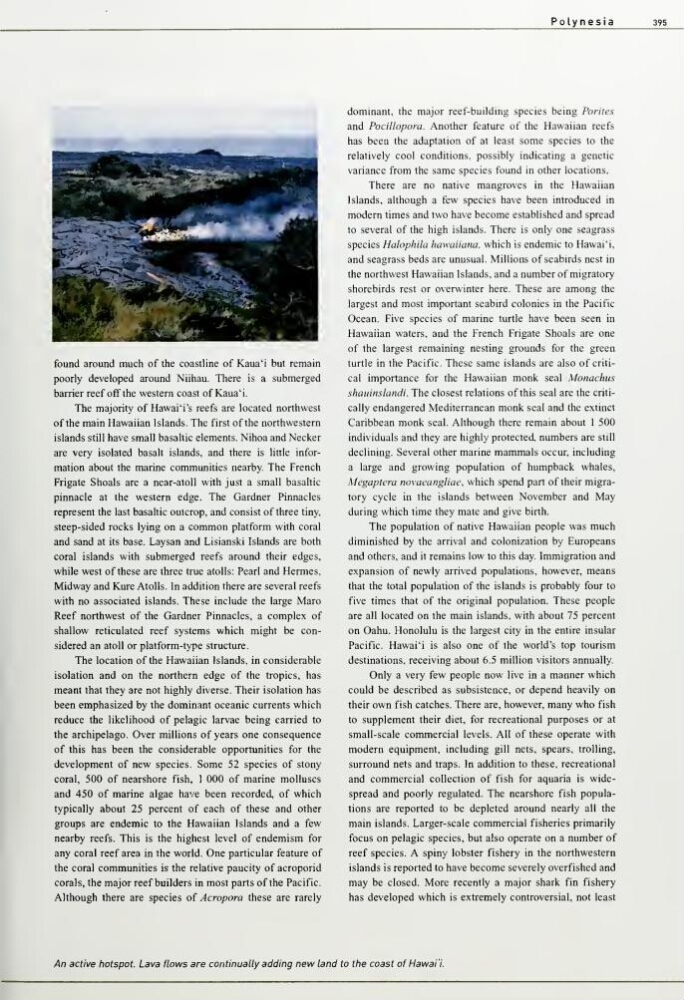
An active hotspot. Lava flows are continually adding new land to tlie coast of Hawai'i.
found around much of the coastUne of Kaua'i but remain
poorly developed around Niihau. There is a submerged
barrier reef off the western coast of Kaua'i.
The majority of Hawaii's reefs are located northwest
of the main Hawaiian Islands. The first of the northwestern
islands still have small basaltic elements. Nihoa and Necker
are very isolated basalt islands, and there is little information about the marine communities nearby. The French
Frigate Shoals are a near-atoll with just a small basaltic
pirmacle at the western edge. The Gardner Pinnacles
represent the last basaltic outcrop, and consist of three tiny,
steep-sided rocks lying on a common platform with coral
and sand at its base. Laysan and Lisianski Islands are both
coral islands with submerged reefs around their edges,
while west of these are three true atolls: Pearl and Hermes,
Midway and Kure Atolls. In addition there are several reefs
with no associated islands. These include the large Maro
Reef northwest of the Gardner Pinnacles, a complex of
shallow reticulated reef systems which might be considered an atoll or platform-type structure.
The location of the Hawaiian Islands, in considerable
isolation and on the northern edge of the tropics, has
meant that they are not highly diverse. Their isolation has
been emphasized by the domin.ant oceanic currents which
reduce the likelihood of pelagic larvae being carried to
the archipelago. Over millions of years one consequence
of this has been the considerable opportunities for the
development of new species. Some 52 species of stony
coral, 500 of nearshore fish, 1 000 of marine molluscs
and 450 of marine algae have been recorded, of which
typically about 25 percent of each of these and other
groups are endemic to the Hawaiian Islands and a few
nearby reefs. This is the highest level of endemism for
any coral reef area in the world. One particular feature of
the coral communities is the relative paucity of acroporid
corals, the major reef builders in most parts of the Pacific.
Although there are species of Acropora these are rarely
dominant, the major reef-building species being Pontes
and PociUopora. Another feature of the Hawaiian reefs
has been the adaptation of at least some species to the
relatively cool conditions, possibly indicating a genetic
variance from the same species found in other locations.
There are no native mangroves in the Hawaiian
Islands, although a few species have been introduced in
modern times and two have become established and spread
to several of the high islands. There is only one seagrass
species Halophila hawaiiana. which is endemic to Hawai'i,
and seagrass beds are unusual. Millions of seabirds nest in
the northwest Hawaiian Islands, and a number of migratory
shorebirds rest or overwinter here. These are among the
largest and most important seabird colonies in the Pacific
Ocean. Five species of marine turtle have been seen in
Hawaiian waters, and the French Frigate Shoals are one
of the largest remaining nesting grounds for the green
turtle in the Pacific. These same islands are also of critical importance for the Hawaiian monk seal Monachiis
shauinslandi. The closest relations of this seal are the critically endangered Mediterranean monk seal and the extinct
Caribbean monk seal. Although there remain about 1 500
individuals and they are highly protected, numbers are still
declining. Several other marine mammals occur, including
a large and growing population of humpback whales,
Megaptera novaeangliae, which spend part of their migratory cycle in the islands between November and May
during which time they mate and give birth.
The population of native Hawaiian people was much
diminished by the arrival and colonization by Europeans
and others, and it remains low to this day. Immigration and
expansion of newly arrived populations, however, means
that the total population of the islands is probably four to
five times that of the original population. These people
are all located on the main islands, with about 75 percent
on Oahu. Honolulu is the largest city in the entire insular
Pacific. Hawai'i is also one of the world's top tourism
destinations, receiving about 6.5 million visitors annually.
Only a very few people now live in a manner which
could be described as subsistence, or depend heavily on
their own fish catches. There are, however, many who fish
to supplement their diet, for recreational purposes or at
small-scale commercial levels. All of these operate with
modern equipment, including gill nets, spears, trolling,
surround nets and traps. In addition to these, recreational
and commercial collection of fish for aquaria is widespread and poorly regulated. The nearshore fish populations are reported to be depleted around nearly all the
main islands. Larger-scale commercial fisheries primarily
focus on pelagic species, but also operate on a number of
reef species. A spiny lobster fishery in the northwestern
islands is reported to have become severely overfished and
may be closed. More recently a major shark fin fishery
has developed which is extremely controversial, not least
An active hotspot. Lava flows are continually adding new land to tlie coast of Hawai'i.