

Polynesia
397
stresses caused by wider coastal development, effluent
discharge and the physical disturbance of nearshore
communities. Diving and snorkellmg are popular, although
limited in some areas by rough seas and currents.
Hana'uma Bay, the most popular snorkelling destination on
Oahu, receives up to 10 000 visitors per day.
In the northwestern islands there are no permanent
residents, although there are workers on Midway. French
Frigate Shoals and, seasonally, on Laysan. Tourism to the
outer islands is highly restricted, although ecotourism is
developing, notably on Midway Atoll.
Efforts to regulate and protect coral reefs in Hawai'i
include a large number of marine protected areas. Federal
legislation covers most of the more remote islands and their
surrounding reefs as national wildlife refuge. In 2000 all
of the other reefs and shallow banks which lay outside
these declared refiiges, together with a very large area of
surrounding seas, were declared a Coral Reef Ecosystem
Reserve. The combined legislation for these areas has
created a contiguous marine protected area, second in size
only to the Great Barrier Reef in Australia. Among the main
islands the Hawaiian Humpback Whale National Marine
Sanctuary covers significant areas of offshore waters.
Closer to centers of human population there are several
sites protected at the state level. The degree of protection
afforded by these varies considerably.
US minor outlying islands
In addition to Hawai'i. the USA holds jurisdiction over
a number of other territories in the Pacific. These include
American Samoa, Guam and the Northern Mariana
Islands (see separate accounts), but also a number of
remote atolls and reefs in the Central Pacific. Lacking any
native population these islands have primarily been seen
as important for defense, and they are administered at the
federal level. Their importance in terms of biodiversity is
now increasingly recognized.
Baker and Howland Islands are both low coral islands
with surrounding fringing reefs, geologically associated
with the Phoenix Islands of Kiribati to the south. Jarvis
Island IS similarly small with fringing reefs, an outlier to
the west of the northern Line Islands in Kiribati. All three
of these islands were exploited for guano in the 18th
century. Johnston Atoll is one of the most remote reefs in
(he Pacific, lying midway between Hawai'i and the islands
and reefs of Kiribati. Although it bears strong affinities to
the Hawaiian fauna it may also provide a stepping stone
connecting these faunas to those of the rest of the Pacific.
Wake Atoll is a small atoll lying to the north of the
Marshall Islands, with three islands dominating most of
the rim. Biodiversity is relatively low. which may be a
product of the shallow lagoon combined with the isolation
and the relatively northerly latitude.
From a geological perspective. Palmyra Atoll and
Kingman Reef make up the northern end of the Line
Islands of Kiribati. The 50 or so islets of Palmyra have
been under private ownership since the 1920s, but The
Nature Conservancy, a large US-based non-governmental
organization, bought the entire atoll in early 2001, and will
maintain it for conservation. Kingman Reef to the north of
Palmyra is an atoll with a slightly submerged western edge
and a deep lagoon, with no true islands but some exposed
rocks (including at high tide).
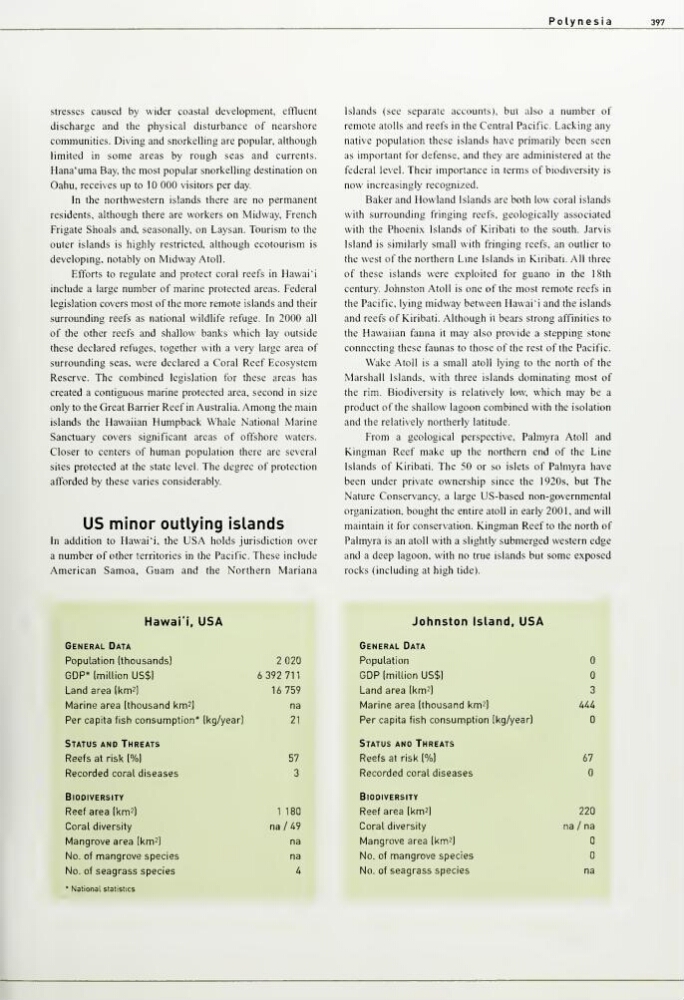
Hawai'i, USA
General Data
Population (thousands!
2 020
GDP* (million US$1
6 392 711
Land area (km^l
16 759
Marine area (thousand km'l
na
Per capita fish consumption • (kg/year|
21
Status and Threats
Reefs at risk (%1
57
Recorded coral diseases
3
Biodiversity
Reef area (km^j
1
180
Coral diversity
na/i9
Mangrove area (km^l
na
No. of mangrove species
na
No. of seagrass species
U
• National statistics
Johnston Isl and, USA
General Data
Population
GDP (million US$1
Land area (km^l
3
Marine area (thousand km^l
Wi
Per capita fish consumption (kg/yiBarl
Status and Threats
Reefs at risk (%l
67
Recorded coral diseases
Biodiversity
Reef area (km^l
220
Coral diversity
na / na
Mangrove area (km^l
No. of mangrove species
No. of seagrass species
na
397
stresses caused by wider coastal development, effluent
discharge and the physical disturbance of nearshore
communities. Diving and snorkellmg are popular, although
limited in some areas by rough seas and currents.
Hana'uma Bay, the most popular snorkelling destination on
Oahu, receives up to 10 000 visitors per day.
In the northwestern islands there are no permanent
residents, although there are workers on Midway. French
Frigate Shoals and, seasonally, on Laysan. Tourism to the
outer islands is highly restricted, although ecotourism is
developing, notably on Midway Atoll.
Efforts to regulate and protect coral reefs in Hawai'i
include a large number of marine protected areas. Federal
legislation covers most of the more remote islands and their
surrounding reefs as national wildlife refuge. In 2000 all
of the other reefs and shallow banks which lay outside
these declared refiiges, together with a very large area of
surrounding seas, were declared a Coral Reef Ecosystem
Reserve. The combined legislation for these areas has
created a contiguous marine protected area, second in size
only to the Great Barrier Reef in Australia. Among the main
islands the Hawaiian Humpback Whale National Marine
Sanctuary covers significant areas of offshore waters.
Closer to centers of human population there are several
sites protected at the state level. The degree of protection
afforded by these varies considerably.
US minor outlying islands
In addition to Hawai'i. the USA holds jurisdiction over
a number of other territories in the Pacific. These include
American Samoa, Guam and the Northern Mariana
Islands (see separate accounts), but also a number of
remote atolls and reefs in the Central Pacific. Lacking any
native population these islands have primarily been seen
as important for defense, and they are administered at the
federal level. Their importance in terms of biodiversity is
now increasingly recognized.
Baker and Howland Islands are both low coral islands
with surrounding fringing reefs, geologically associated
with the Phoenix Islands of Kiribati to the south. Jarvis
Island IS similarly small with fringing reefs, an outlier to
the west of the northern Line Islands in Kiribati. All three
of these islands were exploited for guano in the 18th
century. Johnston Atoll is one of the most remote reefs in
(he Pacific, lying midway between Hawai'i and the islands
and reefs of Kiribati. Although it bears strong affinities to
the Hawaiian fauna it may also provide a stepping stone
connecting these faunas to those of the rest of the Pacific.
Wake Atoll is a small atoll lying to the north of the
Marshall Islands, with three islands dominating most of
the rim. Biodiversity is relatively low. which may be a
product of the shallow lagoon combined with the isolation
and the relatively northerly latitude.
From a geological perspective. Palmyra Atoll and
Kingman Reef make up the northern end of the Line
Islands of Kiribati. The 50 or so islets of Palmyra have
been under private ownership since the 1920s, but The
Nature Conservancy, a large US-based non-governmental
organization, bought the entire atoll in early 2001, and will
maintain it for conservation. Kingman Reef to the north of
Palmyra is an atoll with a slightly submerged western edge
and a deep lagoon, with no true islands but some exposed
rocks (including at high tide).
Hawai'i, USA
General Data
Population (thousands!
2 020
GDP* (million US$1
6 392 711
Land area (km^l
16 759
Marine area (thousand km'l
na
Per capita fish consumption • (kg/year|
21
Status and Threats
Reefs at risk (%1
57
Recorded coral diseases
3
Biodiversity
Reef area (km^j
1
180
Coral diversity
na/i9
Mangrove area (km^l
na
No. of mangrove species
na
No. of seagrass species
U
• National statistics
Johnston Isl and, USA
General Data
Population
GDP (million US$1
Land area (km^l
3
Marine area (thousand km^l
Wi
Per capita fish consumption (kg/yiBarl
Status and Threats
Reefs at risk (%l
67
Recorded coral diseases
Biodiversity
Reef area (km^l
220
Coral diversity
na / na
Mangrove area (km^l
No. of mangrove species
No. of seagrass species
na