

WORLD ATLAS OF CORAL REEFS
i
^\'
J' '*^
r-"'<»l
incorporate sediments into their mesoglea for support
or protection.
The Antipatharia are commonly Icnown as the black
corals. They are all colonial, and secrete a horny proteinaceous skeleton. Although well known and economically
important, they are not a major component of most reef
communities and are not common in depths of less than
20 meters, with the majority of species being found below
100 meters.
Scleractinia
The Scleractinia, or stony corals, are a very large order
within the zoantharians, all of which secrete a calcium
carbonate skeleton. Although widespread throughout the
world they reach their greatest extent and abundance in
shallow tropical waters where the majority of species are
colonial and lay down large skeletal structures, the basic
building blocks of reefs. Some 794 species of hermatypic
Scleractinia have now been described and the great center
of scleractinian diversity lies in insular Southeast Asia, the
center of the Indo-Pacific region.
The Scleractinia have an ancient lineage, and leave a
good fossil record which can be traced back to at least
the mid-Triassic over 200 million years ago. There is no
clear evidence that they evolved from a single ancestor,
however, and many of the features of this group may in
fact have arisen independently.
The skeleton of the individual coral polyp is called a
corallite, with a base-plate from which a number of divisions known as septa rise up. radiating in towards the
center The outer edge of the polyp is often defined by a
wall forming a tube-like structure enclosing the septae.
New polyps are formed in colonial species by budding from
existing polyps, or by growth upwards from the connecting
tissues between existing polyps. Gradually new skeletal
material is laid down over existing material. The skeletal
structure of individual polyps forms the basis for species
identification, and in many cases full identification can
only be completed with dried skeletal material.
The larger structures built by colonies can become
highly complex, with massive corals producing domes or
towers, encrusting corals, and a vast range of branching
(ramose), columnar, foliacious (sheet or leaf-like) and
tabular (plate-like) structures. Many ecological studies
utilize this coral morphology as a means of describing a
reef The dominance of different growth forms is often
indicative of environmental conditions such as wave
exposure and varies across the reef profile. It also provides a partial measure of structural complexity. While
morphology can appear highly distinctive, it can also be
highly varied within a species, influenced by these same
external environmental parameters, and hence it is often
of limited value in species identification.
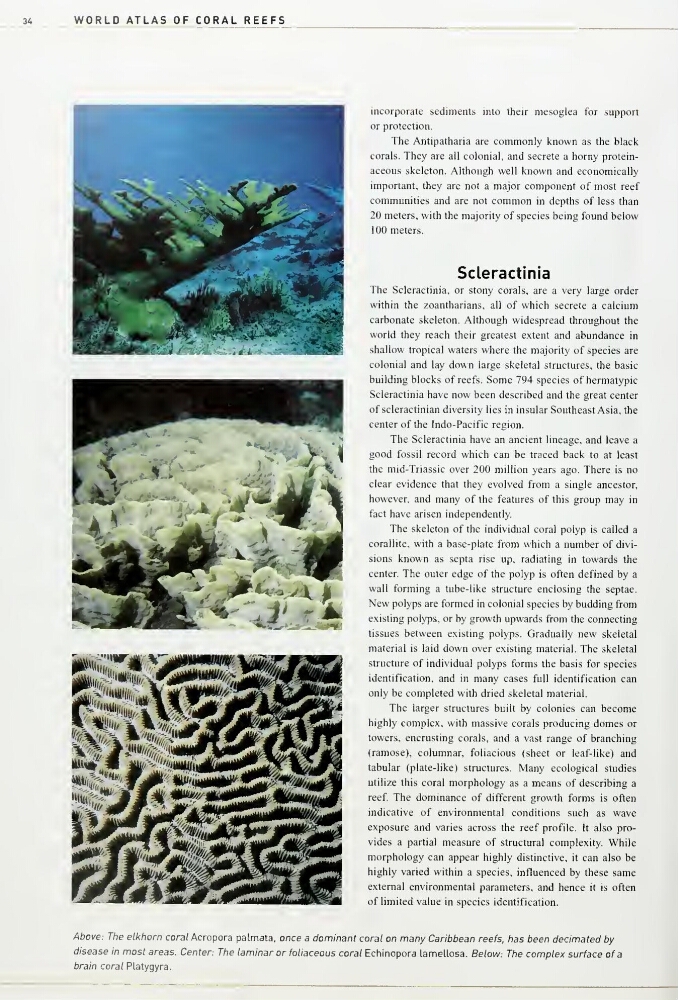
Above: The elkhorn coral Acropora palmata, once a dominant coral on many Caribbean reefs, has been decimated by
disease in most areas. Center: The laminar or foliaceous coral Echinopora lamellosa. Below: The complex surface of a
brain coral Platygyra.
i
^\'
J' '*^
r-"'<»l
incorporate sediments into their mesoglea for support
or protection.
The Antipatharia are commonly Icnown as the black
corals. They are all colonial, and secrete a horny proteinaceous skeleton. Although well known and economically
important, they are not a major component of most reef
communities and are not common in depths of less than
20 meters, with the majority of species being found below
100 meters.
Scleractinia
The Scleractinia, or stony corals, are a very large order
within the zoantharians, all of which secrete a calcium
carbonate skeleton. Although widespread throughout the
world they reach their greatest extent and abundance in
shallow tropical waters where the majority of species are
colonial and lay down large skeletal structures, the basic
building blocks of reefs. Some 794 species of hermatypic
Scleractinia have now been described and the great center
of scleractinian diversity lies in insular Southeast Asia, the
center of the Indo-Pacific region.
The Scleractinia have an ancient lineage, and leave a
good fossil record which can be traced back to at least
the mid-Triassic over 200 million years ago. There is no
clear evidence that they evolved from a single ancestor,
however, and many of the features of this group may in
fact have arisen independently.
The skeleton of the individual coral polyp is called a
corallite, with a base-plate from which a number of divisions known as septa rise up. radiating in towards the
center The outer edge of the polyp is often defined by a
wall forming a tube-like structure enclosing the septae.
New polyps are formed in colonial species by budding from
existing polyps, or by growth upwards from the connecting
tissues between existing polyps. Gradually new skeletal
material is laid down over existing material. The skeletal
structure of individual polyps forms the basis for species
identification, and in many cases full identification can
only be completed with dried skeletal material.
The larger structures built by colonies can become
highly complex, with massive corals producing domes or
towers, encrusting corals, and a vast range of branching
(ramose), columnar, foliacious (sheet or leaf-like) and
tabular (plate-like) structures. Many ecological studies
utilize this coral morphology as a means of describing a
reef The dominance of different growth forms is often
indicative of environmental conditions such as wave
exposure and varies across the reef profile. It also provides a partial measure of structural complexity. While
morphology can appear highly distinctive, it can also be
highly varied within a species, influenced by these same
external environmental parameters, and hence it is often
of limited value in species identification.
Above: The elkhorn coral Acropora palmata, once a dominant coral on many Caribbean reefs, has been decimated by
disease in most areas. Center: The laminar or foliaceous coral Echinopora lamellosa. Below: The complex surface of a
brain coral Platygyra.