

The World of Coral Reefs
35
Most species are involved in a tight symbiosis with
zooxanthellae and derive the majority of their nutrients
from these algae. They are all equipped with tentacles
and capable of feeding independently to some degree,
typically on plankton or minute organic particles.
However, the dependence on their algal partners is
considerable, and many species can be considered
virtually autotrophic.
Aside from asexual reproduction during colony
growth, corals undergo sexual reproduction. Some species
are hermaphroditic, while others have separate sexes. The
majority of species release eggs and sperm during a
spawning event - such events can be tightly harmonized
within and between species leading to spectacular mass
spawning events. In a few species the fertilized egg is kept
within the polyp and free-swimming larvae or planulae are
released some days or weeks later Both eggs and planulae
spend some days or weeks living in the plankton prior to
settling and this is critical to the genetic flow between
reefs and the establishment of corals in new areas.
Scleractinian corals are one of the few groups on
reefs which have been sufficiently well studied to provide
a global picture of their distribution and abundance
(see Map 1.2).
Worm-like groups
-
There are several large, unrelated groups in the animal
kingdom which have soft, elongated bodies and a general
worm-like appearance. Many of these, while inconspicuous,
are important residents of the reef
Bristle worms (Polychaeta)
These are segmented worms with a pair of paddle-like legs
on each segment. The head bears a number of sensory
organs, which may be highly adapted in different species.
They include almost every feeding habit: carnivores,
herbivores, omnivores, detritus feeders and filter feeders.
Many burrow inside coral or rock, chemically dissolving
or physically grinding their way in and then remaining to
filter feed or to gather and digest sheets of mucus secreted
by the coral. Perhaps the most familiar are the sabellid
worms, sessile burrowing forms that extend a feathery net
of tentacles to filter the passing water. Such conspicuous
species are just the tip of the iceberg, however, and in one
study over 1 400 individual polychaete worms representing
103 species were extracted from a single 4.7 kilo lump of
branching coral.
Ribbon worms (Nemertea)
These are typically highly elongated and flattened worms,
free-living carnivores often feeding on polychaetes. They
have very soft bodies, and some produce complex protective chemicals to deter predators.
Peanut worms (Sipuncula)
This is a group of unsegmented worms which typically
burrow into sand or bore into rocks and corals and are
detrital or algal feeders.
Flatworms (Platyhelminthes)
The phylum Platyhelminthes is a large group of small,
elongated animals with highly flattened bodies. Many
species are parasitic, however there is one highly active
carnivorous group, the polyclad flatworms (Polycladida)
which are relatively widespread on reefs. Their bodies are
covered in cilia and some are capable of swimming. A
number of coral reef species are highly colorful and can be
confused with nudibranchs (see Molluscs, page 37). Few
detailed inventories have been produced and identification
to species is usually very difficult.
Crustaceans
The Crustacea, one of the largest groups of organisms
on the reefs, are not the most conspicuous. They are
defined by having two pairs of antennae, and typically have
a chitinous exoskeleton and jointed biramous limbs.
Beyond this definition, the group includes a vast array
of species with highly different body forms The class
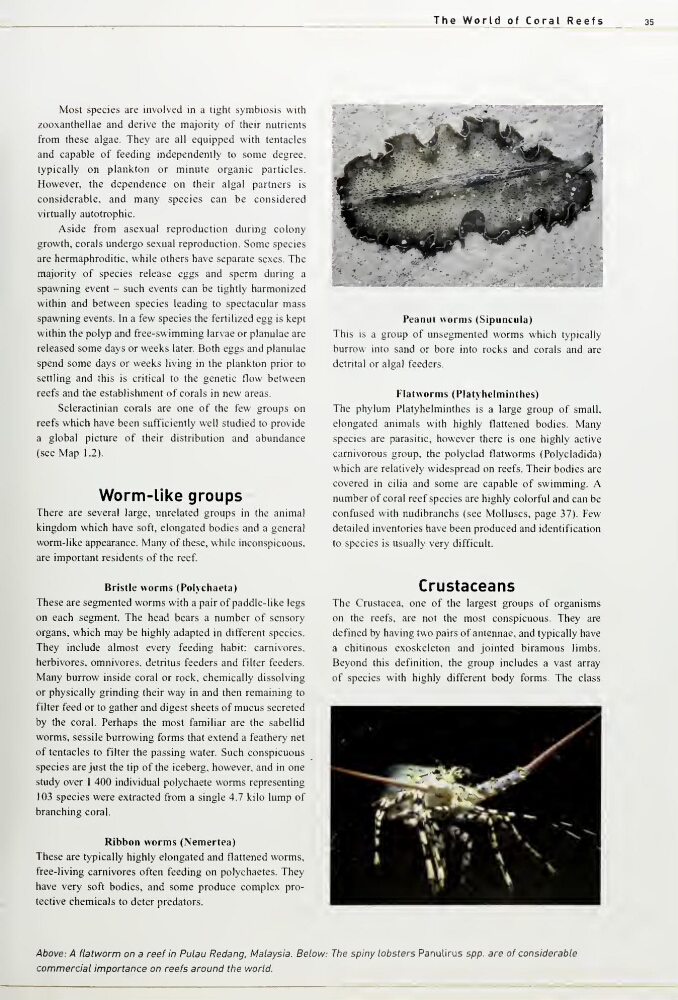
Above: A flatworm on a reef in Pulau Redang, Malaysia. Below: The spiny lobsters Panulirus spp. are of considerable
commercial importance on reefs around the world.
35
Most species are involved in a tight symbiosis with
zooxanthellae and derive the majority of their nutrients
from these algae. They are all equipped with tentacles
and capable of feeding independently to some degree,
typically on plankton or minute organic particles.
However, the dependence on their algal partners is
considerable, and many species can be considered
virtually autotrophic.
Aside from asexual reproduction during colony
growth, corals undergo sexual reproduction. Some species
are hermaphroditic, while others have separate sexes. The
majority of species release eggs and sperm during a
spawning event - such events can be tightly harmonized
within and between species leading to spectacular mass
spawning events. In a few species the fertilized egg is kept
within the polyp and free-swimming larvae or planulae are
released some days or weeks later Both eggs and planulae
spend some days or weeks living in the plankton prior to
settling and this is critical to the genetic flow between
reefs and the establishment of corals in new areas.
Scleractinian corals are one of the few groups on
reefs which have been sufficiently well studied to provide
a global picture of their distribution and abundance
(see Map 1.2).
Worm-like groups
-
There are several large, unrelated groups in the animal
kingdom which have soft, elongated bodies and a general
worm-like appearance. Many of these, while inconspicuous,
are important residents of the reef
Bristle worms (Polychaeta)
These are segmented worms with a pair of paddle-like legs
on each segment. The head bears a number of sensory
organs, which may be highly adapted in different species.
They include almost every feeding habit: carnivores,
herbivores, omnivores, detritus feeders and filter feeders.
Many burrow inside coral or rock, chemically dissolving
or physically grinding their way in and then remaining to
filter feed or to gather and digest sheets of mucus secreted
by the coral. Perhaps the most familiar are the sabellid
worms, sessile burrowing forms that extend a feathery net
of tentacles to filter the passing water. Such conspicuous
species are just the tip of the iceberg, however, and in one
study over 1 400 individual polychaete worms representing
103 species were extracted from a single 4.7 kilo lump of
branching coral.
Ribbon worms (Nemertea)
These are typically highly elongated and flattened worms,
free-living carnivores often feeding on polychaetes. They
have very soft bodies, and some produce complex protective chemicals to deter predators.
Peanut worms (Sipuncula)
This is a group of unsegmented worms which typically
burrow into sand or bore into rocks and corals and are
detrital or algal feeders.
Flatworms (Platyhelminthes)
The phylum Platyhelminthes is a large group of small,
elongated animals with highly flattened bodies. Many
species are parasitic, however there is one highly active
carnivorous group, the polyclad flatworms (Polycladida)
which are relatively widespread on reefs. Their bodies are
covered in cilia and some are capable of swimming. A
number of coral reef species are highly colorful and can be
confused with nudibranchs (see Molluscs, page 37). Few
detailed inventories have been produced and identification
to species is usually very difficult.
Crustaceans
The Crustacea, one of the largest groups of organisms
on the reefs, are not the most conspicuous. They are
defined by having two pairs of antennae, and typically have
a chitinous exoskeleton and jointed biramous limbs.
Beyond this definition, the group includes a vast array
of species with highly different body forms The class
Above: A flatworm on a reef in Pulau Redang, Malaysia. Below: The spiny lobsters Panulirus spp. are of considerable
commercial importance on reefs around the world.