

The World of Coral Reefs
Hexacorallia) which have six tentacles and body
partitions, or multiples thereof.
Octocorals are predominantly a tropical group of
photic (sunlit) waters, although some species are found in
cooler and deeper waters. Many of the reef species contam
symbiotic zooxanthellae within their tissues. Perhaps the
best known are the gorgonians (Gorgonacea), which are
widespread on coral reefs globally. These include the sea
whips and sea fans that are often dominant in deeper
parts of reefs. Their colonies are strengthened by a central
scleroprotein skeleton. Another spectacular group on coral
reefs are the soft corals (Alcyonacea), which are common
on many Indo-Pacific reefs, but less significant in the
Caribbean. These do not have a clear skeletal structure,
and body structure is maintained through hydrostatic
pressure. Most species secrete spicules of calcium
carbonate. Well known and widespread genera include
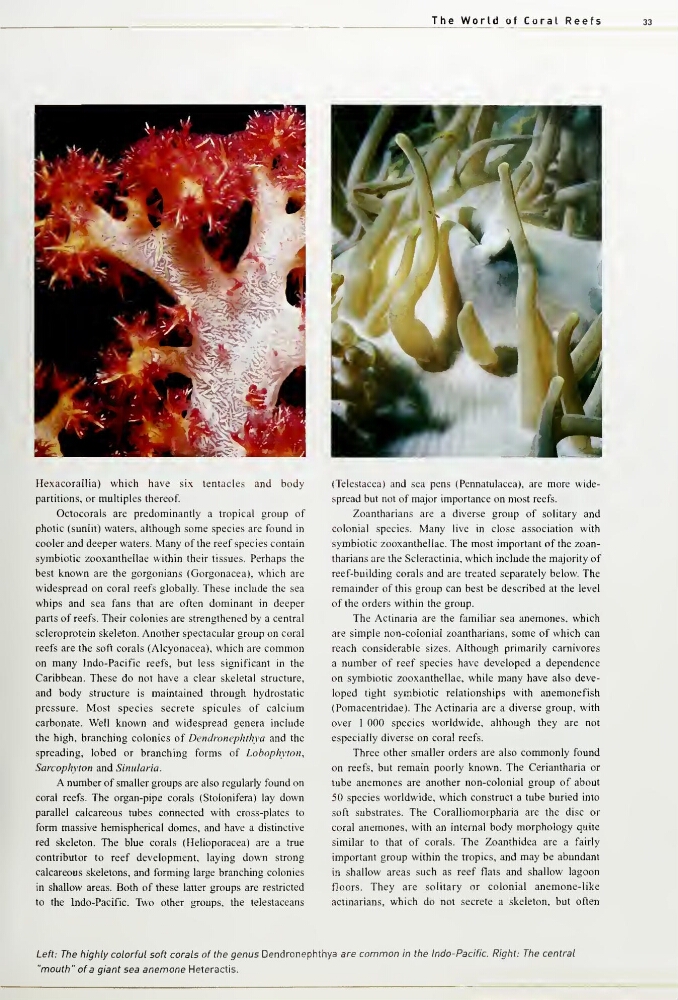
the high, branching colonies of Dendronephthya and the
spreading, lobed or branching forms of Lobophyton,
Sarcophyton and Sinularia.
A number of smaller groups are also regularly found on
coral reefs. The organ-pipe corals (Stolonifera) lay down
parallel calcareous tubes connected with cross-plates to
form massive hemispherical domes, and have a distinctive
red skeleton. The blue corals (Helioporacea) are a true
contributor to reef development, laying down strong
calcareous skeletons, and forming large branching colonies
in shallow areas. Both of these latter groups are restricted
to the Indo-Pacific. Two other groups, the telestaceans
(Telestacea) and sea pens (Pennatulacea), are more widespread but not of major importance on most reefs.
Zoantharians are a diverse group of solitary and
colonial species. Many live in close association with
symbiotic zooxanthellae. The most important of the zoantharians are the Scleractinia, which include the majority of
reef-building corals and are treated separately below. The
remainder of this group can best be described at the level
of the orders within the group.
The Actinaria are the familiar sea anemones, which
are simple non-colonial zoantharians, some of which can
reach considerable sizes. Although primarily carnivores
a number of reef species have developed a dependence
on symbiotic zooxanthellae, while many have also developed tight symbiotic relationships with anemonefish
(Pomacentridae). The Actinaria are a diverse group, with
over 1 000 species worldwide, although they are not
especially diverse on coral reefs.
Three other smaller orders are also commonly found
on reefs, but remain poorly known. The Ceriantharia or
tube anemones are another non-colonial group of about
50 species worldwide, which construct a lube buried into
soft substrates. The Coralliomorpharia are the disc or
coral anemones, with an internal body morphology quite
similar to that of corals. The Zoanthidea are a fairly
important group within the tropics, and may be abundant
in shallow areas such as reef flats and shallow lagoon
floors. They are solitary or colonial anemone-like
actinarians, which do not secrete a skeleton, but often
Left: The highly colorful soft corals of the genus Dendronephthya are common in the Indo-Pacific. Right: The central
"mouth" of a giant sea anemone Heteractis.
Hexacorallia) which have six tentacles and body
partitions, or multiples thereof.
Octocorals are predominantly a tropical group of
photic (sunlit) waters, although some species are found in
cooler and deeper waters. Many of the reef species contam
symbiotic zooxanthellae within their tissues. Perhaps the
best known are the gorgonians (Gorgonacea), which are
widespread on coral reefs globally. These include the sea
whips and sea fans that are often dominant in deeper
parts of reefs. Their colonies are strengthened by a central
scleroprotein skeleton. Another spectacular group on coral
reefs are the soft corals (Alcyonacea), which are common
on many Indo-Pacific reefs, but less significant in the
Caribbean. These do not have a clear skeletal structure,
and body structure is maintained through hydrostatic
pressure. Most species secrete spicules of calcium
carbonate. Well known and widespread genera include
the high, branching colonies of Dendronephthya and the
spreading, lobed or branching forms of Lobophyton,
Sarcophyton and Sinularia.
A number of smaller groups are also regularly found on
coral reefs. The organ-pipe corals (Stolonifera) lay down
parallel calcareous tubes connected with cross-plates to
form massive hemispherical domes, and have a distinctive
red skeleton. The blue corals (Helioporacea) are a true
contributor to reef development, laying down strong
calcareous skeletons, and forming large branching colonies
in shallow areas. Both of these latter groups are restricted
to the Indo-Pacific. Two other groups, the telestaceans
(Telestacea) and sea pens (Pennatulacea), are more widespread but not of major importance on most reefs.
Zoantharians are a diverse group of solitary and
colonial species. Many live in close association with
symbiotic zooxanthellae. The most important of the zoantharians are the Scleractinia, which include the majority of
reef-building corals and are treated separately below. The
remainder of this group can best be described at the level
of the orders within the group.
The Actinaria are the familiar sea anemones, which
are simple non-colonial zoantharians, some of which can
reach considerable sizes. Although primarily carnivores
a number of reef species have developed a dependence
on symbiotic zooxanthellae, while many have also developed tight symbiotic relationships with anemonefish
(Pomacentridae). The Actinaria are a diverse group, with
over 1 000 species worldwide, although they are not
especially diverse on coral reefs.
Three other smaller orders are also commonly found
on reefs, but remain poorly known. The Ceriantharia or
tube anemones are another non-colonial group of about
50 species worldwide, which construct a lube buried into
soft substrates. The Coralliomorpharia are the disc or
coral anemones, with an internal body morphology quite
similar to that of corals. The Zoanthidea are a fairly
important group within the tropics, and may be abundant
in shallow areas such as reef flats and shallow lagoon
floors. They are solitary or colonial anemone-like
actinarians, which do not secrete a skeleton, but often
Left: The highly colorful soft corals of the genus Dendronephthya are common in the Indo-Pacific. Right: The central
"mouth" of a giant sea anemone Heteractis.