

WORLD ATLAS OF CORAL REEFS
sponge faunas of the Caribbean are at least equal to those
of the Indo-Pacific in terms of diversity (per unit-area),
while sponge biomass is considerably greater on many
Caribbean reefs. One further difference is that Caribbean
sponges are more strongly heterotrophic, which could
reflect the higher amounts of nutrients available on these
reefs. In the Indo-Pacific autotrophic sponges are rather
more common.
Despite having high diversity, much of which remains
undescribed, sponges are often not highly visible or dominant in the reef benthos. In the tropical island regions
of Oceania some 1 000 species have currently been
described. For many countries the known species may
number no more than 30-40. However, an estimated 500
species have been recorded at Chuuk Atoll (Federated
States of Micronesia, in the Pacific) alone. Alongside
this genetic diversity, many sponges produce complex
chemical compounds, often as a form of defense against
predators. The investigation of these chemicals for pharmaceutical products is proving increasingly interesting.
Cnidarians
This is a large group of relatively simple organisms.
They are characterized by a basic body structure, with
two primary cell layers, an epidermis and an endodermis,
separated in most species by a simple, supportive, jellylike matrix, the mesoglea. A rudimentary nervous system
has developed in this group, with a nerve net but no centralized nervous system. Carnivory is common, although
some species have developed close associations with
endosymbiont algae (see above). One feature of this group
is
possession of specially adapted cells known as
cnidocytes, which incorporate a highly complex capsule
or "nematocyst" which, when triggered, is inverted to
release a long, whip-like thread with a barbed or pointed
tip and often releasing highly potent toxins. These may
be used to capture prey or for defense. There are two
basic body forms: the medusa is disc shaped, solitary and
pelagic, while the polyp is typically sessile, and consists
of an upright body with a fringe of tentacles encircling
a single opening which acts as both mouth and anus.
Colonial living has arisen in a number of members of this
group. There are four classes.
The Hydrozoa are a fairly mixed group, and include
some complex colonial planktonic members such as the
Portuguese man-o'-war Physalia spp. There are also a
number of sessile groups which are common on reefs
worldwide, including colonial hydroids, but also a number
of species which lay down a calcareous skeleton. These
include the members of the orders Milleporina and
Stylasterina. The former are the fire corals, Millepora
spp. which are widespread in all coral areas and can
form an important part of the substrate on the reef crest
and reef slope. Growth forms are typically branching
or encrusting. The stylasterinids are also known as lace
corals and typically form fairly small and fragile
branching colonies in darker areas and overhangs. In both
milleporids and stylasterinids there is some specialization
of polyps, with numbers of specialized stinging polyps
surrounding a single feeding polyp.
The Scyphozoa, or jellyfish, is a large group, though
not dominant on reefs. One genus, the upside-down
jellyfish Cassiopea is often found resting in reef flat
areas. Like many corals these have algal endosymbionts
living within their body tissues. Another class, the
Cubozoa, are like the jellyfish, but with a clearly foursided body wall and tentacles concentrated at the corners.
Also known as box jellyfish or sea wasps, these include
some highly toxic species, including the box jellyfish
Chironex fleckeri in the waters off Australia and the sea
wasp Cary-bdea alata from Caribbean waters.
The most important class on the coral reefs of the
world is the anthozoans. and these are considered
separately below.
Anthozoans
These are a very large group of cnidarians which lack
any medusoid form and have polyps with a central
gastrovascular cavity divided into partitions by septae.
They are divided into two main groups, the Octocorallia
(or Alcyonaria) which have eight tentacles and body
partitions and are all colonial, and the Zoantharia (or
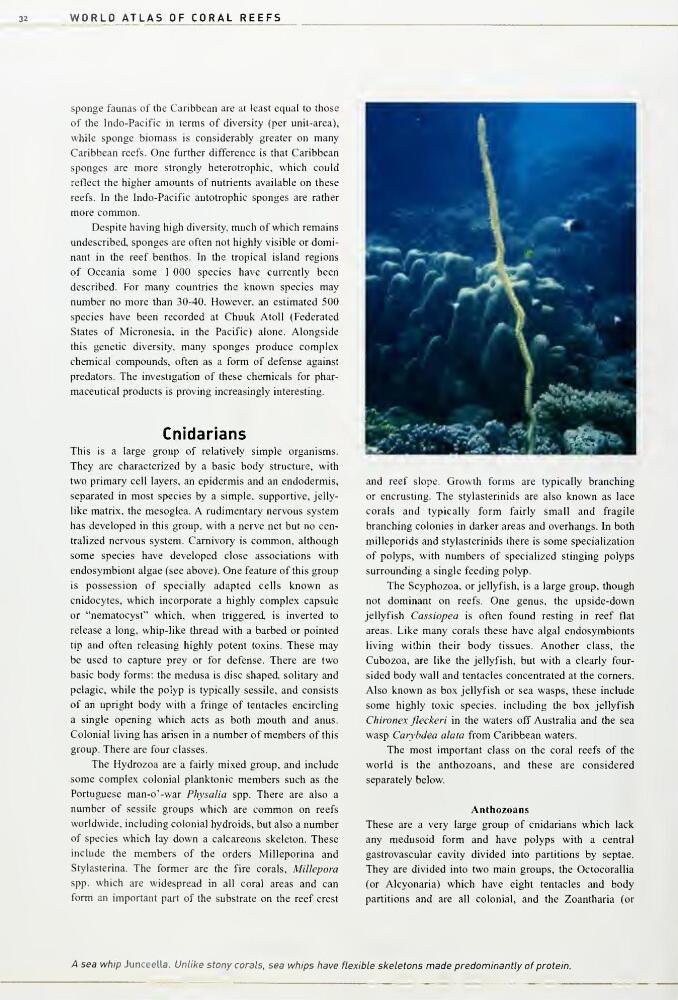
A sea whip Junceella. Unlike stony corals, sea whips have flexible skeletons made predominantly of protein.
sponge faunas of the Caribbean are at least equal to those
of the Indo-Pacific in terms of diversity (per unit-area),
while sponge biomass is considerably greater on many
Caribbean reefs. One further difference is that Caribbean
sponges are more strongly heterotrophic, which could
reflect the higher amounts of nutrients available on these
reefs. In the Indo-Pacific autotrophic sponges are rather
more common.
Despite having high diversity, much of which remains
undescribed, sponges are often not highly visible or dominant in the reef benthos. In the tropical island regions
of Oceania some 1 000 species have currently been
described. For many countries the known species may
number no more than 30-40. However, an estimated 500
species have been recorded at Chuuk Atoll (Federated
States of Micronesia, in the Pacific) alone. Alongside
this genetic diversity, many sponges produce complex
chemical compounds, often as a form of defense against
predators. The investigation of these chemicals for pharmaceutical products is proving increasingly interesting.
Cnidarians
This is a large group of relatively simple organisms.
They are characterized by a basic body structure, with
two primary cell layers, an epidermis and an endodermis,
separated in most species by a simple, supportive, jellylike matrix, the mesoglea. A rudimentary nervous system
has developed in this group, with a nerve net but no centralized nervous system. Carnivory is common, although
some species have developed close associations with
endosymbiont algae (see above). One feature of this group
is
possession of specially adapted cells known as
cnidocytes, which incorporate a highly complex capsule
or "nematocyst" which, when triggered, is inverted to
release a long, whip-like thread with a barbed or pointed
tip and often releasing highly potent toxins. These may
be used to capture prey or for defense. There are two
basic body forms: the medusa is disc shaped, solitary and
pelagic, while the polyp is typically sessile, and consists
of an upright body with a fringe of tentacles encircling
a single opening which acts as both mouth and anus.
Colonial living has arisen in a number of members of this
group. There are four classes.
The Hydrozoa are a fairly mixed group, and include
some complex colonial planktonic members such as the
Portuguese man-o'-war Physalia spp. There are also a
number of sessile groups which are common on reefs
worldwide, including colonial hydroids, but also a number
of species which lay down a calcareous skeleton. These
include the members of the orders Milleporina and
Stylasterina. The former are the fire corals, Millepora
spp. which are widespread in all coral areas and can
form an important part of the substrate on the reef crest
and reef slope. Growth forms are typically branching
or encrusting. The stylasterinids are also known as lace
corals and typically form fairly small and fragile
branching colonies in darker areas and overhangs. In both
milleporids and stylasterinids there is some specialization
of polyps, with numbers of specialized stinging polyps
surrounding a single feeding polyp.
The Scyphozoa, or jellyfish, is a large group, though
not dominant on reefs. One genus, the upside-down
jellyfish Cassiopea is often found resting in reef flat
areas. Like many corals these have algal endosymbionts
living within their body tissues. Another class, the
Cubozoa, are like the jellyfish, but with a clearly foursided body wall and tentacles concentrated at the corners.
Also known as box jellyfish or sea wasps, these include
some highly toxic species, including the box jellyfish
Chironex fleckeri in the waters off Australia and the sea
wasp Cary-bdea alata from Caribbean waters.
The most important class on the coral reefs of the
world is the anthozoans. and these are considered
separately below.
Anthozoans
These are a very large group of cnidarians which lack
any medusoid form and have polyps with a central
gastrovascular cavity divided into partitions by septae.
They are divided into two main groups, the Octocorallia
(or Alcyonaria) which have eight tentacles and body
partitions and are all colonial, and the Zoantharia (or
A sea whip Junceella. Unlike stony corals, sea whips have flexible skeletons made predominantly of protein.