

The World of Coral Reefs
areas where reefs are absent, notably the coasts of West
Africa and the Bay of Bengal. Unlike reefs, they are
absent over most of the Central and Western Pacific and
are very sparsely distributed in the arid regions of the
northern Red Sea and the Arabian Gulf, and on many
oceanic atolls.
Dinoflagellates (Dinoflagellata)
This is a common group of microscopic organisms
generally found in the plankton. Most are heterotrophic,
but a few photosynthesize. They are characterized by the
possession of two flagella, and are sometimes considered
to be algae (Dinophyceae), but more commonly grouped
with the Protozoa. The dinoflagellates are particularly
important in the coral reef ecosystem, as it is this group
which contains the zoo.xanthellae.
Zooxanthellae are capable of living freely in the
plankton, although they are regularly associated with a
broad range of coral reef organisms, living as endosymbionts within the tissues of these organisms. As
photosynthetic organisms, they are able to supply a
considerable amount of the nutrition required by their
hosts, but also benefit both from the waste products of
their hosts and from the shelter provided by their tissues.
The vast majority of reef-building corals are dependent
on these organisms. It was long considered that the zooxanthellae inhabiting corals were from only one or two
species, but this view is now strongly challenged and
the full diversity of this group is in need of further
investigation.
Another important dinoflagellate, at least from a
human perspective, is Gambierdiscus loxicus, which
grows on benthic algae and dead coral rock. This species
produces a toxin known as ciguatera which is not broken
down by the organisms which unwittingly ingest it. This
toxin can build up through the food chain reaching
concentrations, in some larger predatory fish, that are
highly toxic to humans who eat them. Outbreaks of
ciguatera have, in some cases, been linked to extensive
coral reef disturbance, the dead and bare surfaces perhaps
providing a greater surface area for this species to inhabit.
Sponges
Sponges are among the most primitive multicellular
organisms (with ancestral-like organisms detected from
pre-Cambrian deposits some 650-700 million years old),
and yet they have a high diversity and are widespread
across the globe. Although they do not form true bodies
with differentiated organs, most sponges grow into well
structured forms, with a network of internal canals
through which sea water is passed, aided by the movement
of flagella and microvillae. Water is drawn into the sponge
through specialized cells, and wastewater is then flushed
through exhalent pores, which are usually clearly marked
on the surface of the sponge. The majority of sponges are
filter feeders and are able to process considerable volumes
of water every day, filtering out nutrients. Other sponges,
including many which live in the nutrient-poor waters
of the reef rely on associations with blue-green algae
(cyanobacteria) or zooxanthellae and are effectively
autotrophic. A number of sponges are capable of chemically dissolving (etching) into corals in a process which
is a major part of bioerosion on coral reefs. Sponges have
a great variety of physical structures, and indeed many
show considerable plasticity in their growth forms. Within
their cellular matrix, certain specialized cells lay down
skeletal tissues. Skeletons are formed from numerous
smaller elements called spicules made from silica or
calcite, while in others they are formed from spicules or
longer fibres made from collagen. With these strengthening skeletons sponges produce large structures, which
may be encrusting, lattice-, ball-, vase-, or barrel-shaped,
or longer rope-like or branching forms.
Unlike many other groups it would appear that the
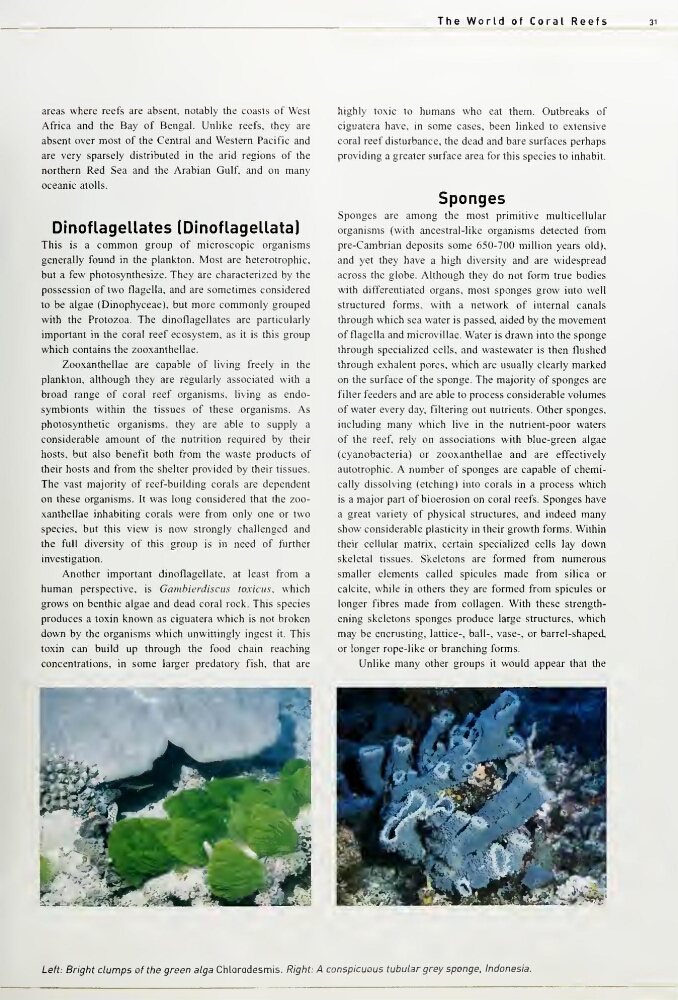
Left: Bright clumps of the green alga Chlorodesmis. Right: A conspicuous tubular grey sponge, Indonesia.
areas where reefs are absent, notably the coasts of West
Africa and the Bay of Bengal. Unlike reefs, they are
absent over most of the Central and Western Pacific and
are very sparsely distributed in the arid regions of the
northern Red Sea and the Arabian Gulf, and on many
oceanic atolls.
Dinoflagellates (Dinoflagellata)
This is a common group of microscopic organisms
generally found in the plankton. Most are heterotrophic,
but a few photosynthesize. They are characterized by the
possession of two flagella, and are sometimes considered
to be algae (Dinophyceae), but more commonly grouped
with the Protozoa. The dinoflagellates are particularly
important in the coral reef ecosystem, as it is this group
which contains the zoo.xanthellae.
Zooxanthellae are capable of living freely in the
plankton, although they are regularly associated with a
broad range of coral reef organisms, living as endosymbionts within the tissues of these organisms. As
photosynthetic organisms, they are able to supply a
considerable amount of the nutrition required by their
hosts, but also benefit both from the waste products of
their hosts and from the shelter provided by their tissues.
The vast majority of reef-building corals are dependent
on these organisms. It was long considered that the zooxanthellae inhabiting corals were from only one or two
species, but this view is now strongly challenged and
the full diversity of this group is in need of further
investigation.
Another important dinoflagellate, at least from a
human perspective, is Gambierdiscus loxicus, which
grows on benthic algae and dead coral rock. This species
produces a toxin known as ciguatera which is not broken
down by the organisms which unwittingly ingest it. This
toxin can build up through the food chain reaching
concentrations, in some larger predatory fish, that are
highly toxic to humans who eat them. Outbreaks of
ciguatera have, in some cases, been linked to extensive
coral reef disturbance, the dead and bare surfaces perhaps
providing a greater surface area for this species to inhabit.
Sponges
Sponges are among the most primitive multicellular
organisms (with ancestral-like organisms detected from
pre-Cambrian deposits some 650-700 million years old),
and yet they have a high diversity and are widespread
across the globe. Although they do not form true bodies
with differentiated organs, most sponges grow into well
structured forms, with a network of internal canals
through which sea water is passed, aided by the movement
of flagella and microvillae. Water is drawn into the sponge
through specialized cells, and wastewater is then flushed
through exhalent pores, which are usually clearly marked
on the surface of the sponge. The majority of sponges are
filter feeders and are able to process considerable volumes
of water every day, filtering out nutrients. Other sponges,
including many which live in the nutrient-poor waters
of the reef rely on associations with blue-green algae
(cyanobacteria) or zooxanthellae and are effectively
autotrophic. A number of sponges are capable of chemically dissolving (etching) into corals in a process which
is a major part of bioerosion on coral reefs. Sponges have
a great variety of physical structures, and indeed many
show considerable plasticity in their growth forms. Within
their cellular matrix, certain specialized cells lay down
skeletal tissues. Skeletons are formed from numerous
smaller elements called spicules made from silica or
calcite, while in others they are formed from spicules or
longer fibres made from collagen. With these strengthening skeletons sponges produce large structures, which
may be encrusting, lattice-, ball-, vase-, or barrel-shaped,
or longer rope-like or branching forms.
Unlike many other groups it would appear that the
Left: Bright clumps of the green alga Chlorodesmis. Right: A conspicuous tubular grey sponge, Indonesia.