

358
WORLD ATLAS OF CORAL REEFS
Federated States of Micronesia
This country consists of a vast and scattered chain of
islands (with Palau also referred to as the Caroline
Islands) stretching some 2 900 kilometers from east to
west. Politically they are independent, but remain in a
"compact of free association" with the USA. Although the
total land area is small, there are some 600 islands with
diverse geological origins. The total reef area is very large
indeed, over 5 000 square kilometers, but remains very
poorly known.
There are four states. The State of Yap, in the west,
is centered on Yap itself, a large island group with four
tightly associated islands formed from uplifted crustal
material, includmg both volcanic and metamorphic rock,
and reaching a height of 174 meters above sea level. It is
surrounded by a broad reef which is part barrier and part
fringing in structure, with lagoon development on the reef
flat in some areas. The other islands and reefs in the State
of Yap are predominantly atolls with associated islands.
They include the two large atolls of Ulithi and Ngulu, and
also the small uplifted atoll of Pais. The state of Chunk
(Truk) is dominated by the near-atoll of Chuuk itself,
which includes a scattering of high volcanic islands
encircled by a barrier reef, the whole structure being
some 85 kilometers across its widest axis. This state
also incorporates a number of other large atolls, notably
Namonuito in the northwest, the Hall Islands (comprising
the two atolls of Murilo and Nomwin and the coral
platform and island of Fayu), and the Mortlock Islands to
the south (a complex of three atolls). Pohnpei is a large
volcanic island reaching 798 meters above sea level, and
is surrounded by a well developed barrier reef This state
also includes eight other atolls, mostly widely spaced and
with only a scattering of small cays on their atoll rims. The
easternmost state in the country consists of the single
island and reef complex of Kosrae. This is another high
volcanic island, surrounded by fringing reefs. In addition
to the reefs and islands described there are several areas
of relatively shallow banks where reef communities may
be well developed, notably between Yap and Chuuk. The
climate is similar to that of Palau, with warm moist
conditions and northeasterly trade winds dominating from
November to June, and more variable conditions the rest
of the year.
Biodiversity is slightly lower than in Palau, with
decreasing diversity moving from west to east. There is
very little information describing the reefs in terms of
their biodiversity, but reef status throughout the country is
generally thought to be very good. Mangrove communities are particularly well developed around the coastlines
of Pohnpei and Yap.
The reefs are of critical importance as a source of
food throughout the country. Close to urban areas there is
some overfishing and there have been problems with blast
fishing. Clams, in particular giant clams, are declining
and have been completely eliminated in some areas. There
are ongoing efforts to establish giant clam mariculture at
a national center in Kosrae. Trochus harvesting is also
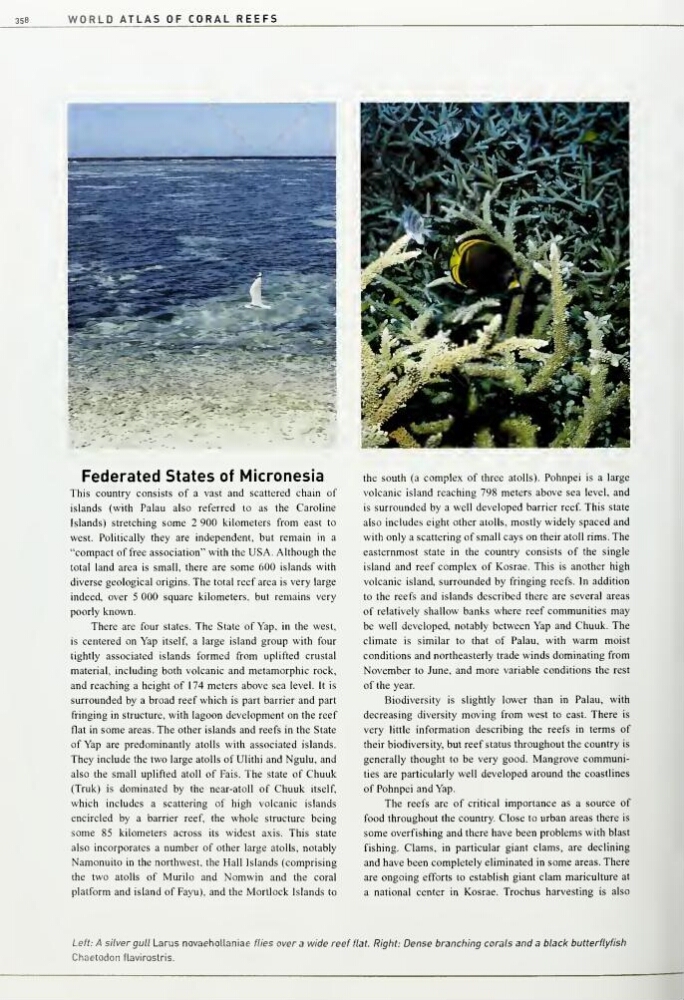
Left: A silver gull Larus novaehollaniae flies over a wide reef flat. Right: Dense brancfiing corals and a black butterflyfisti
Chaetodon flavirostris.
WORLD ATLAS OF CORAL REEFS
Federated States of Micronesia
This country consists of a vast and scattered chain of
islands (with Palau also referred to as the Caroline
Islands) stretching some 2 900 kilometers from east to
west. Politically they are independent, but remain in a
"compact of free association" with the USA. Although the
total land area is small, there are some 600 islands with
diverse geological origins. The total reef area is very large
indeed, over 5 000 square kilometers, but remains very
poorly known.
There are four states. The State of Yap, in the west,
is centered on Yap itself, a large island group with four
tightly associated islands formed from uplifted crustal
material, includmg both volcanic and metamorphic rock,
and reaching a height of 174 meters above sea level. It is
surrounded by a broad reef which is part barrier and part
fringing in structure, with lagoon development on the reef
flat in some areas. The other islands and reefs in the State
of Yap are predominantly atolls with associated islands.
They include the two large atolls of Ulithi and Ngulu, and
also the small uplifted atoll of Pais. The state of Chunk
(Truk) is dominated by the near-atoll of Chuuk itself,
which includes a scattering of high volcanic islands
encircled by a barrier reef, the whole structure being
some 85 kilometers across its widest axis. This state
also incorporates a number of other large atolls, notably
Namonuito in the northwest, the Hall Islands (comprising
the two atolls of Murilo and Nomwin and the coral
platform and island of Fayu), and the Mortlock Islands to
the south (a complex of three atolls). Pohnpei is a large
volcanic island reaching 798 meters above sea level, and
is surrounded by a well developed barrier reef This state
also includes eight other atolls, mostly widely spaced and
with only a scattering of small cays on their atoll rims. The
easternmost state in the country consists of the single
island and reef complex of Kosrae. This is another high
volcanic island, surrounded by fringing reefs. In addition
to the reefs and islands described there are several areas
of relatively shallow banks where reef communities may
be well developed, notably between Yap and Chuuk. The
climate is similar to that of Palau, with warm moist
conditions and northeasterly trade winds dominating from
November to June, and more variable conditions the rest
of the year.
Biodiversity is slightly lower than in Palau, with
decreasing diversity moving from west to east. There is
very little information describing the reefs in terms of
their biodiversity, but reef status throughout the country is
generally thought to be very good. Mangrove communities are particularly well developed around the coastlines
of Pohnpei and Yap.
The reefs are of critical importance as a source of
food throughout the country. Close to urban areas there is
some overfishing and there have been problems with blast
fishing. Clams, in particular giant clams, are declining
and have been completely eliminated in some areas. There
are ongoing efforts to establish giant clam mariculture at
a national center in Kosrae. Trochus harvesting is also
Left: A silver gull Larus novaehollaniae flies over a wide reef flat. Right: Dense brancfiing corals and a black butterflyfisti
Chaetodon flavirostris.