

Micronesia
Mastigias spp. which have formed vast communities.
Marine lakes are most numerous on Koror where there are
58, of which 28 have jellyfish. The reefs of Palau were
heavily impacted by crown-of-thorns starfish outbreaks in
1977 and recovery was reported to be poor, even into the
1990s. The reefs were further impacted by the bleaching
event of 1998. with mortality reaching over 50 percent in
most areas. Acropora was devastated almost everywhere,
but other corals showed slightly higher levels of survival
in nearshore lagoons and fringing reefs. The warm waters
of 1998 also had a dramatic impact on jellyfish populations in some of the marine lakes, although they now
seem to be recovering. The crown-of-thorns starfish has
had a number of outbreaks, and high densities in some
areas may be exacerbating the setbacks caused by
bleaching-associated mortalities.
The majority of the Palauan population live on Koror.
but numbers are growing rapidly and there is some expansion to the other islands. Management of marine resources
is devolved to the state level. The individual states (of
which there are 16. each typically incorporating several
villages) have ownership of all living and non-living
resources out to 12 nautical miles, with the exception of
highly migratory species. Although traditional law is upheld in the constitution it has been combined with Western
statutes, and respect for traditional systems is diminishing.
Several of the islands are connected by bridges and causeways which have interfered with natural water circulation
in some areas. Sewage and solid waste disposal are a
localized problem.
Fishing at the subsistence level is very important, but
there are also some export fisheries, including a trochus
fishery and a large marine ornamental fishery. Over the
past ten years it has been estimated that some 1 800 tons
of fish have been taken from the reefs per year: about
1
200 tons for direct consumption, 360 tons for local
markets and 250 tons for export. Although such levels
may be sustainable, there is considerable evidence of
overfishing of certain target species, notably groupers,
and a number of these are showing declines in abundance
and changes in demographic structure. In the southwestern islands there have been some reports of blast and
cyanide fishing.
Mariculture is relatively important. There has been
a giant clam mariculture project in existence for many
years and coral mariculture is also under development.
The dugong population is believed to be in decline, with a
1 99 1 estimate of between 50 and 200 individuals. There is
still thought to be some illegal hunting of these animals,
and slow rates of reproduction mean that any recovery
could take many years. Crocodiles are also now rare and
may number fewer than 150 individuals.
There is an active interest in conservation in the
country. Protected area legislation is developed at the
state level, and a number of sites have been established
with regulations ranging from seasonal closures and other
fisheries restrictions to strict reserves with no entry
permitted. For the most part there is strong community
support for these areas. The Ngaremeduu Conservation
Area has also recently been established covering parts of
three states on the west coast of Babeldaob. Legislation
has had to be passed in each state to protect this site.
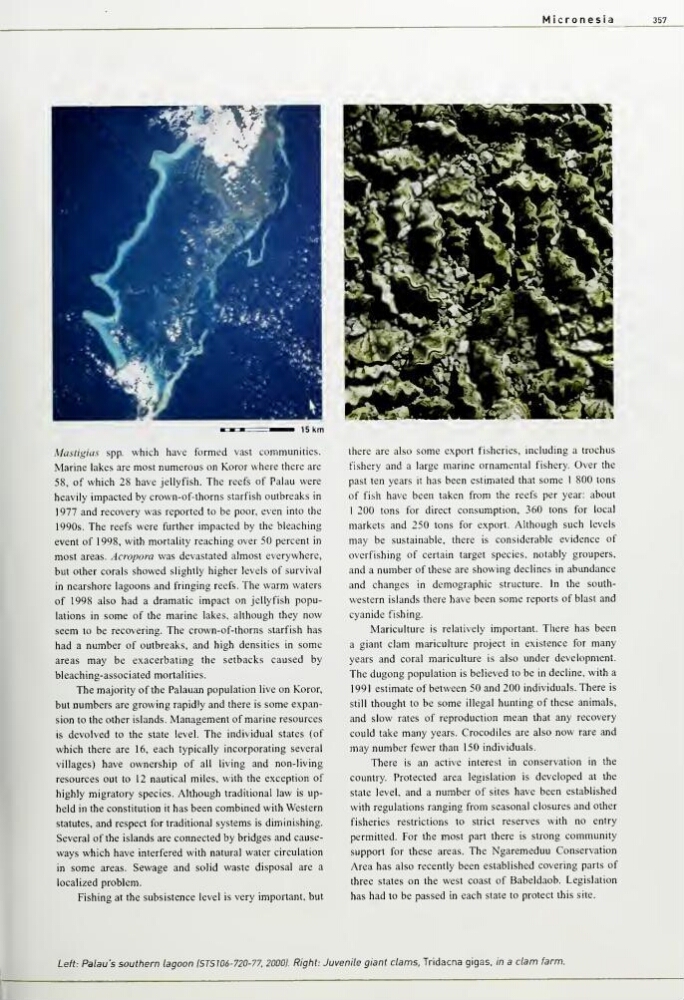
Left: Patau's souttiern lagoon ISTSl 06-720-77, 20001. Rigtit: Juvenite giant clams, Tndacna gigas, in a clam farm.
Mastigias spp. which have formed vast communities.
Marine lakes are most numerous on Koror where there are
58, of which 28 have jellyfish. The reefs of Palau were
heavily impacted by crown-of-thorns starfish outbreaks in
1977 and recovery was reported to be poor, even into the
1990s. The reefs were further impacted by the bleaching
event of 1998. with mortality reaching over 50 percent in
most areas. Acropora was devastated almost everywhere,
but other corals showed slightly higher levels of survival
in nearshore lagoons and fringing reefs. The warm waters
of 1998 also had a dramatic impact on jellyfish populations in some of the marine lakes, although they now
seem to be recovering. The crown-of-thorns starfish has
had a number of outbreaks, and high densities in some
areas may be exacerbating the setbacks caused by
bleaching-associated mortalities.
The majority of the Palauan population live on Koror.
but numbers are growing rapidly and there is some expansion to the other islands. Management of marine resources
is devolved to the state level. The individual states (of
which there are 16. each typically incorporating several
villages) have ownership of all living and non-living
resources out to 12 nautical miles, with the exception of
highly migratory species. Although traditional law is upheld in the constitution it has been combined with Western
statutes, and respect for traditional systems is diminishing.
Several of the islands are connected by bridges and causeways which have interfered with natural water circulation
in some areas. Sewage and solid waste disposal are a
localized problem.
Fishing at the subsistence level is very important, but
there are also some export fisheries, including a trochus
fishery and a large marine ornamental fishery. Over the
past ten years it has been estimated that some 1 800 tons
of fish have been taken from the reefs per year: about
1
200 tons for direct consumption, 360 tons for local
markets and 250 tons for export. Although such levels
may be sustainable, there is considerable evidence of
overfishing of certain target species, notably groupers,
and a number of these are showing declines in abundance
and changes in demographic structure. In the southwestern islands there have been some reports of blast and
cyanide fishing.
Mariculture is relatively important. There has been
a giant clam mariculture project in existence for many
years and coral mariculture is also under development.
The dugong population is believed to be in decline, with a
1 99 1 estimate of between 50 and 200 individuals. There is
still thought to be some illegal hunting of these animals,
and slow rates of reproduction mean that any recovery
could take many years. Crocodiles are also now rare and
may number fewer than 150 individuals.
There is an active interest in conservation in the
country. Protected area legislation is developed at the
state level, and a number of sites have been established
with regulations ranging from seasonal closures and other
fisheries restrictions to strict reserves with no entry
permitted. For the most part there is strong community
support for these areas. The Ngaremeduu Conservation
Area has also recently been established covering parts of
three states on the west coast of Babeldaob. Legislation
has had to be passed in each state to protect this site.
Left: Patau's souttiern lagoon ISTSl 06-720-77, 20001. Rigtit: Juvenite giant clams, Tndacna gigas, in a clam farm.