

Micronesia
359
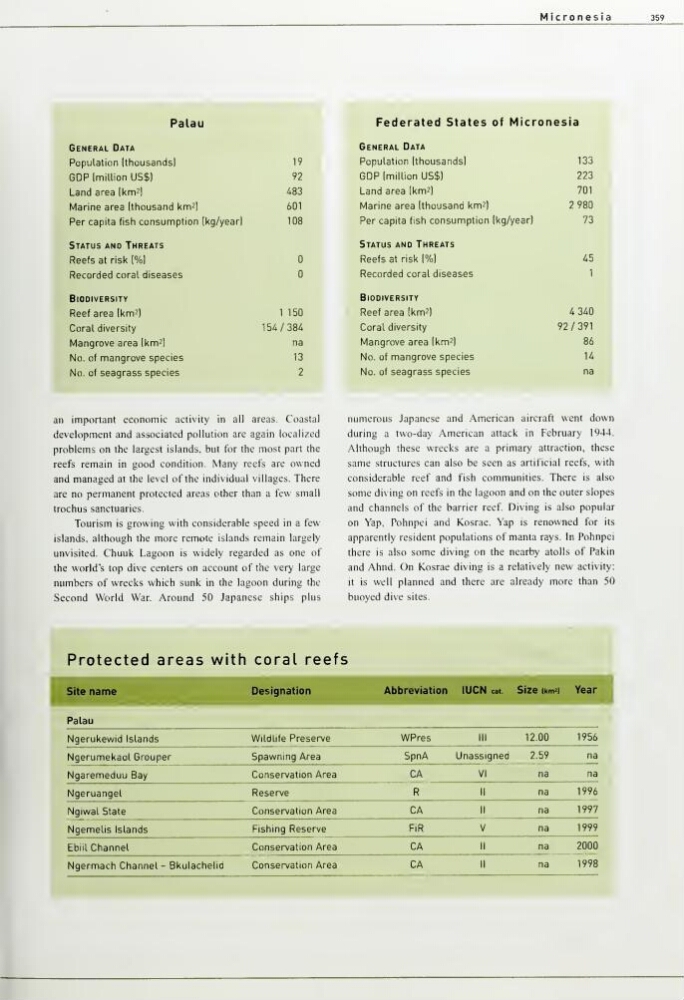
Palau
General Data
Population Ithousandsl
19
GDP (million US$1
92
Land area Ikm^)
483
Marine area (thousand (
Per capita fisin consumption (i
Status and Threats
Reefs at risk (%1
Recorded coral diseases
Biodiversity
Reef area (km^l
1
150
Coral diversity
15/i/38/i
Mangrove area (km^l
na
No. of mangrove species
13
No. of seagrass species
2
Federated States Of Miicronesia
General Data
Population (tfiousandsl
133
GDP (million US$1
223
Land area (km^l
701
Marine area (thousand km^l
2 980
Per capita fish consumption (kg/year)
73
Status and Threats
Reefs at risk (%l
45
Recorded coral diseases
1
Biodiversity
Reef area (km?)
4 340
Coral diversity
92/391
Mangrove area (km^l
86
No. of mangrove species
14
No. of seagrass species
na
an important economic activity in all areas. Coastal
development and associated pollution are again localized
problems on the largest islands, but for the most part the
reefs remain in good condition. IVIany reefs are owned
and managed at the level of the individual villages. There
are no permanent protected areas other than a few small
trochus sanctuaries.
Tourism is growing with considerable speed in a few
islands, although the more remote islands remain largely
unvisited. Chuuk Lagoon is widely regarded as one of
the world's top dive centers on account of the very large
numbers of wrecks which sunk in the lagoon during the
Second World War. Around 50 Japanese ships plus
numerous Japanese and American aircraft went down
during a two-day American attack in February 1944.
Although these wrecks are a primary attraction, these
same structures can also be seen as artificial reefs, with
considerable reef and fish communities. There is also
some diving on reefs in the lagoon and on the outer slopes
and channels of the barrier reef Diving is also popular
on Yap, Pohnpei and Kosrae. Yap is renowned for its
apparently resident populations of manta rays. In Pohnpei
there is also some diving on the nearby atolls of Pakin
and Ahnd. On Kosrae diving is a relatively new activity;
it
is well planned and there are already more than 50
buoyed dive sites.
Protected areas with coral reefs
Site name
Palau
Designation
Abbreviation
lUCN cat. Size ikm^i
Year
Ngerukew/id Islands
Wildlife Preserve
WPres
III
12.00
1956
Ngerumekaol Grouper
Spawning Area
SpnA
Unassigned
2.59
na
Ngaremeduu Bay
Conservation Area
CA
VI
na
na
Ngeruangel
Reserve
R
II
na
1996
Ngiwal State
Conservation Area
CA
II
na
1997
Ngemelis Islands
Fishing Reserve
FiR
V
na
1999
Ebiil Channel
Conservation Area
CA
II
na
2000
Ngermach Channel - Bkulachelid
Conservation Area
CA
II
na
1998
359
Palau
General Data
Population Ithousandsl
19
GDP (million US$1
92
Land area Ikm^)
483
Marine area (thousand (
Per capita fisin consumption (i
Status and Threats
Reefs at risk (%1
Recorded coral diseases
Biodiversity
Reef area (km^l
1
150
Coral diversity
15/i/38/i
Mangrove area (km^l
na
No. of mangrove species
13
No. of seagrass species
2
Federated States Of Miicronesia
General Data
Population (tfiousandsl
133
GDP (million US$1
223
Land area (km^l
701
Marine area (thousand km^l
2 980
Per capita fish consumption (kg/year)
73
Status and Threats
Reefs at risk (%l
45
Recorded coral diseases
1
Biodiversity
Reef area (km?)
4 340
Coral diversity
92/391
Mangrove area (km^l
86
No. of mangrove species
14
No. of seagrass species
na
an important economic activity in all areas. Coastal
development and associated pollution are again localized
problems on the largest islands, but for the most part the
reefs remain in good condition. IVIany reefs are owned
and managed at the level of the individual villages. There
are no permanent protected areas other than a few small
trochus sanctuaries.
Tourism is growing with considerable speed in a few
islands, although the more remote islands remain largely
unvisited. Chuuk Lagoon is widely regarded as one of
the world's top dive centers on account of the very large
numbers of wrecks which sunk in the lagoon during the
Second World War. Around 50 Japanese ships plus
numerous Japanese and American aircraft went down
during a two-day American attack in February 1944.
Although these wrecks are a primary attraction, these
same structures can also be seen as artificial reefs, with
considerable reef and fish communities. There is also
some diving on reefs in the lagoon and on the outer slopes
and channels of the barrier reef Diving is also popular
on Yap, Pohnpei and Kosrae. Yap is renowned for its
apparently resident populations of manta rays. In Pohnpei
there is also some diving on the nearby atolls of Pakin
and Ahnd. On Kosrae diving is a relatively new activity;
it
is well planned and there are already more than 50
buoyed dive sites.
Protected areas with coral reefs
Site name
Palau
Designation
Abbreviation
lUCN cat. Size ikm^i
Year
Ngerukew/id Islands
Wildlife Preserve
WPres
III
12.00
1956
Ngerumekaol Grouper
Spawning Area
SpnA
Unassigned
2.59
na
Ngaremeduu Bay
Conservation Area
CA
VI
na
na
Ngeruangel
Reserve
R
II
na
1996
Ngiwal State
Conservation Area
CA
II
na
1997
Ngemelis Islands
Fishing Reserve
FiR
V
na
1999
Ebiil Channel
Conservation Area
CA
II
na
2000
Ngermach Channel - Bkulachelid
Conservation Area
CA
II
na
1998