

278
WORLD ATLAS OF CORAL REEFS
Corals are also widespread in the narrow winding channels
which separate these islands, despite the still and often turbid
waters which are found here. Fringing reefs are also found
on the west coast of these islands, particularly in the northwest.
Socio-economic considerations
Despite the vast area of the Indonesian Archipelago and
the lack of detailed information about its reef communities,
the majority of its coastal area is already heavily utilized,
particularly in the west, and considerable areas are under
increasing stress from human activities. About 6 000 of
Indonesia's islands are inhabited, and marine and coastal
resources and activities generate 25 percent of the
country's gross domestic product. One study along the
west coast of Lombok made a detailed assessment of
coral reef value, particularly looking at fisheries
production, but also at tourism, mariculture. ornamental
trade and other resources. The estimated value of the reefs
in the area was USS5 800 per hectare. This same coastline
was utilized by 7 100 fishermen and over 35 percent of
their fish catch came from coral reefs.
Fisheries are a major activity, and it has been estimated that 60 percent of protein consumption is derived
from fisheries. About 90 percent of all fisheries are
artisanal. with products for local consumption or for sale
in local markets. Unfortunately overfishing is widespread
and is almost continuous in all regions from Sulawesi
westwards. In addition a number of destructive fishing
practices, blast and cyanide fishing amongst them, are
employed in all areas, including many remote reefs and
atolls. Blast fishing, in particular, is having an extremely
detrimental effect across the country. Although illegal
since 1985. few places have escaped it. even in protected
areas. The total probable cost of this fishery to the country,
in terms of long-term fishery losses and loss of tourist
income, has been estimated at US$3 billion over the 20
years from 1999. Indonesia is the largest supplier of live
food fish to the Asian markets with large vessels operating
among the more remote reefs, and mostly using cyanide
(although illegal since 1995). Muro-ami fishing has
significant impacts in a number of areas, including
Kepulauan Seribu. This involves the use of large nets and
large groups of fishers, often children, who swim with
poles or rocks on ropes and smash the reef surface to
frighten fish up into the nets. The impacts of trawling on
submerged reef systems are less well known, in part
because the location and extent of these reefs is unknown.
Collection of fish and corals for export in the
ornamental and aquarium trade is considerable. Indonesia is
the world's largest exporter of corals under the regulations
of the Convention on International Trade in Endangered
Species of Wild Fauna and Flora (CITES). Reaching well
over 1 000 tons of coral per year in the early 1990s and now
exporting around 500 tons per year. Indonesia has provided
approximately 41 percent of all coral exports worldwide
since 1985. These exports are relatively low on a unit-area
basis because of the very large coral reef area in the
country, but they may have localized impacts.
Coastal development causes considerable problems,
particularly in the western half of the country. Extensive
deforestation has greatly exacerbated the natural influences of freshwater and sediment discharge on reef growth
and condition, and these impacts are continually expanding
to new areas. Urban and industrial pollution is widespread,
entering coastal areas through rivers and discharge pipes.
In 1998 it was reported that there was no sewage treatment
plant in any major coastal city. Agricultural development
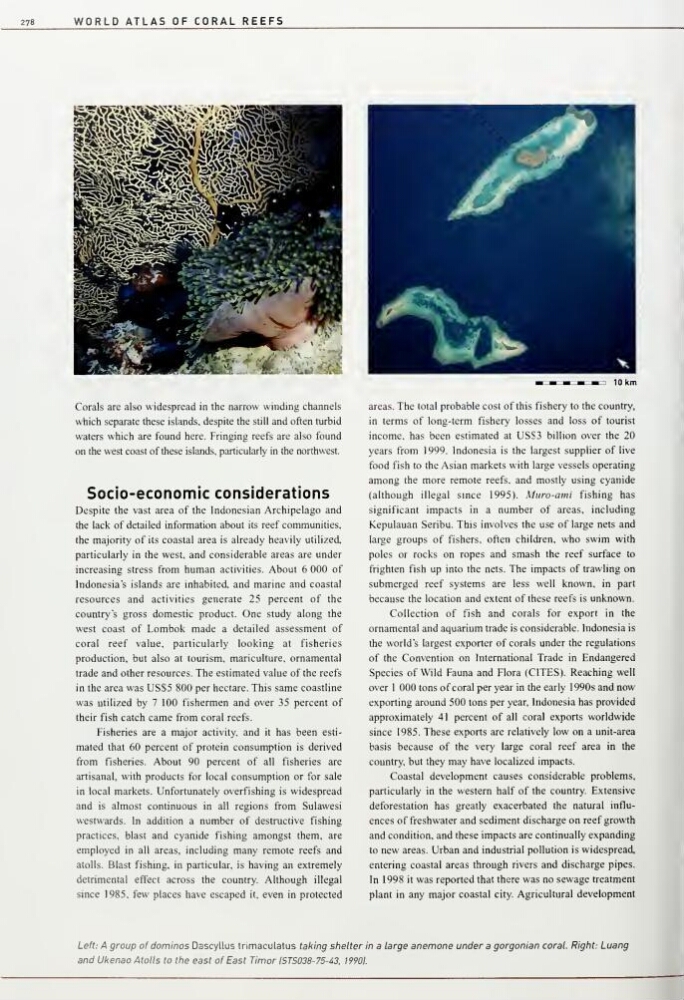
Left: A group of dominos Dascyllus trimaculatus taking sfielter In a large anemone under a gorgonian coral. Rigfit: Luang
and Ukenao Atolls to ttie east of East Timor ISTS038-75-43. 19901.
WORLD ATLAS OF CORAL REEFS
Corals are also widespread in the narrow winding channels
which separate these islands, despite the still and often turbid
waters which are found here. Fringing reefs are also found
on the west coast of these islands, particularly in the northwest.
Socio-economic considerations
Despite the vast area of the Indonesian Archipelago and
the lack of detailed information about its reef communities,
the majority of its coastal area is already heavily utilized,
particularly in the west, and considerable areas are under
increasing stress from human activities. About 6 000 of
Indonesia's islands are inhabited, and marine and coastal
resources and activities generate 25 percent of the
country's gross domestic product. One study along the
west coast of Lombok made a detailed assessment of
coral reef value, particularly looking at fisheries
production, but also at tourism, mariculture. ornamental
trade and other resources. The estimated value of the reefs
in the area was USS5 800 per hectare. This same coastline
was utilized by 7 100 fishermen and over 35 percent of
their fish catch came from coral reefs.
Fisheries are a major activity, and it has been estimated that 60 percent of protein consumption is derived
from fisheries. About 90 percent of all fisheries are
artisanal. with products for local consumption or for sale
in local markets. Unfortunately overfishing is widespread
and is almost continuous in all regions from Sulawesi
westwards. In addition a number of destructive fishing
practices, blast and cyanide fishing amongst them, are
employed in all areas, including many remote reefs and
atolls. Blast fishing, in particular, is having an extremely
detrimental effect across the country. Although illegal
since 1985. few places have escaped it. even in protected
areas. The total probable cost of this fishery to the country,
in terms of long-term fishery losses and loss of tourist
income, has been estimated at US$3 billion over the 20
years from 1999. Indonesia is the largest supplier of live
food fish to the Asian markets with large vessels operating
among the more remote reefs, and mostly using cyanide
(although illegal since 1995). Muro-ami fishing has
significant impacts in a number of areas, including
Kepulauan Seribu. This involves the use of large nets and
large groups of fishers, often children, who swim with
poles or rocks on ropes and smash the reef surface to
frighten fish up into the nets. The impacts of trawling on
submerged reef systems are less well known, in part
because the location and extent of these reefs is unknown.
Collection of fish and corals for export in the
ornamental and aquarium trade is considerable. Indonesia is
the world's largest exporter of corals under the regulations
of the Convention on International Trade in Endangered
Species of Wild Fauna and Flora (CITES). Reaching well
over 1 000 tons of coral per year in the early 1990s and now
exporting around 500 tons per year. Indonesia has provided
approximately 41 percent of all coral exports worldwide
since 1985. These exports are relatively low on a unit-area
basis because of the very large coral reef area in the
country, but they may have localized impacts.
Coastal development causes considerable problems,
particularly in the western half of the country. Extensive
deforestation has greatly exacerbated the natural influences of freshwater and sediment discharge on reef growth
and condition, and these impacts are continually expanding
to new areas. Urban and industrial pollution is widespread,
entering coastal areas through rivers and discharge pipes.
In 1998 it was reported that there was no sewage treatment
plant in any major coastal city. Agricultural development
Left: A group of dominos Dascyllus trimaculatus taking sfielter In a large anemone under a gorgonian coral. Rigfit: Luang
and Ukenao Atolls to ttie east of East Timor ISTS038-75-43. 19901.