

Southeast Asia
279
is leading to increased inputs of nutrients and chemicals,
and their effects are now widely apparent. In a gradient
across the Spermonde Archipelago, for example, there is a
rapid decline in biodiversity and coral cover closely linked
with proximity to the highly polluted coastline approaching Makassar. Coral cover at 68 kilometers distance from
the town is over 65 percent, dropping to 14 percent at
1.3 kilometers. Mangroves have been widely removed,
oflen for the development of shrimp ponds, but also
for commercial woodchip or pulp production, or due to
general overe.xploitation by growing coastal populations.
Coral mining is also common, with corals being used
for various purposes including building (houses, road
foundations, sea walls and jetties), to lime production (for
mortar), and decorative use both within the country and
for export.
Tourism is now important in many areas, and is itself
responsible for a range of problems, particularly associated with the developments on small coral cays. Impacts
include land reclamation, dredging of lagoons and mangrove clearance. A large number of the islands in Kepulauan
Seribu have been modified in this way. At the same time
tourism provides an alternate income source and may lead
to the reduction of fishing pressures in some locations.
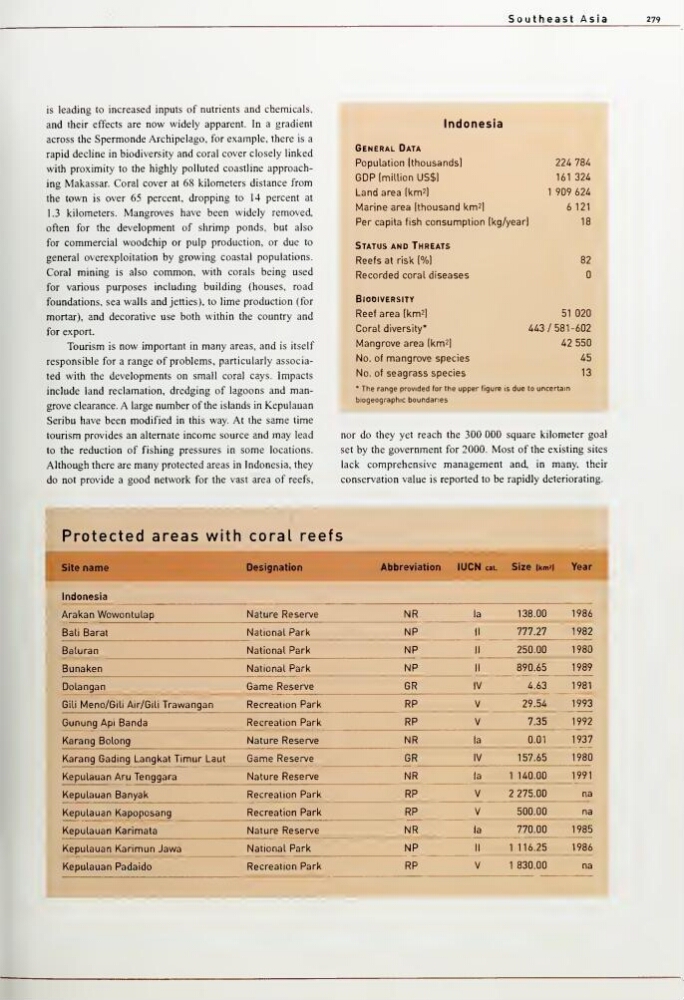
Although there are many protected areas in Indonesia, they
do not provide a good network for the vast area of reefs.
Indonesia
General Data
Population Ithousandsl
224 784
GDP|millionUS$)
161 32A
Land area Ikm^l
1 909 62/1
Marine area Ithousand km-j
6 121
Per capita fish consumption |kg/y earl
18
Status and Threats
Reefs at risk l%l
82
Recorded coral diseases
Biodiversity
Reef area (km^l
51 02D
Coral diversity*
443/581-602
Mangrove area Ikm^l
42 550
No. of mangrove species
45
No. of seagrass species
13
The range provided for the upper figure 15 due to uncertain
biogeographic boundaries
nor do they yet reach the 300 000 square kilometer goal
set by the government for 2000. Most of the existing sites
lack comprehensive management and, in many, their
conservation value is reported to be rapidly deteriorating.
Protected areas with coral reefs
W Site name
^^^
Designation
Abbreviation
lUCN cat.
Size ikn<>i
Year
Indonesia
Arakan Wowontulap
Nature Reserve
NR
la
138.00
1986
Bali Barat
National Park
NP
II
777.27
1982
Baluran
National Park
NP
II
250.00
1980
Bunaken
National Park
NP
II
890.65
1989
Dolangan
Game Reserve
GR
IV
4.63
1981
Gili Meno/Gili Air/Gili Trawang an
Recreation Park
RP
V
29.54
1993
Gunung Api Banda
Recreation Park
RP
V
7.35
1992
Karang Belong
Nature Reserve
NR
la
0.01
1937
Karang Gading Langkat Timur Laut
Game Reserve
GR
IV
157.65
1980
Kepulauan Aru Tenggara
Nature Reserve
NR
la
1
140.00
1991
Kepulauan Banyak
Recreation Park
RP
V
2 275.00
na
Kepulauan Kapoposang
Recreation Park
RP
V
500.00
na
Kepulauan Karimata
Nature Reserve
NR
la
770.00
1985
Kepulauan Karimun Jawa
National Park
NP
II
1
116.25
1986
Kepulauan Padaido
Recreation Park
RP
V
1 830.00
na
279
is leading to increased inputs of nutrients and chemicals,
and their effects are now widely apparent. In a gradient
across the Spermonde Archipelago, for example, there is a
rapid decline in biodiversity and coral cover closely linked
with proximity to the highly polluted coastline approaching Makassar. Coral cover at 68 kilometers distance from
the town is over 65 percent, dropping to 14 percent at
1.3 kilometers. Mangroves have been widely removed,
oflen for the development of shrimp ponds, but also
for commercial woodchip or pulp production, or due to
general overe.xploitation by growing coastal populations.
Coral mining is also common, with corals being used
for various purposes including building (houses, road
foundations, sea walls and jetties), to lime production (for
mortar), and decorative use both within the country and
for export.
Tourism is now important in many areas, and is itself
responsible for a range of problems, particularly associated with the developments on small coral cays. Impacts
include land reclamation, dredging of lagoons and mangrove clearance. A large number of the islands in Kepulauan
Seribu have been modified in this way. At the same time
tourism provides an alternate income source and may lead
to the reduction of fishing pressures in some locations.
Although there are many protected areas in Indonesia, they
do not provide a good network for the vast area of reefs.
Indonesia
General Data
Population Ithousandsl
224 784
GDP|millionUS$)
161 32A
Land area Ikm^l
1 909 62/1
Marine area Ithousand km-j
6 121
Per capita fish consumption |kg/y earl
18
Status and Threats
Reefs at risk l%l
82
Recorded coral diseases
Biodiversity
Reef area (km^l
51 02D
Coral diversity*
443/581-602
Mangrove area Ikm^l
42 550
No. of mangrove species
45
No. of seagrass species
13
The range provided for the upper figure 15 due to uncertain
biogeographic boundaries
nor do they yet reach the 300 000 square kilometer goal
set by the government for 2000. Most of the existing sites
lack comprehensive management and, in many, their
conservation value is reported to be rapidly deteriorating.
Protected areas with coral reefs
W Site name
^^^
Designation
Abbreviation
lUCN cat.
Size ikn<>i
Year
Indonesia
Arakan Wowontulap
Nature Reserve
NR
la
138.00
1986
Bali Barat
National Park
NP
II
777.27
1982
Baluran
National Park
NP
II
250.00
1980
Bunaken
National Park
NP
II
890.65
1989
Dolangan
Game Reserve
GR
IV
4.63
1981
Gili Meno/Gili Air/Gili Trawang an
Recreation Park
RP
V
29.54
1993
Gunung Api Banda
Recreation Park
RP
V
7.35
1992
Karang Belong
Nature Reserve
NR
la
0.01
1937
Karang Gading Langkat Timur Laut
Game Reserve
GR
IV
157.65
1980
Kepulauan Aru Tenggara
Nature Reserve
NR
la
1
140.00
1991
Kepulauan Banyak
Recreation Park
RP
V
2 275.00
na
Kepulauan Kapoposang
Recreation Park
RP
V
500.00
na
Kepulauan Karimata
Nature Reserve
NR
la
770.00
1985
Kepulauan Karimun Jawa
National Park
NP
II
1
116.25
1986
Kepulauan Padaido
Recreation Park
RP
V
1 830.00
na