

276
WORLD ATLAS OF CORAL REEFS
iB 10km
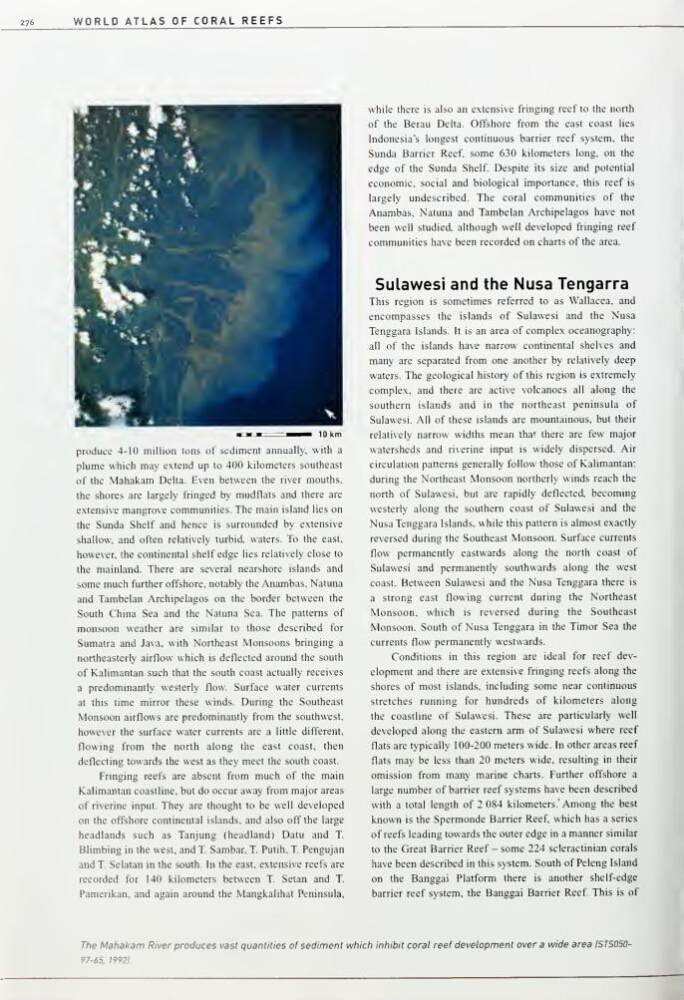
produce 4-10 million tons of sediment annually, with a
plume which may extend up to 400 kilometers southeast
of the Mahakam Delta. Even between the river mouths,
the shores are largely fringed by mudflats and there are
extensive mangrove communities. The main island lies on
the Sunda Shelf and hence is surrounded by extensive
shallow, and often relatively turbid, waters. To the east,
however, the continental shelf edge lies relatively close to
the mainland. There are several nearshore islands and
some much further offshore, notably the Anambas, Natuna
and Tambelan Archipelagos on the border between the
South China Sea and the Natuna Sea. The patterns of
monsoon weather are similar to those described for
Sumatra and Java, with Northeast Monsoons bnngmg a
northeasterly airflow which is deflected around the south
of Kalimantan such that the south coast actually receives
a predominantly westerly flow. Surface water currents
at this time mirror these winds. During the Southeast
Monsoon airflows are predominantly from the southwest,
however the surface water currents are a little different,
flowing from the north along the east coast, then
deflecting towards the west as they meet the south coast.
Fringing reefs are absent from much of the main
Kalimantan coastline, but do occur away from major areas
of riverine input. They are thought to be well developed
on the offshore continental islands, and also off the large
headlands such as Tanjung (headland) Datu and T.
Blimbing in the west, and T. Sambar, T. Putih, T. Pengujan
and T. Selatan in the south. In the east, extensive reefs are
recorded for 140 kilometers between T. Setan and T.
Pamerikan, and again around the Mangkalihat Peninsula,
while there is also an extensive fringing reef to the north
of the Berau Delta. Offshore from the east coast lies
Indonesia's longest continuous barrier reef system, the
Sunda Barrier Reef, some 630 kilometers long, on the
edge of the Sunda Shelf Despite its size and potential
economic, social and biological importance, this reef is
largely undescribed. The coral communities of the
Anambas. Natuna and Tambelan Archipelagos have not
been well studied, although well developed fringing reef
communities have been recorded on charts of the area.
Sulawesi and the Nusa Tengarra
This region is sometimes referred to as Wallacea. and
encompasses the islands of Sulawesi and the Nusa
Tenggara Islands. It is an area of complex oceanography:
all of the islands have narrow continental shelves and
many are separated from one another by relatively deep
waters. The geological history of this region is extremely
complex, and there are active volcanoes all along the
southern islands and in the northeast peninsula of
Sulawesi. All of these islands are mountainous, but their
relatively narrow widths mean that there are few major
watersheds and riverine input is widely dispersed. Air
circulation patterns generally follow those of Kalimantan:
during the Northeast Monsoon northerly winds reach the
north of Sulawesi, but are rapidly deflected, becoming
westerly along the southern coast of Sulawesi and the
Nusa Tenggara Islands, while this pattern is almost exactly
reversed during the Southeast Monsoon. Surface currents
flow permanently eastwards along the north coast of
Sulawesi and permanently southwards along the west
coast. Between Sulawesi and the Nusa Tenggara there is
a strong east flowing current during the Northeast
Monsoon, which is reversed during the Southeast
Monsoon. South of Nusa Tenggara in the Timor Sea the
currents flow permanently westwards.
Conditions in this region are ideal for reef development and there are extensive fringing reefs along the
shores of most islands, including some near continuous
stretches running for hundreds of kilometers along
the coastline of Sulawesi. These are particularly well
developed along the eastern arm of Sulawesi where reef
flats are typically 100-200 meters wide. In other areas reef
flats may be less than 20 meters wide, resulting in their
omission from many marine charts. Further offshore a
large number of barrier reef systems have been described
with a total length of 2 084 kilometers.' Among the best
known is the Spermonde Barrier Reef, which has a series
of reefs leading towards the outer edge in a manner similar
to the Great Barrier Reef - some 224 scleractinian corals
have been described in this system. South of Peleng Island
on the Banggai Platform there is another shelf-edge
barrier reef system, the Banggai Barrier Reef This is of
The Mahakam River produces vast quantities of sediment which inhibit coral reef development over a wide area ISTS05097-65. 19921.
WORLD ATLAS OF CORAL REEFS
iB 10km
produce 4-10 million tons of sediment annually, with a
plume which may extend up to 400 kilometers southeast
of the Mahakam Delta. Even between the river mouths,
the shores are largely fringed by mudflats and there are
extensive mangrove communities. The main island lies on
the Sunda Shelf and hence is surrounded by extensive
shallow, and often relatively turbid, waters. To the east,
however, the continental shelf edge lies relatively close to
the mainland. There are several nearshore islands and
some much further offshore, notably the Anambas, Natuna
and Tambelan Archipelagos on the border between the
South China Sea and the Natuna Sea. The patterns of
monsoon weather are similar to those described for
Sumatra and Java, with Northeast Monsoons bnngmg a
northeasterly airflow which is deflected around the south
of Kalimantan such that the south coast actually receives
a predominantly westerly flow. Surface water currents
at this time mirror these winds. During the Southeast
Monsoon airflows are predominantly from the southwest,
however the surface water currents are a little different,
flowing from the north along the east coast, then
deflecting towards the west as they meet the south coast.
Fringing reefs are absent from much of the main
Kalimantan coastline, but do occur away from major areas
of riverine input. They are thought to be well developed
on the offshore continental islands, and also off the large
headlands such as Tanjung (headland) Datu and T.
Blimbing in the west, and T. Sambar, T. Putih, T. Pengujan
and T. Selatan in the south. In the east, extensive reefs are
recorded for 140 kilometers between T. Setan and T.
Pamerikan, and again around the Mangkalihat Peninsula,
while there is also an extensive fringing reef to the north
of the Berau Delta. Offshore from the east coast lies
Indonesia's longest continuous barrier reef system, the
Sunda Barrier Reef, some 630 kilometers long, on the
edge of the Sunda Shelf Despite its size and potential
economic, social and biological importance, this reef is
largely undescribed. The coral communities of the
Anambas. Natuna and Tambelan Archipelagos have not
been well studied, although well developed fringing reef
communities have been recorded on charts of the area.
Sulawesi and the Nusa Tengarra
This region is sometimes referred to as Wallacea. and
encompasses the islands of Sulawesi and the Nusa
Tenggara Islands. It is an area of complex oceanography:
all of the islands have narrow continental shelves and
many are separated from one another by relatively deep
waters. The geological history of this region is extremely
complex, and there are active volcanoes all along the
southern islands and in the northeast peninsula of
Sulawesi. All of these islands are mountainous, but their
relatively narrow widths mean that there are few major
watersheds and riverine input is widely dispersed. Air
circulation patterns generally follow those of Kalimantan:
during the Northeast Monsoon northerly winds reach the
north of Sulawesi, but are rapidly deflected, becoming
westerly along the southern coast of Sulawesi and the
Nusa Tenggara Islands, while this pattern is almost exactly
reversed during the Southeast Monsoon. Surface currents
flow permanently eastwards along the north coast of
Sulawesi and permanently southwards along the west
coast. Between Sulawesi and the Nusa Tenggara there is
a strong east flowing current during the Northeast
Monsoon, which is reversed during the Southeast
Monsoon. South of Nusa Tenggara in the Timor Sea the
currents flow permanently westwards.
Conditions in this region are ideal for reef development and there are extensive fringing reefs along the
shores of most islands, including some near continuous
stretches running for hundreds of kilometers along
the coastline of Sulawesi. These are particularly well
developed along the eastern arm of Sulawesi where reef
flats are typically 100-200 meters wide. In other areas reef
flats may be less than 20 meters wide, resulting in their
omission from many marine charts. Further offshore a
large number of barrier reef systems have been described
with a total length of 2 084 kilometers.' Among the best
known is the Spermonde Barrier Reef, which has a series
of reefs leading towards the outer edge in a manner similar
to the Great Barrier Reef - some 224 scleractinian corals
have been described in this system. South of Peleng Island
on the Banggai Platform there is another shelf-edge
barrier reef system, the Banggai Barrier Reef This is of
The Mahakam River produces vast quantities of sediment which inhibit coral reef development over a wide area ISTS05097-65. 19921.