

Southeast Asia
by the opposing monsoon systems. During the Nonheast
Monsoon (December-March) winds over Sumatra predominate from the northeast, bearing moist air and
typically driving higher rainfalls. This air is deflected
in southern Sumatra and out over the Indian Ocean and
bears round such that Java is dominated by northwesterly
and westerly winds. During the Southeast Monsoon
(particularly June-July), typically drier air flows from the
southwest across Sumatra, and from the southeast across
Java. Patterns of surface water currents are largely driven
by these winds and during the Northeast Monsoon currents
from the northeast flow in and are largely deflected into
southeast and eastward flowing currents along eastern
Sumatra and northern Java. These are mirrored by longshore
currents flowing south and east along the Indian Ocean
shores of these islands. During the Southeast Monsoon
some of these patterns are reversed, with strong westward
flowing currents along the coasts of Java and deflecting
northwards along the east coast of Sumatra. The west coast
of Sumatra, by contrast, maintains a southeasterly flowing
current all year round. In the Strait of Malacca there is a
permanent current flowing to the northwest.
Surprisingly little is known about the development of
reefs around Sumatra. Fringing reefs are considered well
developed in the north around Aceh and around the islands
immediately north of Sumatra. They are are also likely to
be widespread along much of the west coast of Sumatra
facing the Indian Ocean - and have actually been recorded
at the Mentawai Islands - but there is little published
material describing the remainder of this coastline.
Likewise this region is believed to support some extensive
barrier reef systems: an 85 kilometer section is reported in
the north, 20 kilometers off the coast of Aceh. This is a
submerged or drowned system some 13-20 meters below
the surface, but it is not clear to what degree it enjoys
active coral growth. Further barrier reefs along the west
coast of Sumatra are recorded with a combined length of
660 kilometers, although these have been little studied and
rarely mentioned in regional reviews. Reefs are thought to
be poorly developed along the east Sumatra coast where
there is significant riverine input and the coastline is
dominated by large mangrove communities. Fringing reefs
are widespread in the Riau Archipelago and 95 species
of scleractinian coral have been recorded from Batam
Island. Water conditions are highly turbid in this area,
however, and coral co\er quickly diminishes with depth.
Much further south around Belitung Island, fringing reefs
have significantly higher diversities, presumably associated with more suitable conditions for reef development
- 174 scleractinian species have been recorded.
The fringing reefs around Java have received little
attention despite their high accessibility (compared to
much of the rest of the country). There are well developed
fringing reefs surrounding the volcanic islands in the
Sunda Strait. Although not marked on most charts, it
has been suggested that there may be extensive reef
development off the south coast of Java, but that classic
reef flat and reef crest structures have not developed due
to the extreme exposure and high energy environment.
Fringing reefs are well developed around the Blambangan
Peninsula and off the short east coast of Java, with reef
flats reaching 200-400 meters in width, but these are again
limited off much of the north coast. One of the best known
reef comple.xes in the region is the Kepulauan Seribu
patch reef chain, also known as the Thousand Islands.
This is a group of almost 700 reefs lying in a chain just
northwest of Jakarta Bay. Many have associated islands
and most have shallow intertidal reef flats. The reef slopes
are quite diverse and there appears to be an increase in
diversity with distance from Java - 88 scleractinian
species have been recorded at one of the southerly reefs,
rising to 190 species in the north. Outbreaks of crown-ofthoms starfish in 1995 may have reduced diversity in these
southern islands still further.
Reefs are widely developed around the Karimunjawa
Archipelago north of Java, and there are reported to be
extensive fringing communities around Bawean Island on
its eastern side. Fringing reefs are also well developed
along the south coast of Bali and have a deep spur and
groove formation associated with the high exposure along
this coast. The 1998 bleaching event did affect the reefs
around Bali, with over 75 percent bleaching in some areas.
North of Java it appeared to be more varied and generally
less significant.
Kalimantan
Much of the coastline of Kalimantan, or Indonesian
Borneo, is low-lying and subjected to considerable
riverine inputs. The Mahakam River, in particular, is noted
for its high volume discharge and has been estimated to
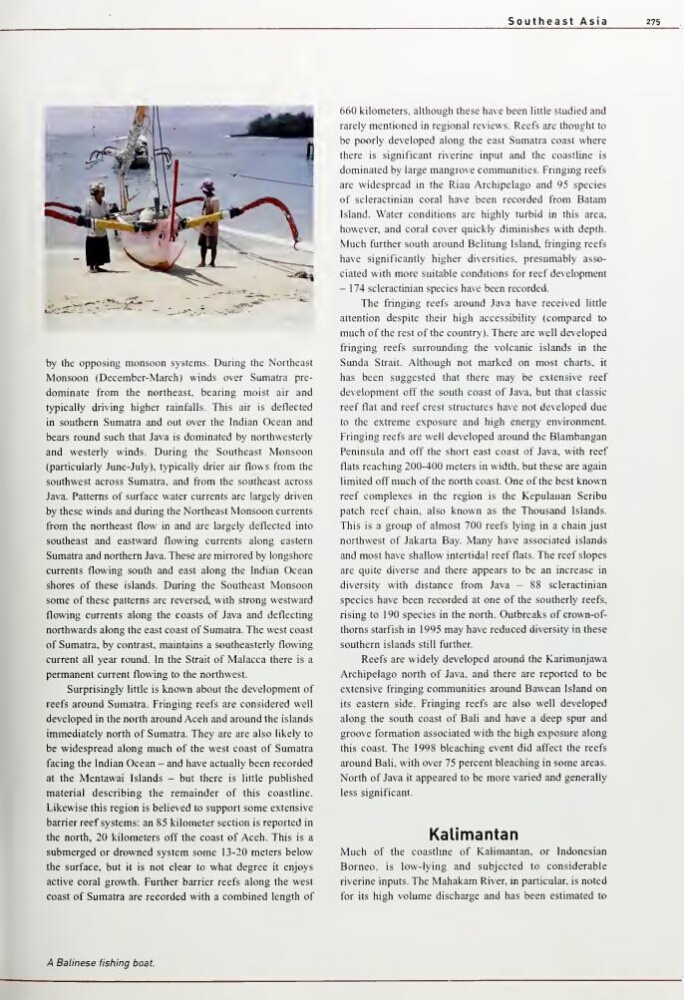
4 Batinese fishing boat.
by the opposing monsoon systems. During the Nonheast
Monsoon (December-March) winds over Sumatra predominate from the northeast, bearing moist air and
typically driving higher rainfalls. This air is deflected
in southern Sumatra and out over the Indian Ocean and
bears round such that Java is dominated by northwesterly
and westerly winds. During the Southeast Monsoon
(particularly June-July), typically drier air flows from the
southwest across Sumatra, and from the southeast across
Java. Patterns of surface water currents are largely driven
by these winds and during the Northeast Monsoon currents
from the northeast flow in and are largely deflected into
southeast and eastward flowing currents along eastern
Sumatra and northern Java. These are mirrored by longshore
currents flowing south and east along the Indian Ocean
shores of these islands. During the Southeast Monsoon
some of these patterns are reversed, with strong westward
flowing currents along the coasts of Java and deflecting
northwards along the east coast of Sumatra. The west coast
of Sumatra, by contrast, maintains a southeasterly flowing
current all year round. In the Strait of Malacca there is a
permanent current flowing to the northwest.
Surprisingly little is known about the development of
reefs around Sumatra. Fringing reefs are considered well
developed in the north around Aceh and around the islands
immediately north of Sumatra. They are are also likely to
be widespread along much of the west coast of Sumatra
facing the Indian Ocean - and have actually been recorded
at the Mentawai Islands - but there is little published
material describing the remainder of this coastline.
Likewise this region is believed to support some extensive
barrier reef systems: an 85 kilometer section is reported in
the north, 20 kilometers off the coast of Aceh. This is a
submerged or drowned system some 13-20 meters below
the surface, but it is not clear to what degree it enjoys
active coral growth. Further barrier reefs along the west
coast of Sumatra are recorded with a combined length of
660 kilometers, although these have been little studied and
rarely mentioned in regional reviews. Reefs are thought to
be poorly developed along the east Sumatra coast where
there is significant riverine input and the coastline is
dominated by large mangrove communities. Fringing reefs
are widespread in the Riau Archipelago and 95 species
of scleractinian coral have been recorded from Batam
Island. Water conditions are highly turbid in this area,
however, and coral co\er quickly diminishes with depth.
Much further south around Belitung Island, fringing reefs
have significantly higher diversities, presumably associated with more suitable conditions for reef development
- 174 scleractinian species have been recorded.
The fringing reefs around Java have received little
attention despite their high accessibility (compared to
much of the rest of the country). There are well developed
fringing reefs surrounding the volcanic islands in the
Sunda Strait. Although not marked on most charts, it
has been suggested that there may be extensive reef
development off the south coast of Java, but that classic
reef flat and reef crest structures have not developed due
to the extreme exposure and high energy environment.
Fringing reefs are well developed around the Blambangan
Peninsula and off the short east coast of Java, with reef
flats reaching 200-400 meters in width, but these are again
limited off much of the north coast. One of the best known
reef comple.xes in the region is the Kepulauan Seribu
patch reef chain, also known as the Thousand Islands.
This is a group of almost 700 reefs lying in a chain just
northwest of Jakarta Bay. Many have associated islands
and most have shallow intertidal reef flats. The reef slopes
are quite diverse and there appears to be an increase in
diversity with distance from Java - 88 scleractinian
species have been recorded at one of the southerly reefs,
rising to 190 species in the north. Outbreaks of crown-ofthoms starfish in 1995 may have reduced diversity in these
southern islands still further.
Reefs are widely developed around the Karimunjawa
Archipelago north of Java, and there are reported to be
extensive fringing communities around Bawean Island on
its eastern side. Fringing reefs are also well developed
along the south coast of Bali and have a deep spur and
groove formation associated with the high exposure along
this coast. The 1998 bleaching event did affect the reefs
around Bali, with over 75 percent bleaching in some areas.
North of Java it appeared to be more varied and generally
less significant.
Kalimantan
Much of the coastline of Kalimantan, or Indonesian
Borneo, is low-lying and subjected to considerable
riverine inputs. The Mahakam River, in particular, is noted
for its high volume discharge and has been estimated to
4 Batinese fishing boat.