

240
WORLD ATLAS OF CORAL REEFS
Saudi Arabia
MAPS 9b, c, d, and e
20 km
The
Kingdom of Saudi Arabia is the largest coral reef
nation in the region, with an extensive coastline
facing the Red Sea, and an additional significant
coastline along the western shores of the Arabian Gulf A
brief description of the distribution and biodiversity of these
reefs is provided here, and further information on their
physical and biological features and surrounding waters is
provided in the other regional sections of this chapter
The Red Sea coastline extends from the border with
Jordan in the northern Gulf of Aqaba all the way to the
border with Yemen in the southern Red Sea, following the
clear climatic and physical gradients described elsewhere.
This region is arid and dominated by high relief along much
of its length. Offshore the waters mirror the patterns of the
western shores of the Red Sea. In the north there is little or
no continental shelf, reef flats are narrow, and the reef
profiles are often steep to vertiginous. Further south the
continental shelf widens, and in the far south becomes very
wide, with extensive, shallow, and turbid inshore waters.
In terms of biodiversity, this coastline incorporates the
full wealth of Red Sea species, including those endemic to
northern regions, but also the communities and species
which are more abundant further south. Surveys from 1997
to 1999 revealed some 260 species of hard coral.
Fringing reefs form a near continuous strip along
much of the northern coastline. Further south there is a
complex series of fringing, patch and barrier reefs and
small islands near the Saudi Arabian coastline on the Al
Wadj Bank. This area also houses important and extensive
seagrass and mangrove communities. South of this, a
discontinuous barrier-type structure has been described
running from Al Wadj to Jeddah and termed the Little
Barrier Reef In the far south of the country physical
conditions inhibit the development of extensive reef areas
close to the continental coastline. However, in a direct
parallel with conditions on the coastline of Eritrea, there
is extensive mangrove and seagrass development along
this coastline, while offshore there is important reef
development around the Farasan Islands. Reefs at some
locations from Yanbu to Rabigh were observed to be
heavily bleached in August/September 1998, associated
with elevated sea surface temperatures.
Large parts of Saudi Arabia's Red Sea coastline are
undeveloped, particularly away from the central towns of
Jeddah and Yanbu. Sewage pollution and land reclamation
are concerns around many of the larger towns, including Al
Wadj, Yanbu, Jeddah and Jizan. Close to these there are an
estimated 18 desalination plants along the Red Sea coast.
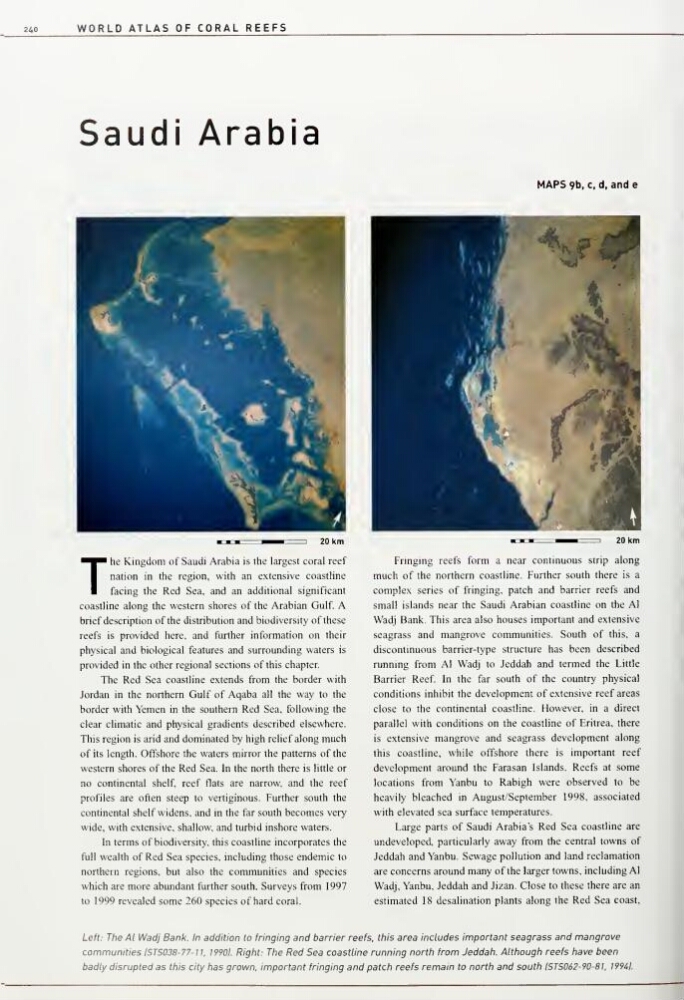
Left: The Al Wadj Bank. In addition to fringing and barrier reefs, tfiis area includes important seagrass and mangrove
communities ISTS038-77-11. 19901. Rigl^t: The Red Sea coastline running north from Jeddah. Although reefs have been
badly disrupted as this city has grown, important fringing and patch reefs remain to north and south ISTS062-90-8I, 19941.
WORLD ATLAS OF CORAL REEFS
Saudi Arabia
MAPS 9b, c, d, and e
20 km
The
Kingdom of Saudi Arabia is the largest coral reef
nation in the region, with an extensive coastline
facing the Red Sea, and an additional significant
coastline along the western shores of the Arabian Gulf A
brief description of the distribution and biodiversity of these
reefs is provided here, and further information on their
physical and biological features and surrounding waters is
provided in the other regional sections of this chapter
The Red Sea coastline extends from the border with
Jordan in the northern Gulf of Aqaba all the way to the
border with Yemen in the southern Red Sea, following the
clear climatic and physical gradients described elsewhere.
This region is arid and dominated by high relief along much
of its length. Offshore the waters mirror the patterns of the
western shores of the Red Sea. In the north there is little or
no continental shelf, reef flats are narrow, and the reef
profiles are often steep to vertiginous. Further south the
continental shelf widens, and in the far south becomes very
wide, with extensive, shallow, and turbid inshore waters.
In terms of biodiversity, this coastline incorporates the
full wealth of Red Sea species, including those endemic to
northern regions, but also the communities and species
which are more abundant further south. Surveys from 1997
to 1999 revealed some 260 species of hard coral.
Fringing reefs form a near continuous strip along
much of the northern coastline. Further south there is a
complex series of fringing, patch and barrier reefs and
small islands near the Saudi Arabian coastline on the Al
Wadj Bank. This area also houses important and extensive
seagrass and mangrove communities. South of this, a
discontinuous barrier-type structure has been described
running from Al Wadj to Jeddah and termed the Little
Barrier Reef In the far south of the country physical
conditions inhibit the development of extensive reef areas
close to the continental coastline. However, in a direct
parallel with conditions on the coastline of Eritrea, there
is extensive mangrove and seagrass development along
this coastline, while offshore there is important reef
development around the Farasan Islands. Reefs at some
locations from Yanbu to Rabigh were observed to be
heavily bleached in August/September 1998, associated
with elevated sea surface temperatures.
Large parts of Saudi Arabia's Red Sea coastline are
undeveloped, particularly away from the central towns of
Jeddah and Yanbu. Sewage pollution and land reclamation
are concerns around many of the larger towns, including Al
Wadj, Yanbu, Jeddah and Jizan. Close to these there are an
estimated 18 desalination plants along the Red Sea coast.
Left: The Al Wadj Bank. In addition to fringing and barrier reefs, tfiis area includes important seagrass and mangrove
communities ISTS038-77-11. 19901. Rigl^t: The Red Sea coastline running north from Jeddah. Although reefs have been
badly disrupted as this city has grown, important fringing and patch reefs remain to north and south ISTS062-90-8I, 19941.