

Middle Eastern Seas
239
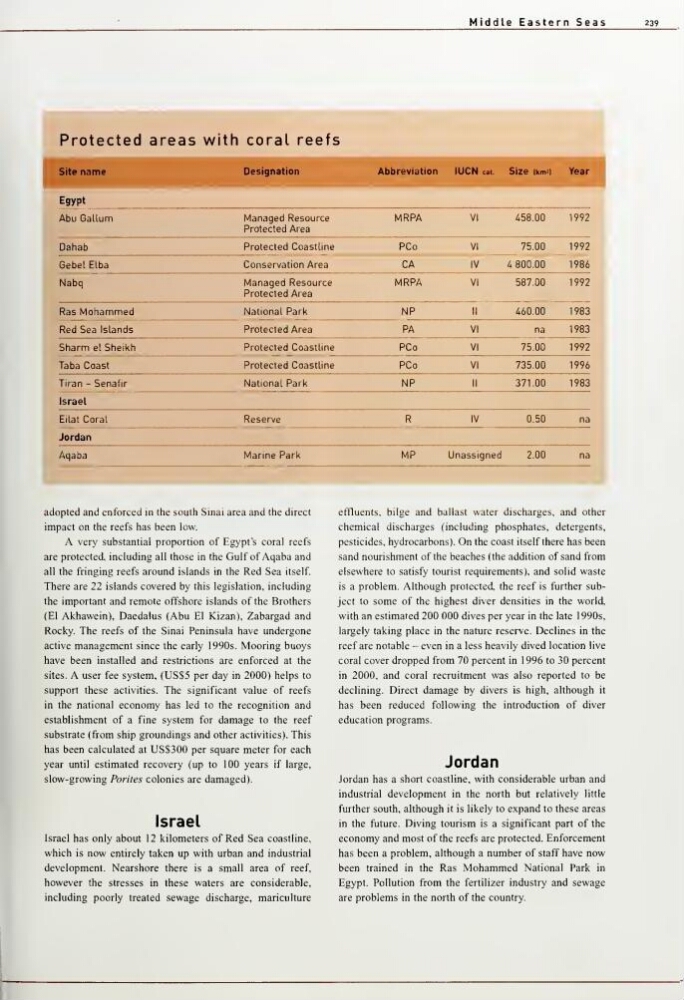
Protected areas with coral reefs
Site name
Designation
Abbreviation
lUCN cat.
Size Ikmil
Year
Egypt
Abu Galium
Managed Resource
Protected Area
MRPA
VI
458.00
1992
Dahab
Protected Coastline
PCo
VI
75.00
1992
Gebel Elba
Conservation Area
CA
IV
4 800.00
1986
Nabq
Managed Resource
Protected Area
MRPA
VI
587.00
1992
Ras Mohammed
National Park
NP
II
460.00
1983
Red Sea Islands
Protected Area
PA
VI
na
1983
Sharm el Sheikh
Protected Coastline
PCo
VI
75.00
1992
Taba Coast
Protected Coastline
PCo
VI
735.00
371.00
1996
1983
Tiran - Senafir
National Park
NP
II
Israel
Eilat Coral
Reserve
R
IV
0.50
na
Jordan
Aqaba
Marine Park
MP
Unassigned
2.00
na
adopted and enforced in the south Sinai area and the direct
impact on the reefs has been low.
A very substantial proportion of Egypt's coral reefs
are protected, including all those in the Gulf of Aqaba and
all the fringing reefs around islands in the Red Sea itself
There are 22 islands covered by this legislation, including
the important and remote offshore islands of the Brothers
(El Akhawein), Daedalus (Abu El Kizan). Zabargad and
Rocky. The reefs of the Sinai Peninsula have undergone
active management since the early 1990s. Mooring buoys
have been installed and restrictions are enforced at the
sites. A user fee system, (US$5 per day in 2000) helps to
support these activities. The significant value of reefs
in the national economy has led to the recognition and
establishment of a fine system for damage to the reef
substrate (from ship groundings and other activities). This
has been calculated at USS300 per square meter for each
year until estimated recovery (up to 100 years if large,
slow-growing Pontes colonies are damaged).
Israel
Israel has only about 12 kilometers of Red Sea coastline,
which is now entirely taken up with urban and industrial
development. Nearshore there is a small area of reef,
however the stresses in these waters are considerable,
including poorly treated sewage discharge, mariculture
effluents, bilge and ballast water discharges, and other
chemical discharges (including phosphates, detergents,
pesticides, hydrocarbons). On the coast itself there has been
sand nourishment of the beaches (the addition of sand from
elsewhere to satisfy tourist requirements), and solid waste
IS a problem. Although protected, the reef is further subject to some of the highest diver densities in the world,
with an estimated 200 000 dives per year in the late 1990s,
largely taking place in the nature reserve. Declines in the
reef are notable - even in a less heavily dived location live
coral cover dropped from 70 percent in 1996 to 30 percent
in 2000, and coral recruitment was also reported to be
declining. Direct damage by divers is high, although it
has been reduced following the introduction of diver
education programs.
Jordan
Jordan has a short coastline, with considerable urban and
industrial development in the north but relatively little
further south, although it is likely to expand to these areas
in the future. Diving tourism is a significant part of the
economy and most of the reefs are protected. Enforcement
has been a problem, although a number of staff have now
been trained in the Ras Mohammed National Park in
Egypt. Pollution from the fertilizer industry and sewage
are problems in the north of the country.
239
Protected areas with coral reefs
Site name
Designation
Abbreviation
lUCN cat.
Size Ikmil
Year
Egypt
Abu Galium
Managed Resource
Protected Area
MRPA
VI
458.00
1992
Dahab
Protected Coastline
PCo
VI
75.00
1992
Gebel Elba
Conservation Area
CA
IV
4 800.00
1986
Nabq
Managed Resource
Protected Area
MRPA
VI
587.00
1992
Ras Mohammed
National Park
NP
II
460.00
1983
Red Sea Islands
Protected Area
PA
VI
na
1983
Sharm el Sheikh
Protected Coastline
PCo
VI
75.00
1992
Taba Coast
Protected Coastline
PCo
VI
735.00
371.00
1996
1983
Tiran - Senafir
National Park
NP
II
Israel
Eilat Coral
Reserve
R
IV
0.50
na
Jordan
Aqaba
Marine Park
MP
Unassigned
2.00
na
adopted and enforced in the south Sinai area and the direct
impact on the reefs has been low.
A very substantial proportion of Egypt's coral reefs
are protected, including all those in the Gulf of Aqaba and
all the fringing reefs around islands in the Red Sea itself
There are 22 islands covered by this legislation, including
the important and remote offshore islands of the Brothers
(El Akhawein), Daedalus (Abu El Kizan). Zabargad and
Rocky. The reefs of the Sinai Peninsula have undergone
active management since the early 1990s. Mooring buoys
have been installed and restrictions are enforced at the
sites. A user fee system, (US$5 per day in 2000) helps to
support these activities. The significant value of reefs
in the national economy has led to the recognition and
establishment of a fine system for damage to the reef
substrate (from ship groundings and other activities). This
has been calculated at USS300 per square meter for each
year until estimated recovery (up to 100 years if large,
slow-growing Pontes colonies are damaged).
Israel
Israel has only about 12 kilometers of Red Sea coastline,
which is now entirely taken up with urban and industrial
development. Nearshore there is a small area of reef,
however the stresses in these waters are considerable,
including poorly treated sewage discharge, mariculture
effluents, bilge and ballast water discharges, and other
chemical discharges (including phosphates, detergents,
pesticides, hydrocarbons). On the coast itself there has been
sand nourishment of the beaches (the addition of sand from
elsewhere to satisfy tourist requirements), and solid waste
IS a problem. Although protected, the reef is further subject to some of the highest diver densities in the world,
with an estimated 200 000 dives per year in the late 1990s,
largely taking place in the nature reserve. Declines in the
reef are notable - even in a less heavily dived location live
coral cover dropped from 70 percent in 1996 to 30 percent
in 2000, and coral recruitment was also reported to be
declining. Direct damage by divers is high, although it
has been reduced following the introduction of diver
education programs.
Jordan
Jordan has a short coastline, with considerable urban and
industrial development in the north but relatively little
further south, although it is likely to expand to these areas
in the future. Diving tourism is a significant part of the
economy and most of the reefs are protected. Enforcement
has been a problem, although a number of staff have now
been trained in the Ras Mohammed National Park in
Egypt. Pollution from the fertilizer industry and sewage
are problems in the north of the country.