

Middle Eastern Seas
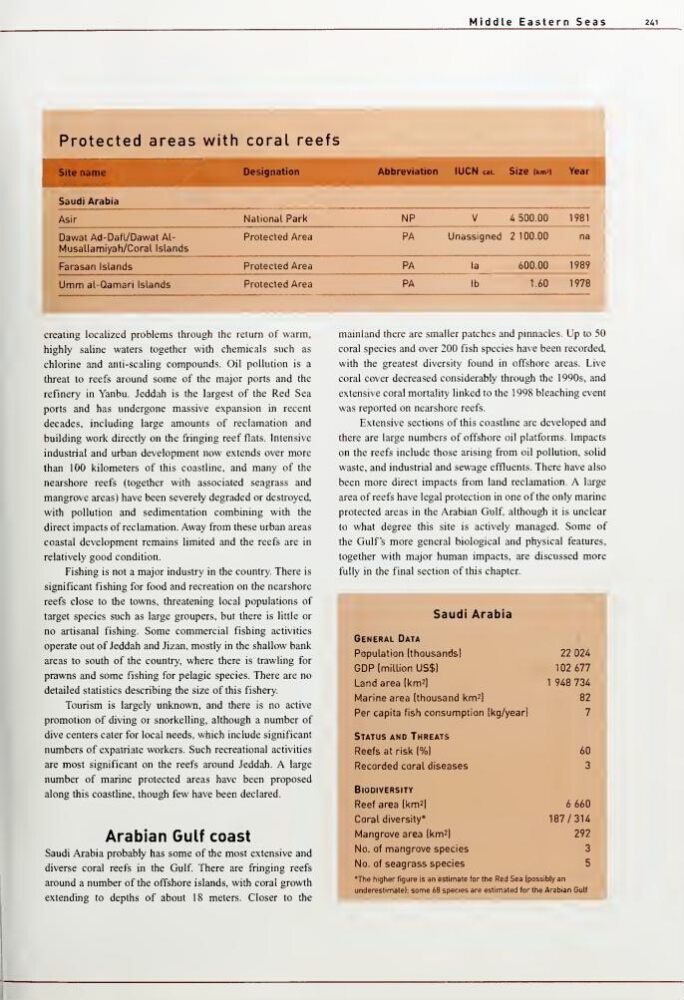
Protected areas wi th coral reefs
W Site name ^^^^^^^^v.
Designation
Abbreviation
lUCN cat.
Size IkmM
Year
Saudi Arabia
1981
Asir
National Park
NP
V
A 500.00
Dawat Ad-Dafl/Dawat AlMusallamiyah/CoraL Islands
Protected Area
PA
Unassigned 2 100.00
na
Farasan Islands
Protected Area
PA
Umm al-Qamari Islands
Protected Area
PA
600.00
1989
1.60
1978
creating localized problems through the return of warm,
highly saline waters together with chemicals such as
chlorine and anti-scaling compounds. Oil pollution is a
threat to reefs around some of the major ports and the
refinery in Yanbu. Jeddah is the largest of the Red Sea
ports and has undergone massive expansion in recent
decades, including large amounts of reclamation and
building work directly on the fringing reef flats. Intensive
industrial and urban development now extends over more
than 100 kilometers of this coastline, and many of the
nearshore reefs (together with associated seagrass and
mangrove areas) have been severely degraded or destroyed,
with pollution and sedimentation combining with the
direct impacts of reclamation. Away from these urban areas
coastal development remains limited and the reefs are in
relatively good condition.
Fishing is not a major industry in the country. There is
significant fishing for food and recreation on the nearshore
reefs close to the towns, threatening local populations of
target species such as large groupers, but there is little or
no artisanal fishing. Some commercial fishing activities
operate out of Jeddah and Jizan, mostly in the shallow bank
areas to south of the country, where there is trawling for
prawns and some fishing for pelagic species. There are no
detailed statistics describing the size of this fishery.
Tourism is largely unknown, and there is no active
promotion of diving or snorkelling, although a number of
dive centers cater for local needs, which include significant
numbers of expatriate workers. Such recreational activities
are most significant on the reefs around Jeddah. A large
number of marine protected areas have been proposed
along this coastline, though few have been declared.
Arabian Gulf coast
Saudi Arabia probably has some of the most extensive and
diverse coral reefs in the Gulf There are fringing reefs
around a number of the offshore islands, with coral growth
extending to depths of about 18 meters. Closer to the
mainland there are smaller patches and pinnacles. Up to 50
coral species and over 200 fish species have been recorded,
with the greatest diversity found in offshore areas. Live
coral cover decreased considerably through the 1990s, and
extensive coral mortality linked to the 1998 bleaching event
was reported on nearshore reefs.
Extensive sections of this coastline are developed and
there are large numbers of offshore oil platforms. Impacts
on the reefs include those arising from oil pollution, solid
waste, and industrial and sewage effluents. There have also
been more direct impacts from land reclamation. A large
area of reefs have legal protection in one of the only marine
protected areas in the Arabian Gulf, although it is unclear
to what degree this site is actively managed. Some of
the Gulf's more general biological and physical features,
together with major human impacts, are discussed more
fiilly in the final section of this chapter
HH^^B
Saudi Arabia
-^
General Data
Population (thousands)
22 02/J
GDPImiUion US$1
102 677
Land area (km^l
1 9A8 734
Marine area (thousand km^
82
Per capita fish consumption (kg/year)
7
Status and Threats
Reefs at risk (%l
60
Recorded coral diseases
3
Biodiversity
Reef area (km^l
6 660
Coral diversity*
187/3U
Mangrove area [km^l
292
No. of mangrove species
3
No. of seagrass species
5
*The higher figure is an estimate for the Red Sea Iposs bly an
underestimate); some 68 species are estimated for the Arabian Gulf
Protected areas wi th coral reefs
W Site name ^^^^^^^^v.
Designation
Abbreviation
lUCN cat.
Size IkmM
Year
Saudi Arabia
1981
Asir
National Park
NP
V
A 500.00
Dawat Ad-Dafl/Dawat AlMusallamiyah/CoraL Islands
Protected Area
PA
Unassigned 2 100.00
na
Farasan Islands
Protected Area
PA
Umm al-Qamari Islands
Protected Area
PA
600.00
1989
1.60
1978
creating localized problems through the return of warm,
highly saline waters together with chemicals such as
chlorine and anti-scaling compounds. Oil pollution is a
threat to reefs around some of the major ports and the
refinery in Yanbu. Jeddah is the largest of the Red Sea
ports and has undergone massive expansion in recent
decades, including large amounts of reclamation and
building work directly on the fringing reef flats. Intensive
industrial and urban development now extends over more
than 100 kilometers of this coastline, and many of the
nearshore reefs (together with associated seagrass and
mangrove areas) have been severely degraded or destroyed,
with pollution and sedimentation combining with the
direct impacts of reclamation. Away from these urban areas
coastal development remains limited and the reefs are in
relatively good condition.
Fishing is not a major industry in the country. There is
significant fishing for food and recreation on the nearshore
reefs close to the towns, threatening local populations of
target species such as large groupers, but there is little or
no artisanal fishing. Some commercial fishing activities
operate out of Jeddah and Jizan, mostly in the shallow bank
areas to south of the country, where there is trawling for
prawns and some fishing for pelagic species. There are no
detailed statistics describing the size of this fishery.
Tourism is largely unknown, and there is no active
promotion of diving or snorkelling, although a number of
dive centers cater for local needs, which include significant
numbers of expatriate workers. Such recreational activities
are most significant on the reefs around Jeddah. A large
number of marine protected areas have been proposed
along this coastline, though few have been declared.
Arabian Gulf coast
Saudi Arabia probably has some of the most extensive and
diverse coral reefs in the Gulf There are fringing reefs
around a number of the offshore islands, with coral growth
extending to depths of about 18 meters. Closer to the
mainland there are smaller patches and pinnacles. Up to 50
coral species and over 200 fish species have been recorded,
with the greatest diversity found in offshore areas. Live
coral cover decreased considerably through the 1990s, and
extensive coral mortality linked to the 1998 bleaching event
was reported on nearshore reefs.
Extensive sections of this coastline are developed and
there are large numbers of offshore oil platforms. Impacts
on the reefs include those arising from oil pollution, solid
waste, and industrial and sewage effluents. There have also
been more direct impacts from land reclamation. A large
area of reefs have legal protection in one of the only marine
protected areas in the Arabian Gulf, although it is unclear
to what degree this site is actively managed. Some of
the Gulf's more general biological and physical features,
together with major human impacts, are discussed more
fiilly in the final section of this chapter
HH^^B
Saudi Arabia
-^
General Data
Population (thousands)
22 02/J
GDPImiUion US$1
102 677
Land area (km^l
1 9A8 734
Marine area (thousand km^
82
Per capita fish consumption (kg/year)
7
Status and Threats
Reefs at risk (%l
60
Recorded coral diseases
3
Biodiversity
Reef area (km^l
6 660
Coral diversity*
187/3U
Mangrove area [km^l
292
No. of mangrove species
3
No. of seagrass species
5
*The higher figure is an estimate for the Red Sea Iposs bly an
underestimate); some 68 species are estimated for the Arabian Gulf