

234
WORLD ATLAS OF CORAL REEFS
the Indian Ocean took place during the Pleistocene,
and reconnection with the Indian Ocean probably only
occurred some 17 000 years ago. It remains unclear
whether this latest phase led to the total extinction of
coral reef species, or whether some survived in certain
refugia in the southern Red Sea and/or the Gulf of
Aqaba. Many of the reefs that are visible today are
actually relatively thin modern veneers of reef deposits
which have recolonized older Pleistocene reefs. The
Red Sea and Gulf of Aden have large numbers of
endemic species, and it may well have been these
same climatic shifts and periods of isolation and
reconnection that drove the development of new
species. Areas in the Gulf of Aden may have acted
as refuges for these species when the Red Sea itself
was devoid of life.
^^HHx^K^j^
'^^BiuP^^^B^H
1^^^^^
*M
^"S^!
Reefs are poorly developed along the southern and
eastern shores of Arabia, due to the regular cold upwellings associated with the Somali Current. Along the
areas of coastline most exposed to these upwellings,
in southern Oman and eastern Yemen, macroalgal
rather than coral communities predominate, but in
more sheltered areas such as the leeward sides of
islands, extensive and high-cover coral communities
are found. Recent work in the eastern Gulf of Aden has
revealed unexpectedly extensive and diverse coral
communities along both northern and southern shores,
including some of the most diverse fish communities in
the wider region. This is in marked contrast to the
previously held view that this body of water was devoid
of such coral communities.
The Arabian Gulf is a vast shallow sea with little in
common with the Red Sea, other than the fact that it
too has been subject to periodic drying out over recent
geological history. The natural environment is one of
harsh climatic extremes, relating to both the high
latitude and shallow waters. As a consequence reef
development is somewhat restricted and biological
diversity is very low.
Human pressures on the reefs in the region vary
considerably. Fisheries are an important activity in
some countries, although there are few detailed
records of catch sizes. Overfishing may not yet be as
widespread a problem as in many other regions, but
occurs in some areas, including around Yemen and the
Gulf of Aden where lobster and shark fisheries are
having particular impacts. The region is the principal
world petroleum producer and exporter, and a major
global shipping route, with related risks of pollution,
collisions, groundings, ballast and other discharges.
Chronic oil pollution is higher in the Arabian Gulf than
in any other coral reef area. Massive development has
occurred in parts of the Saudi Arabian Red Sea and
in the Arabian Gulf, leading to direct impacts from
land reclamation and sedimentation, and also more
widespread degradation associated with urban and
industrial pollution. Coastal and reef-based tourism
has only really developed in the northern Red Sea.
but here the rates of growth have been massive, with
significant negative impacts in some areas and important examples of successful management in others.
Many of the physical and biological features of this
region are best explained and understood from the
perspective of natural rather than political subdivisions, so the main sections of this chapter follow
natural sub-divisions. Saudi Arabia, which dominates
the region in terms of reef area, is treated separately.
However, detailed information about the biology and
oceanography of this country can also be found in the
other sub-regional sections.
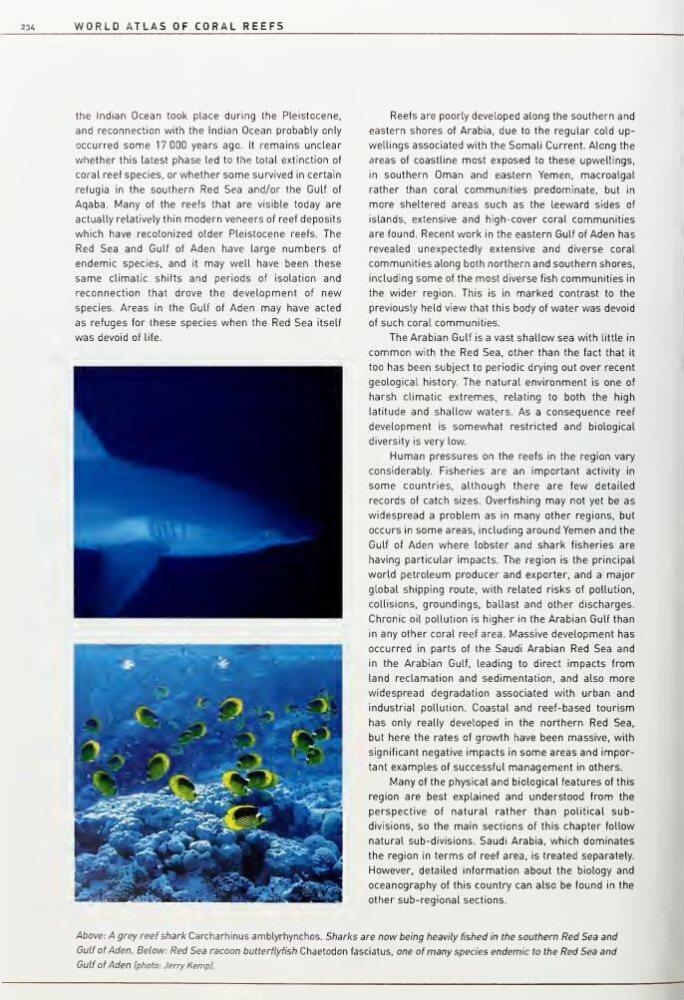
Above: A grey reef shark Carcharhinus amblyrhynchos. Sharks are now being heavily fished in the southern Red Sea and
Gulf of Aden. Below: Red Sea racoon butterflyfish Chaetodon fasciatus, one of many species endemic to the Red Sea and
Gulf of Aden (photo: Jerry Kempl.
WORLD ATLAS OF CORAL REEFS
the Indian Ocean took place during the Pleistocene,
and reconnection with the Indian Ocean probably only
occurred some 17 000 years ago. It remains unclear
whether this latest phase led to the total extinction of
coral reef species, or whether some survived in certain
refugia in the southern Red Sea and/or the Gulf of
Aqaba. Many of the reefs that are visible today are
actually relatively thin modern veneers of reef deposits
which have recolonized older Pleistocene reefs. The
Red Sea and Gulf of Aden have large numbers of
endemic species, and it may well have been these
same climatic shifts and periods of isolation and
reconnection that drove the development of new
species. Areas in the Gulf of Aden may have acted
as refuges for these species when the Red Sea itself
was devoid of life.
^^HHx^K^j^
'^^BiuP^^^B^H
1^^^^^
*M
^"S^!
Reefs are poorly developed along the southern and
eastern shores of Arabia, due to the regular cold upwellings associated with the Somali Current. Along the
areas of coastline most exposed to these upwellings,
in southern Oman and eastern Yemen, macroalgal
rather than coral communities predominate, but in
more sheltered areas such as the leeward sides of
islands, extensive and high-cover coral communities
are found. Recent work in the eastern Gulf of Aden has
revealed unexpectedly extensive and diverse coral
communities along both northern and southern shores,
including some of the most diverse fish communities in
the wider region. This is in marked contrast to the
previously held view that this body of water was devoid
of such coral communities.
The Arabian Gulf is a vast shallow sea with little in
common with the Red Sea, other than the fact that it
too has been subject to periodic drying out over recent
geological history. The natural environment is one of
harsh climatic extremes, relating to both the high
latitude and shallow waters. As a consequence reef
development is somewhat restricted and biological
diversity is very low.
Human pressures on the reefs in the region vary
considerably. Fisheries are an important activity in
some countries, although there are few detailed
records of catch sizes. Overfishing may not yet be as
widespread a problem as in many other regions, but
occurs in some areas, including around Yemen and the
Gulf of Aden where lobster and shark fisheries are
having particular impacts. The region is the principal
world petroleum producer and exporter, and a major
global shipping route, with related risks of pollution,
collisions, groundings, ballast and other discharges.
Chronic oil pollution is higher in the Arabian Gulf than
in any other coral reef area. Massive development has
occurred in parts of the Saudi Arabian Red Sea and
in the Arabian Gulf, leading to direct impacts from
land reclamation and sedimentation, and also more
widespread degradation associated with urban and
industrial pollution. Coastal and reef-based tourism
has only really developed in the northern Red Sea.
but here the rates of growth have been massive, with
significant negative impacts in some areas and important examples of successful management in others.
Many of the physical and biological features of this
region are best explained and understood from the
perspective of natural rather than political subdivisions, so the main sections of this chapter follow
natural sub-divisions. Saudi Arabia, which dominates
the region in terms of reef area, is treated separately.
However, detailed information about the biology and
oceanography of this country can also be found in the
other sub-regional sections.
Above: A grey reef shark Carcharhinus amblyrhynchos. Sharks are now being heavily fished in the southern Red Sea and
Gulf of Aden. Below: Red Sea racoon butterflyfish Chaetodon fasciatus, one of many species endemic to the Red Sea and
Gulf of Aden (photo: Jerry Kempl.