

Middle Eastern Seas
235
Northern Red Sea:
Egypt, Israel, Jordan
MAP 9a
The
northern Red Sea includes the coastlines of
Egypt, Israel and Jordan, and a substantial part
of Saudi Arabia's Red Sea coastline. This section
begins with a description of the coral reefs, together with
many of the physical and biogeographic characteristics
which are continuous between these countries. This is followed by individual descriptions of each country along
with the relevant human interactions and uses of coral
reefs. For this purpose, Saudi Arabia, which spans several
regions, is considered independently.
The northern Red Sea enjoys a number of important
and interesting geological and biogeographic features. In
the far north, the Red Sea rift system splits into the Gulfs
of Suez and Aqaba. Both of these are also rift systems, but
have markedly different morphologies. The Gulf of Suez is
a spreading rift, but has remained very shallow, averaging
a depth of about 30 meters. This area is subjected to considerable climatic extremes associated with its northerly
latitude and shallow waters, and hence species diversity is
generally low compared to the rest of the Red Sea. There
are intermittent fringing reefs along most of the western
side, while the eastern side has smaller discontinuous
patch reefs.
The Gulf of Aqaba is quite different. It has been formed
by a strike-slip rift system as the Arabian Peninsula has
moved both in parallel and apart from the Sinai. The same
faulting goes on into the Dead Sea rift. The gulf is actually
very deep, reaching about 2 000 meters and remaining deep
right up to its northern shores. At its southern "mouth"
there is a shallow sill and some relatively extensive areas of
high quality shallow water reefs, particularly on the eastern
side. Inside the gulf itself only narrow fringing reefs have
developed on the steeply shelving coastline. Reef flats are
often only a few tens of meters wide, while reef slopes are
characteristically steep to vertiginous.
South of the Gulfs of Aqaba and Suez, both eastern
and western shores of the Red Sea are lined by fringing
reefs. These are continuous, often for tens of kilometers,
and typically have relatively narrow reef flats. Offshore
reefs are well developed at the mouths of the Gulfs of
both Aqaba and Suez where there are a number of platform reefs and islands. To the south of the region, in an
area known as Gebel Elba, the coastal reefs lie as far as 70
kilometers offshore. There are likely to be some interesting and important areas of shallow water communities in
this area, although it has not yet been studied.
The reefs in this region extend into high latitudes and
have adapted to relatively low temperatures. Mean surface
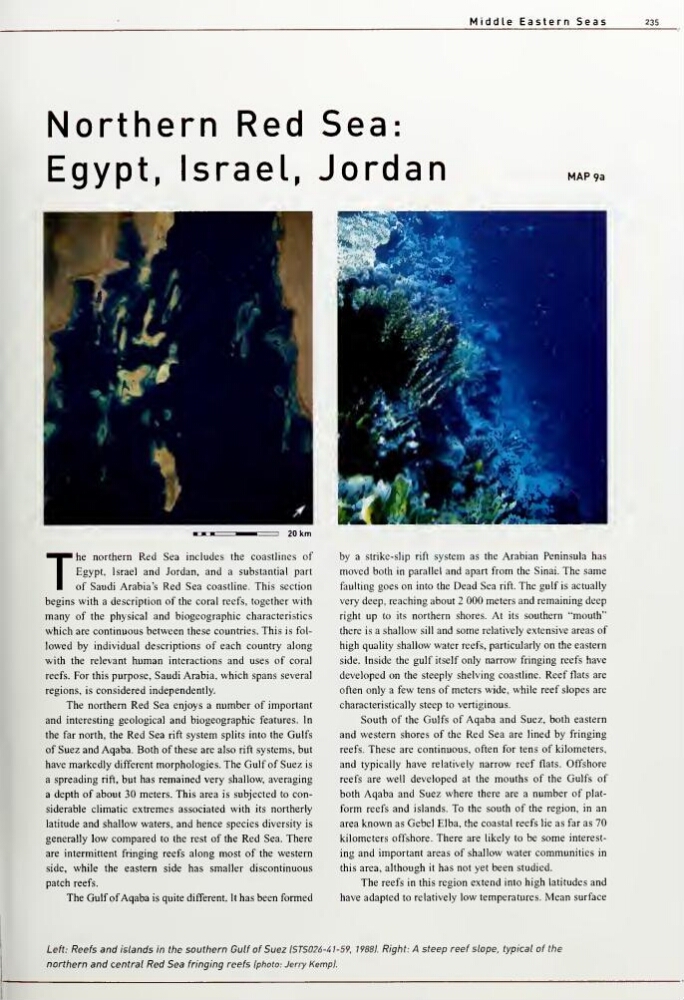
Left: Reefs and islands in the souttiern Gulf of Suez ISTS026-4i-59. 1988i Right: A steep reef slope, typical of the
northern and central Red Sea fringing reefs Ipfioto: Jerry Kempl.
235
Northern Red Sea:
Egypt, Israel, Jordan
MAP 9a
The
northern Red Sea includes the coastlines of
Egypt, Israel and Jordan, and a substantial part
of Saudi Arabia's Red Sea coastline. This section
begins with a description of the coral reefs, together with
many of the physical and biogeographic characteristics
which are continuous between these countries. This is followed by individual descriptions of each country along
with the relevant human interactions and uses of coral
reefs. For this purpose, Saudi Arabia, which spans several
regions, is considered independently.
The northern Red Sea enjoys a number of important
and interesting geological and biogeographic features. In
the far north, the Red Sea rift system splits into the Gulfs
of Suez and Aqaba. Both of these are also rift systems, but
have markedly different morphologies. The Gulf of Suez is
a spreading rift, but has remained very shallow, averaging
a depth of about 30 meters. This area is subjected to considerable climatic extremes associated with its northerly
latitude and shallow waters, and hence species diversity is
generally low compared to the rest of the Red Sea. There
are intermittent fringing reefs along most of the western
side, while the eastern side has smaller discontinuous
patch reefs.
The Gulf of Aqaba is quite different. It has been formed
by a strike-slip rift system as the Arabian Peninsula has
moved both in parallel and apart from the Sinai. The same
faulting goes on into the Dead Sea rift. The gulf is actually
very deep, reaching about 2 000 meters and remaining deep
right up to its northern shores. At its southern "mouth"
there is a shallow sill and some relatively extensive areas of
high quality shallow water reefs, particularly on the eastern
side. Inside the gulf itself only narrow fringing reefs have
developed on the steeply shelving coastline. Reef flats are
often only a few tens of meters wide, while reef slopes are
characteristically steep to vertiginous.
South of the Gulfs of Aqaba and Suez, both eastern
and western shores of the Red Sea are lined by fringing
reefs. These are continuous, often for tens of kilometers,
and typically have relatively narrow reef flats. Offshore
reefs are well developed at the mouths of the Gulfs of
both Aqaba and Suez where there are a number of platform reefs and islands. To the south of the region, in an
area known as Gebel Elba, the coastal reefs lie as far as 70
kilometers offshore. There are likely to be some interesting and important areas of shallow water communities in
this area, although it has not yet been studied.
The reefs in this region extend into high latitudes and
have adapted to relatively low temperatures. Mean surface
Left: Reefs and islands in the souttiern Gulf of Suez ISTS026-4i-59. 1988i Right: A steep reef slope, typical of the
northern and central Red Sea fringing reefs Ipfioto: Jerry Kempl.