

Middle Eastern Seas
233
Chapter 9
Middle Eastern Seas
The
seas surrounding the Arabian Peninsula
are an area of striking contrasts, in their
geology and their biology, and in their status
in relation to man. They are bordered by
some of the world's richest and poorest
countries. The vast majority of reefs are very little
know/n, while others have been the focus of study for
decades. They include some of the most northerly reef
communities in the world, subject to harsh climatic
extremes including high and low temperatures, but
also to high levels of solar insolation. Despite this, the
Red Sea and Gulf of Aden may be the most biologically
diverse coral reef area away from the Southeast Asian
center of diversity. Biologically the area is relatively
isolated as there are no true reefs along much of the
coasts of Pakistan or eastern Somalia, which might be
seen as the edges of the region.
The region is clearly divided into five major
waterbodies: the Arabian Gulf [alternatively referred
to as the Gulf or Persian Gulfl, the Gulf of Oman,
the Arabian Sea, the Gulf of Aden and the Red Sea,
each with distinctive ecological and oceanographic
characteristics. Until the mid to late 1980s however.
only the Red Sea and Arabian Gulf had been studied in
any detail. The Arabian Sea coast was almost entirely
unknown until the late 1980s, and the Gulf of Aden
until the mid to late 1990s. As a conseguence, many of
the earlier reviews of this region have ignored wide
areas where there are highly distinctive and important
marine communities.
Both the Red Sea and the Arabian Gulf are
partially isolated from the Indian Ocean, and both have
inflowing surface currents for much of the yean
Geologically speaking, the Red Sea is an ocean,
defined by its sea floor which is a basaltic and
spreading rift system. It has been separating Africa
from the Arabian Peninsula for the last 70 million
years. Although remarkably deep and steep-sided
along the northern two thirds of this coastline, the
continental shelf south of about 19°N becomes very
wide, giving rise to guite different conditions and
ecological communities. The connection to the Indian
Ocean is very shallow, and has been closed many
times in its history, each time causing massive
changes in salinity and loss of most or all species
living in its waters. The latest phase of isolation from
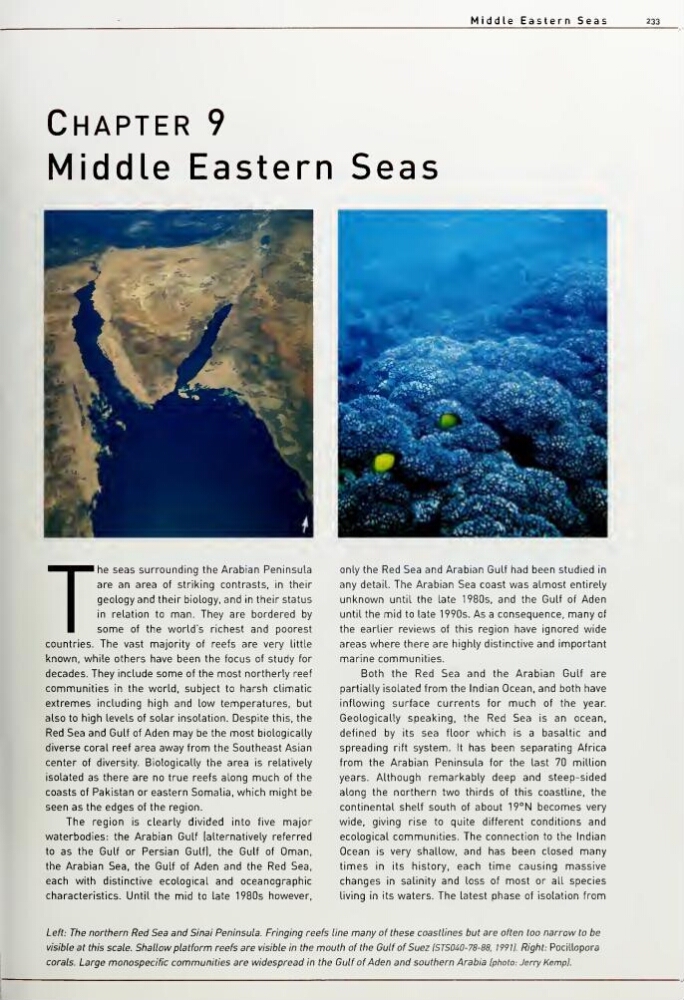
Left: The northern Red Sea and Sinai Peninsula. Fringing reefs line many of these coastlines but are often too narrow to be
visible at this scale. Shallow platform reefs are visible in the mouth of the Gulf of Suez (STSOiO-78-88. 19911 Right: Pocillopora
corals. Large monospecific communities are widespread in the Gulf of Aden and southern Arabia Iphoto: Jerry Kemp).
233
Chapter 9
Middle Eastern Seas
The
seas surrounding the Arabian Peninsula
are an area of striking contrasts, in their
geology and their biology, and in their status
in relation to man. They are bordered by
some of the world's richest and poorest
countries. The vast majority of reefs are very little
know/n, while others have been the focus of study for
decades. They include some of the most northerly reef
communities in the world, subject to harsh climatic
extremes including high and low temperatures, but
also to high levels of solar insolation. Despite this, the
Red Sea and Gulf of Aden may be the most biologically
diverse coral reef area away from the Southeast Asian
center of diversity. Biologically the area is relatively
isolated as there are no true reefs along much of the
coasts of Pakistan or eastern Somalia, which might be
seen as the edges of the region.
The region is clearly divided into five major
waterbodies: the Arabian Gulf [alternatively referred
to as the Gulf or Persian Gulfl, the Gulf of Oman,
the Arabian Sea, the Gulf of Aden and the Red Sea,
each with distinctive ecological and oceanographic
characteristics. Until the mid to late 1980s however.
only the Red Sea and Arabian Gulf had been studied in
any detail. The Arabian Sea coast was almost entirely
unknown until the late 1980s, and the Gulf of Aden
until the mid to late 1990s. As a conseguence, many of
the earlier reviews of this region have ignored wide
areas where there are highly distinctive and important
marine communities.
Both the Red Sea and the Arabian Gulf are
partially isolated from the Indian Ocean, and both have
inflowing surface currents for much of the yean
Geologically speaking, the Red Sea is an ocean,
defined by its sea floor which is a basaltic and
spreading rift system. It has been separating Africa
from the Arabian Peninsula for the last 70 million
years. Although remarkably deep and steep-sided
along the northern two thirds of this coastline, the
continental shelf south of about 19°N becomes very
wide, giving rise to guite different conditions and
ecological communities. The connection to the Indian
Ocean is very shallow, and has been closed many
times in its history, each time causing massive
changes in salinity and loss of most or all species
living in its waters. The latest phase of isolation from
Left: The northern Red Sea and Sinai Peninsula. Fringing reefs line many of these coastlines but are often too narrow to be
visible at this scale. Shallow platform reefs are visible in the mouth of the Gulf of Suez (STSOiO-78-88. 19911 Right: Pocillopora
corals. Large monospecific communities are widespread in the Gulf of Aden and southern Arabia Iphoto: Jerry Kemp).