

WORLD ATLAS OF CORAL REEFS
Protected areas wi th coral ree fs
(
Site name
Designation
Abbreviation
lUCN c.t.
Size lkmz|
Year
Sri Lanka
Bar Reef Marine
Sanctuary
S
IV
306.70
1992
Hil
NR
IV
1.01
1979
valued at approximately USS3 million in 1998. Other
species harvested for export in 1998 included 260 tons of
sea cucumbers, and over 800 tons of molluscs.
Tourism plays an important part in the national
economy, with coastal tourism estimated to contribute
around US$200 million per year Although reef-related
tourism is only a very small fraction of this, it is important
in the southwest, particularly around Hikkaduwa where
the reef received over 10 000 visitors in 1994.
The threats to Sri Lanka's reefs are numerous and it is
likely that the total reef area of this nation may once have
been much larger. Many of the remaining reefs are highly
degraded. Principle causes of degradation include very
high levels of sedimentation arising from erosion of deforested land, poor agricultural practices and construction.
Historically, coral mining has led to almost complete
destruction of many reefs along the south and southwest
coast and may have had similar impacts in the east.
Although officially banned in 1983, mining in the sea
continues in many areas where it is a traditional activity
providing relatively high income employment. Coral rock,
taken from living and fossil reefs, is used as a raw material
in lime production. In addition to direct destruction, coral
mining leads to increased erosion and high turbidity
over wide areas of the coastline. Further threats to the
remaining reefs arise from destructive fishing practices,
including dynamite fishing, uncontrolled exploitation of
resources, and pollution arising from sewage and industrial effluent. The combination of threats and current state
of degradation of many reefs may slow recovery from
the 1998 bleaching event. Although some legislation is in
place controlling such activities as coral mining, enforcement is clearly a problem. Only two protected areas (Bar
Reef and Hikkaduwa) are specifically designated for
the protection of coral reefs, and management is either
extremely weak or absent.
Sri Lanka
nH|
General Data
Population (thousands!
19 239
GDP (million US$)
10 738
Land area (km^l
66 580
Marine area (thousand km^J
531
Per capita fish consumption (kg/year|
21
Status and Threats
Reefs at risk [%1
86
Recorded coral diseases
Biodiversity
Reef area (km^l
680
Coral diversity
100/318
Mangrove area (km^j
89
No. of mangrove species
23
No. of seagrass species
-vflmm^^
7
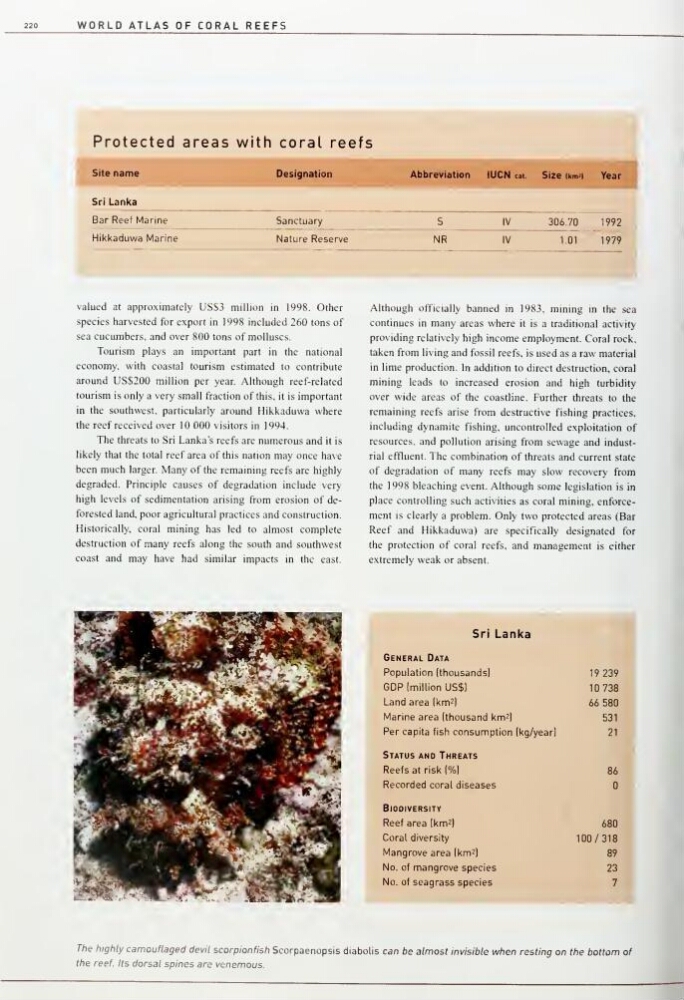
The highly camouflaged devil scorpionfish Scorpaenopsis diabolis can be almost invisible when resting on the bottom of
the reef. Its dorsal spines are venemous.
Protected areas wi th coral ree fs
(
Site name
Designation
Abbreviation
lUCN c.t.
Size lkmz|
Year
Sri Lanka
Bar Reef Marine
Sanctuary
S
IV
306.70
1992
Hil
NR
IV
1.01
1979
valued at approximately USS3 million in 1998. Other
species harvested for export in 1998 included 260 tons of
sea cucumbers, and over 800 tons of molluscs.
Tourism plays an important part in the national
economy, with coastal tourism estimated to contribute
around US$200 million per year Although reef-related
tourism is only a very small fraction of this, it is important
in the southwest, particularly around Hikkaduwa where
the reef received over 10 000 visitors in 1994.
The threats to Sri Lanka's reefs are numerous and it is
likely that the total reef area of this nation may once have
been much larger. Many of the remaining reefs are highly
degraded. Principle causes of degradation include very
high levels of sedimentation arising from erosion of deforested land, poor agricultural practices and construction.
Historically, coral mining has led to almost complete
destruction of many reefs along the south and southwest
coast and may have had similar impacts in the east.
Although officially banned in 1983, mining in the sea
continues in many areas where it is a traditional activity
providing relatively high income employment. Coral rock,
taken from living and fossil reefs, is used as a raw material
in lime production. In addition to direct destruction, coral
mining leads to increased erosion and high turbidity
over wide areas of the coastline. Further threats to the
remaining reefs arise from destructive fishing practices,
including dynamite fishing, uncontrolled exploitation of
resources, and pollution arising from sewage and industrial effluent. The combination of threats and current state
of degradation of many reefs may slow recovery from
the 1998 bleaching event. Although some legislation is in
place controlling such activities as coral mining, enforcement is clearly a problem. Only two protected areas (Bar
Reef and Hikkaduwa) are specifically designated for
the protection of coral reefs, and management is either
extremely weak or absent.
Sri Lanka
nH|
General Data
Population (thousands!
19 239
GDP (million US$)
10 738
Land area (km^l
66 580
Marine area (thousand km^J
531
Per capita fish consumption (kg/year|
21
Status and Threats
Reefs at risk [%1
86
Recorded coral diseases
Biodiversity
Reef area (km^l
680
Coral diversity
100/318
Mangrove area (km^j
89
No. of mangrove species
23
No. of seagrass species
-vflmm^^
7
The highly camouflaged devil scorpionfish Scorpaenopsis diabolis can be almost invisible when resting on the bottom of
the reef. Its dorsal spines are venemous.