

Central Indian Ocean
219
Sri Lanka
MAP 8b
Sri
Lanka is a large continental island off the southeast
coast of the Indian sub-continent. About 30 percent
of the land area is low-lying (less than 30 meters
elevation). Offshore the continental shelf is particularly
narrow to the south and east, widening to the northwest to
join that of India. Much of the coastline is dominated by
high wave energy, while the southern and western coasts are
further affected by considerable turbidity associated with
numerous river mouths. Largely as a consequence of this,
coral reefs are not abundant in the coastal waters.
It has been estimated that fringing reefs of varying
quality occur along about 2 percent of the coastline, mostly
along northwestern and eastern coasts. This statistic
includes many coral communities which have developed
on non-coral, or fossil reef platforms. Most reefs could be
described as fringing-type formations (although not all are
mature structures with clear zonation patterns). Additionally
there are some barrier reefs on the northwest coast at
Vankalai, Silavatturai and Bar Reef, while in the southeast
corals have colonized offshore ridges at Great Basses and
Little Basses. The reefs around the Jaffna Peninsula in the
north are mainly fringing reefs, but not very well developed.
The greatest reef development is in the northwest between
Mannar Island and the Kalpitiya Peninsula.
Marine diversity is not as high as among the reefs of
the oceanic areas of the Indian Ocean. Coral cover is
relatively low, although it reaches more than 50 percent
(live hermatypic coral cover) on Bar Reef and reefs in
the northwest During the 1998 El Nirio warming event
some of the reefs underwent significant bleaching, notably
in the south, with bleaching reported to depths of 42
meters near Batticaloa on the east coast. Shallow corals
down to 3-5 meters were reported to have died in almost
all areas except Trincomalee in the northeast, where
bleaching did not take place. Significant reductions in
butterflyfish and other coral-dependent species have
already been recorded.
Nearshore fisheries are a critical activity in Sri
Lanka, providing food, employment and income. Marine
fisheries account for 90-95 percent of the total landings,
and nearshore fisheries some 70-80 percent of these.
Although coral reefs are not widespread, one estimate has
suggested that up to 50 percent of the nearshore capture
fishery depends directly on coral reef ecosystems. One
other important economic activity is the collection of live
fish for the aquarium trade. This has grown considerably
over the past two decades: some 250 species of reef fish
and 50 invertebrates have been exported, in an industry
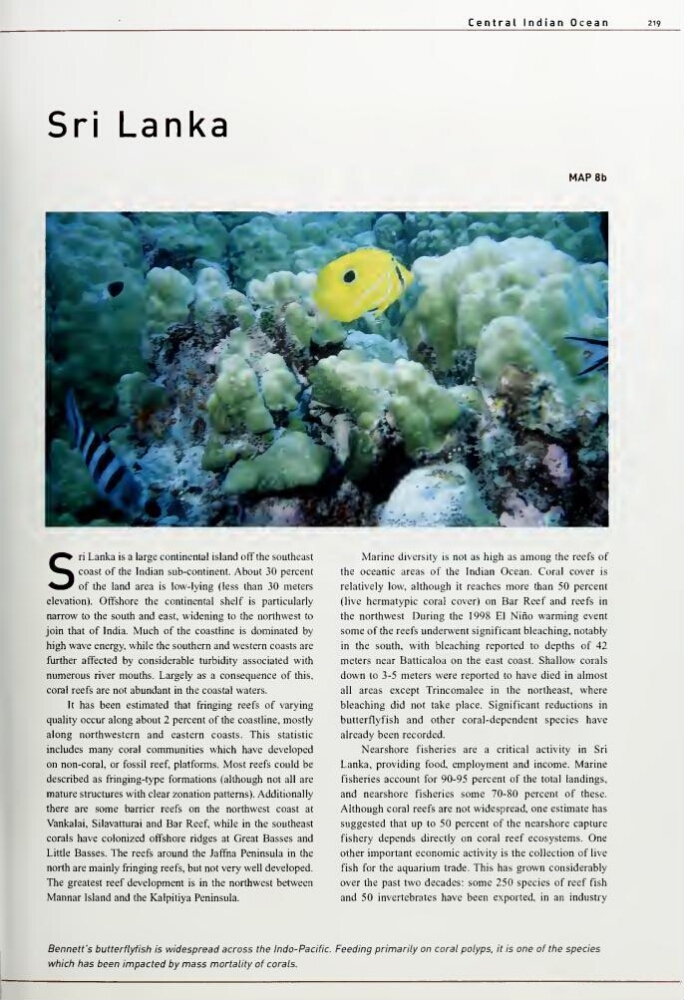
Bennett's butterflyfish is widespread across ttie Indo-Pacific. Feeding primarily on coral polyps, it is one of tfie species
which has been impacted by mass mortality of corals.
219
Sri Lanka
MAP 8b
Sri
Lanka is a large continental island off the southeast
coast of the Indian sub-continent. About 30 percent
of the land area is low-lying (less than 30 meters
elevation). Offshore the continental shelf is particularly
narrow to the south and east, widening to the northwest to
join that of India. Much of the coastline is dominated by
high wave energy, while the southern and western coasts are
further affected by considerable turbidity associated with
numerous river mouths. Largely as a consequence of this,
coral reefs are not abundant in the coastal waters.
It has been estimated that fringing reefs of varying
quality occur along about 2 percent of the coastline, mostly
along northwestern and eastern coasts. This statistic
includes many coral communities which have developed
on non-coral, or fossil reef platforms. Most reefs could be
described as fringing-type formations (although not all are
mature structures with clear zonation patterns). Additionally
there are some barrier reefs on the northwest coast at
Vankalai, Silavatturai and Bar Reef, while in the southeast
corals have colonized offshore ridges at Great Basses and
Little Basses. The reefs around the Jaffna Peninsula in the
north are mainly fringing reefs, but not very well developed.
The greatest reef development is in the northwest between
Mannar Island and the Kalpitiya Peninsula.
Marine diversity is not as high as among the reefs of
the oceanic areas of the Indian Ocean. Coral cover is
relatively low, although it reaches more than 50 percent
(live hermatypic coral cover) on Bar Reef and reefs in
the northwest During the 1998 El Nirio warming event
some of the reefs underwent significant bleaching, notably
in the south, with bleaching reported to depths of 42
meters near Batticaloa on the east coast. Shallow corals
down to 3-5 meters were reported to have died in almost
all areas except Trincomalee in the northeast, where
bleaching did not take place. Significant reductions in
butterflyfish and other coral-dependent species have
already been recorded.
Nearshore fisheries are a critical activity in Sri
Lanka, providing food, employment and income. Marine
fisheries account for 90-95 percent of the total landings,
and nearshore fisheries some 70-80 percent of these.
Although coral reefs are not widespread, one estimate has
suggested that up to 50 percent of the nearshore capture
fishery depends directly on coral reef ecosystems. One
other important economic activity is the collection of live
fish for the aquarium trade. This has grown considerably
over the past two decades: some 250 species of reef fish
and 50 invertebrates have been exported, in an industry
Bennett's butterflyfish is widespread across ttie Indo-Pacific. Feeding primarily on coral polyps, it is one of tfie species
which has been impacted by mass mortality of corals.