

Central Indian Ocean
221
Maldives
MAPS 8c and d
The
Maldives are a spectacular chain of 22 coral
atolls which run for some 800 kilometers north to
south in the Central Indian Ocean. These include
the largest surface-level atolls in the world: the area of
Thiladhunmathi and Miladhunmadulu Atolls (with two
names, but a single atoll structure) is some 3 680 square
kilometers, while Huvadhoo Atoll in the south is over
3 200 square kilometers. (The Great Chagos Bank to the
south occupies an even greater area, but is now largely
submerged.)
There are an estimated 1 200 coralline islands, 199 of
which are inhabited (although only three of these are
larger than 3 square kilometers). The maximum altitude
is only 5 meters above sea level. These islands and reefs
make up the central and largest sector of the ChagosLaccadive Ridge, which marks a volcanic trace left by the
Reunion hotspot. The atolls rise steeply from the base of
the ridge, and are aligned in two parallel chains. The atoll
rims are not unusual, with a wide reef flat, typically
bearing a number of islands and sand cays broken by deep
channels. The atoll lagoons range from IS to 55 meters in
depth, and within these are a number of patch reefs and
knolls, but also some reef structures known as faros which
are common in the Maldives, but very unusual elsewhere.
These have the appearance of miniature atolls, with a
central lagoon, and often bear small islands on their rim.
In terms of their biodiversity, the Maldivian atolls
form part of the "Chagos stricture" and so are an
important link or stepping stone between the reefs of the
Eastern Indian Ocean and those of the East African region.
The fauna therefore combines elements of both eastern
and western assemblages. Diversity is very high. At least
209 scleractinian corals are recorded, with maximum
diversity reported in the south. Over I 000 epipelagic and
shore fishes are recorded from the Maldives, a large
proportion of which are reef associated. Coral cover on
the atoll edges and on the faros and lagoon knolls was
prolific, over 60 percent to depths of at least 20 meters.
During the 1998 El Nirio warming event some of the
worst coral bleaching was recorded in this region and up
to 90 percent of hermatypic corals were reported to have
died in some areas. Impacts of this mortality are the
subject of continuing study - while some growth of new
corals is now occurring, the impacts on the wider ecology
may continue for decades, even assuming no further
extreme events.
More than any other nation outside the Western
Pacific, the Maldives is dependant on coral reefs for the
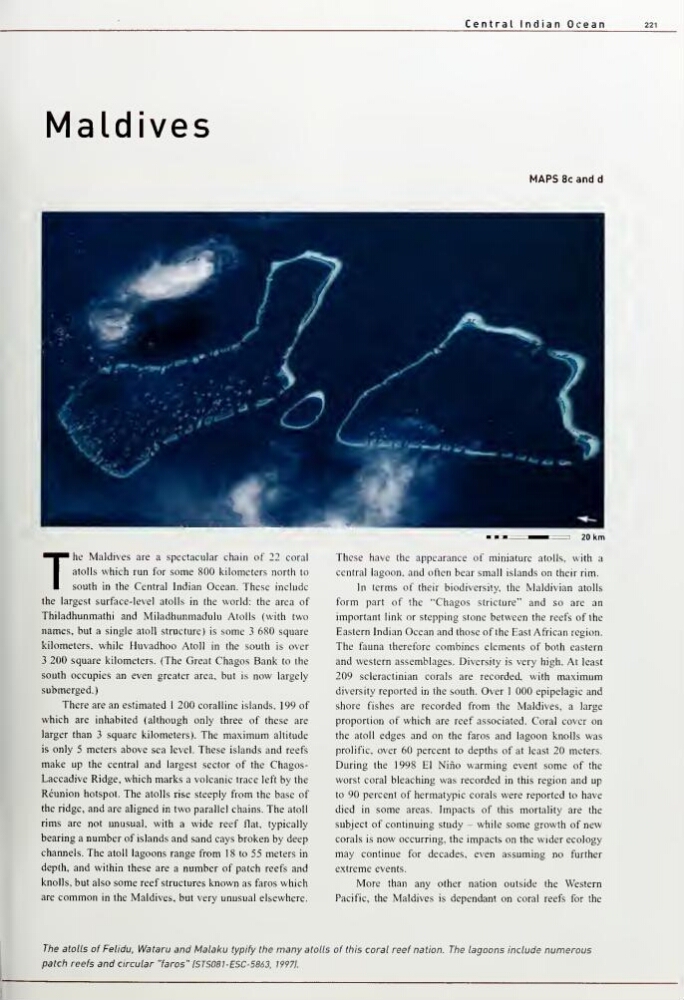
The atolls of Felidu, Wataru and Malaku typify the many atolls of this coral reef nation. The lagoons include numerous
patch reefs and circular "faros" ISTS081-ESC-5863. 19971.
221
Maldives
MAPS 8c and d
The
Maldives are a spectacular chain of 22 coral
atolls which run for some 800 kilometers north to
south in the Central Indian Ocean. These include
the largest surface-level atolls in the world: the area of
Thiladhunmathi and Miladhunmadulu Atolls (with two
names, but a single atoll structure) is some 3 680 square
kilometers, while Huvadhoo Atoll in the south is over
3 200 square kilometers. (The Great Chagos Bank to the
south occupies an even greater area, but is now largely
submerged.)
There are an estimated 1 200 coralline islands, 199 of
which are inhabited (although only three of these are
larger than 3 square kilometers). The maximum altitude
is only 5 meters above sea level. These islands and reefs
make up the central and largest sector of the ChagosLaccadive Ridge, which marks a volcanic trace left by the
Reunion hotspot. The atolls rise steeply from the base of
the ridge, and are aligned in two parallel chains. The atoll
rims are not unusual, with a wide reef flat, typically
bearing a number of islands and sand cays broken by deep
channels. The atoll lagoons range from IS to 55 meters in
depth, and within these are a number of patch reefs and
knolls, but also some reef structures known as faros which
are common in the Maldives, but very unusual elsewhere.
These have the appearance of miniature atolls, with a
central lagoon, and often bear small islands on their rim.
In terms of their biodiversity, the Maldivian atolls
form part of the "Chagos stricture" and so are an
important link or stepping stone between the reefs of the
Eastern Indian Ocean and those of the East African region.
The fauna therefore combines elements of both eastern
and western assemblages. Diversity is very high. At least
209 scleractinian corals are recorded, with maximum
diversity reported in the south. Over I 000 epipelagic and
shore fishes are recorded from the Maldives, a large
proportion of which are reef associated. Coral cover on
the atoll edges and on the faros and lagoon knolls was
prolific, over 60 percent to depths of at least 20 meters.
During the 1998 El Nirio warming event some of the
worst coral bleaching was recorded in this region and up
to 90 percent of hermatypic corals were reported to have
died in some areas. Impacts of this mortality are the
subject of continuing study - while some growth of new
corals is now occurring, the impacts on the wider ecology
may continue for decades, even assuming no further
extreme events.
More than any other nation outside the Western
Pacific, the Maldives is dependant on coral reefs for the
The atolls of Felidu, Wataru and Malaku typify the many atolls of this coral reef nation. The lagoons include numerous
patch reefs and circular "faros" ISTS081-ESC-5863. 19971.