

Western Indian Ocean
193
Protected areas with coral reefs
Site name
Designation
Abbreviation
lUCN cat.
Size Ikmil
Year
Mozambique
Bazaruto
National Parl(
NP
II
150.00
1971
llhas da Inhaca e dos Portugueses
Faunal Reserve
FR
VI
20.00
1965
South Africa
Greater St. Lucia ISouth Africa]
Wetland Park
WP
II
2 586.86
1895
Greater St. Lucia Wetland Park
World Heritage Site
2 395.66
1999
Turtle Beaches/
Coral Reefs of Tongalano
Ramsar Site
395.00
1986
damage to turtle nesting beaches. Efforts to develop coastal
resorts have also been poorly controlled to date, although
this may be changing. Most reef-based tourism operates
around the Bazaruto Archipelago and there is evidence of
significant damage to reefs caused by divers and boats.
Fishing is an important activity in Mozambique.
Trawling for prawns dominates the commercial fishery
and generates 40 percent of the country's foreign
exchange earnings. This catch is highly dependent on the
mangroves and estuaries which act as nursery areas. There
is little agreement about the overall size of the artisanal
catch, with estimates that these may make up anywhere
between 20 and 70 percent of total landings (estimates of
total landings similarly vary between 18 500 and 90 000
tons per year). Fishing is considerable on the Quirimbass
South A< rica
General Data
Population Ithousandsl
^3 421
GDP Imilllon US$)
1U585
Land area (km^l
1 223 124
Marine area (thousand km^l
1 525
Per capita fish consumption (kg/yearl
8
Status and Threats
Reefs at risk |%|
na
Recorded coral diseases
Biodiversity
Reef area (km^l
<50
Coral diversity
na / na
Mangrove area Ikm^)
11
No. of mangrove species
6
No. of seagrass species
3
reefs and seagrass systems, and there are now migrant
fishermen coming to the region, bringing the potential for
overfishing. E.xploitation of the Primeiro and Segundo
Archipelagos is relatively low due to the lack of permanent human settlement and often rough seas. Removal of
molluscs for the curio trade is reported to be of significance on a number of reefs.
Mozambique still has many reefs which have escaped
heavy human impact, however this is changing, and quite
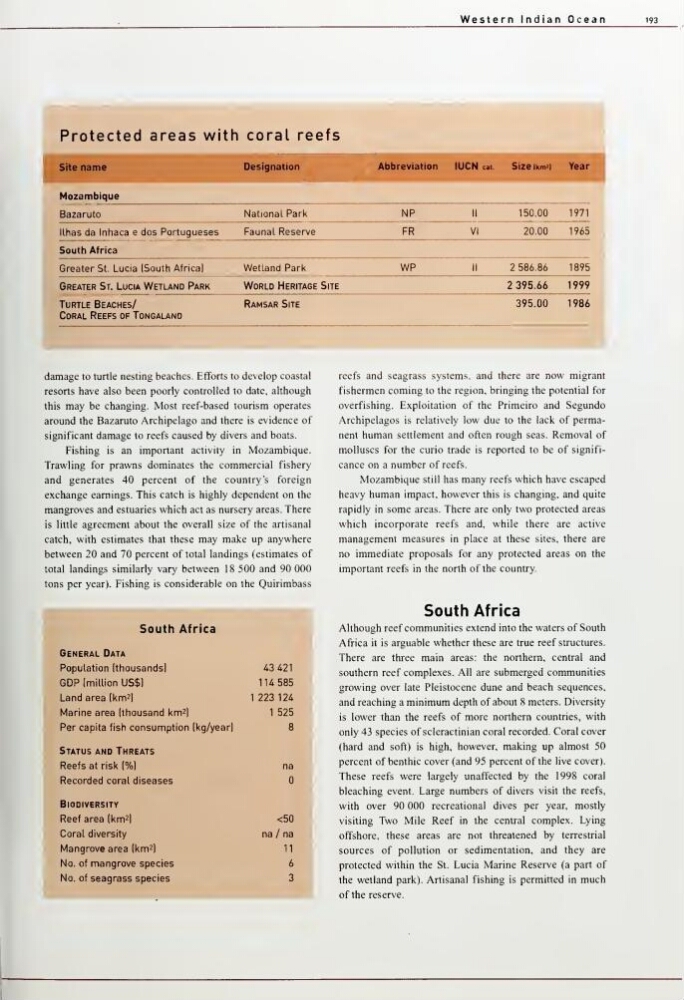
rapidly in some areas. There are only two protected areas
which incorporate reefs and, while there are active
management measures in place at these sites, there are
no immediate proposals for any protected areas on the
important reefs in the north of the country.
South Africa
Although reef communities extend into the waters of South
Africa it is arguable whether these are true reef structures.
There are three main areas: the northern, central and
southern reef complexes. All are submerged communities
growing over late Pleistocene dune and beach sequences,
and reaching a minimum depth of about 8 meters. Diversity
is lower than the reefs of more northern countries, with
only 43 species of scleractinian coral recorded. Coral cover
(hard and soft) is high, however, making up almost 50
percent of benthic cover (and 95 percent of the live cover).
These reefs were largely unaffected by the 1998 coral
bleaching event. Large numbers of divers visit the reefs,
with over 90 000 recreational dives per year, mostly
visiting Two Mile Reef in the central complex. Lying
offshore, these areas are not threatened by terrestrial
sources of pollution or sedimentation, and they are
protected within the St. Lucia Marine Reserve (a part of
the wetland park). Artisanal fishing is permitted in much
of the reserve.
193
Protected areas with coral reefs
Site name
Designation
Abbreviation
lUCN cat.
Size Ikmil
Year
Mozambique
Bazaruto
National Parl(
NP
II
150.00
1971
llhas da Inhaca e dos Portugueses
Faunal Reserve
FR
VI
20.00
1965
South Africa
Greater St. Lucia ISouth Africa]
Wetland Park
WP
II
2 586.86
1895
Greater St. Lucia Wetland Park
World Heritage Site
2 395.66
1999
Turtle Beaches/
Coral Reefs of Tongalano
Ramsar Site
395.00
1986
damage to turtle nesting beaches. Efforts to develop coastal
resorts have also been poorly controlled to date, although
this may be changing. Most reef-based tourism operates
around the Bazaruto Archipelago and there is evidence of
significant damage to reefs caused by divers and boats.
Fishing is an important activity in Mozambique.
Trawling for prawns dominates the commercial fishery
and generates 40 percent of the country's foreign
exchange earnings. This catch is highly dependent on the
mangroves and estuaries which act as nursery areas. There
is little agreement about the overall size of the artisanal
catch, with estimates that these may make up anywhere
between 20 and 70 percent of total landings (estimates of
total landings similarly vary between 18 500 and 90 000
tons per year). Fishing is considerable on the Quirimbass
South A< rica
General Data
Population Ithousandsl
^3 421
GDP Imilllon US$)
1U585
Land area (km^l
1 223 124
Marine area (thousand km^l
1 525
Per capita fish consumption (kg/yearl
8
Status and Threats
Reefs at risk |%|
na
Recorded coral diseases
Biodiversity
Reef area (km^l
<50
Coral diversity
na / na
Mangrove area Ikm^)
11
No. of mangrove species
6
No. of seagrass species
3
reefs and seagrass systems, and there are now migrant
fishermen coming to the region, bringing the potential for
overfishing. E.xploitation of the Primeiro and Segundo
Archipelagos is relatively low due to the lack of permanent human settlement and often rough seas. Removal of
molluscs for the curio trade is reported to be of significance on a number of reefs.
Mozambique still has many reefs which have escaped
heavy human impact, however this is changing, and quite
rapidly in some areas. There are only two protected areas
which incorporate reefs and, while there are active
management measures in place at these sites, there are
no immediate proposals for any protected areas on the
important reefs in the north of the country.
South Africa
Although reef communities extend into the waters of South
Africa it is arguable whether these are true reef structures.
There are three main areas: the northern, central and
southern reef complexes. All are submerged communities
growing over late Pleistocene dune and beach sequences,
and reaching a minimum depth of about 8 meters. Diversity
is lower than the reefs of more northern countries, with
only 43 species of scleractinian coral recorded. Coral cover
(hard and soft) is high, however, making up almost 50
percent of benthic cover (and 95 percent of the live cover).
These reefs were largely unaffected by the 1998 coral
bleaching event. Large numbers of divers visit the reefs,
with over 90 000 recreational dives per year, mostly
visiting Two Mile Reef in the central complex. Lying
offshore, these areas are not threatened by terrestrial
sources of pollution or sedimentation, and they are
protected within the St. Lucia Marine Reserve (a part of
the wetland park). Artisanal fishing is permitted in much
of the reserve.