

192
WORLD ATLAS OF CORAL REEFS
the swamp coast, and is dominated by riverine sediments.
These prevent any major reef developments, while there
are extensive mangroves inshore. Further south again, reef
development is limited, but there are true reefs as well
as rocky structures with coral communities around both
the Bazaruto and Inhaca Islands. At the former, reefs
are mostly patch reef structures, and active growth is
restricted to the shallowest waters, but here coral cover
Mozamb ique
General Data
Population Ithousandsl
19 1Q5
GDP (million US$1
2 089
Land area Ikm^l
788 629
Marine area (thousand km^j
565
Per capita fish consumption (kg/yearl
2
Status and Threats
Reefs at risk [%1
76
Recorded coral diseases
Biodiversity
Reef area Ikm^j
1 860
Coral diversity*
19^/3U
Mangrove area (km^l
925
No. of mangrove species
10
No. of seagrass species
8
The lltgher coral diversity figure is an estimate for Mozambique
and Tanzania combined
can reach 90 percent, and some 27 scleractinian coral
genera have been recorded. Three small fringing reefs
have developed off Inhaca and Portugueses Islands, as
well as a number of smaller patch reefs. These have been
relatively well studied and have a high diversity of corals
and fish. Elsewhere there are anecdotal reports of
extensive coral and gorgonian communities in offshore
areas, but there have been few, if any, surveys of the
region. Probably the largest remaining population of
dugongs is found in the Bazaruto Archipelago, estimated
at 150 individuals in the early 1990s, but thought to
have declined to 60-80 animals by 1999. Crown-of-thorns
starfish are reported to have destroyed a number of reef
areas off Bazaruto and Inhambane.
The 1998 coral bleaching event appears to have
caused significant mortality of corals in Mozambique,
particularly in the north, but with considerable variation in
the degree of impact between localities.
Mozambique has a large coastal population. The
majority of these people moved to urban areas during the
civil unrest which ended in 1992. These are a source of
considerable pollutants to nearby coastal waters as most
sewage is untreated. Away from these urban areas much of
the coastline is dominated by slash-and-burn agriculture,
which releases sediments and nutrients into nearby
waters. Tourism is growing, particularly in the south, and
is generally considered detrimental to the environment,
especially vehicular or camping-based tourism from South
Africa which brings few benefits to the country, and may
lead to unsustainable levels of recreational fishing and
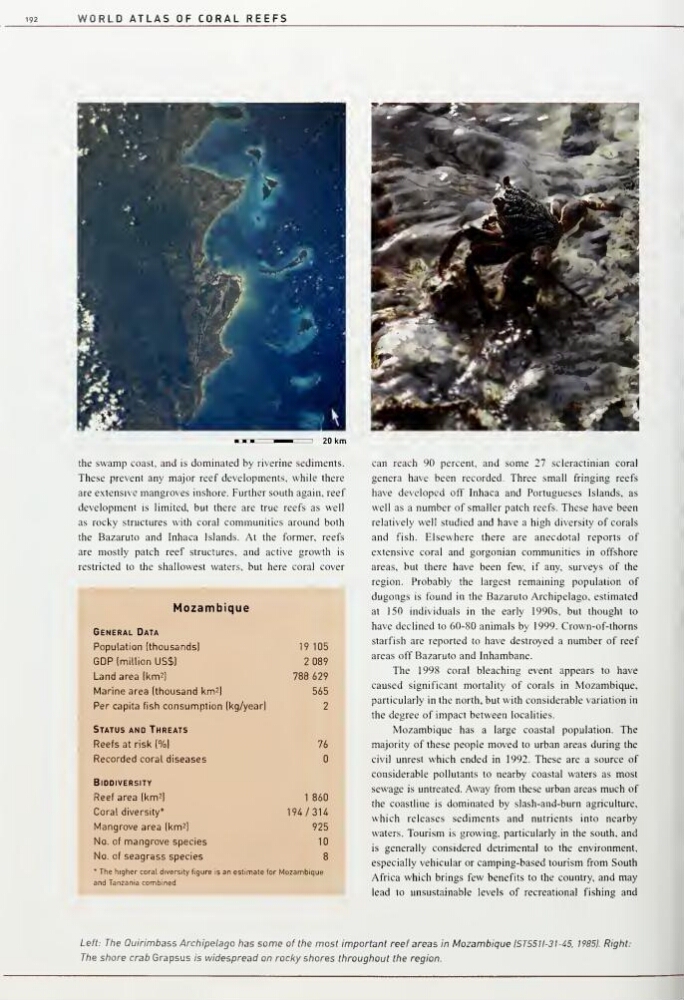
Left: The Quinmbass Archipelago has some of the most important reef areas in Mozambique IST551I-31-45. 19851. Right:
The shore crab Grapsus is widespread on rocky shores throughout the region.
WORLD ATLAS OF CORAL REEFS
the swamp coast, and is dominated by riverine sediments.
These prevent any major reef developments, while there
are extensive mangroves inshore. Further south again, reef
development is limited, but there are true reefs as well
as rocky structures with coral communities around both
the Bazaruto and Inhaca Islands. At the former, reefs
are mostly patch reef structures, and active growth is
restricted to the shallowest waters, but here coral cover
Mozamb ique
General Data
Population Ithousandsl
19 1Q5
GDP (million US$1
2 089
Land area Ikm^l
788 629
Marine area (thousand km^j
565
Per capita fish consumption (kg/yearl
2
Status and Threats
Reefs at risk [%1
76
Recorded coral diseases
Biodiversity
Reef area Ikm^j
1 860
Coral diversity*
19^/3U
Mangrove area (km^l
925
No. of mangrove species
10
No. of seagrass species
8
The lltgher coral diversity figure is an estimate for Mozambique
and Tanzania combined
can reach 90 percent, and some 27 scleractinian coral
genera have been recorded. Three small fringing reefs
have developed off Inhaca and Portugueses Islands, as
well as a number of smaller patch reefs. These have been
relatively well studied and have a high diversity of corals
and fish. Elsewhere there are anecdotal reports of
extensive coral and gorgonian communities in offshore
areas, but there have been few, if any, surveys of the
region. Probably the largest remaining population of
dugongs is found in the Bazaruto Archipelago, estimated
at 150 individuals in the early 1990s, but thought to
have declined to 60-80 animals by 1999. Crown-of-thorns
starfish are reported to have destroyed a number of reef
areas off Bazaruto and Inhambane.
The 1998 coral bleaching event appears to have
caused significant mortality of corals in Mozambique,
particularly in the north, but with considerable variation in
the degree of impact between localities.
Mozambique has a large coastal population. The
majority of these people moved to urban areas during the
civil unrest which ended in 1992. These are a source of
considerable pollutants to nearby coastal waters as most
sewage is untreated. Away from these urban areas much of
the coastline is dominated by slash-and-burn agriculture,
which releases sediments and nutrients into nearby
waters. Tourism is growing, particularly in the south, and
is generally considered detrimental to the environment,
especially vehicular or camping-based tourism from South
Africa which brings few benefits to the country, and may
lead to unsustainable levels of recreational fishing and
Left: The Quinmbass Archipelago has some of the most important reef areas in Mozambique IST551I-31-45. 19851. Right:
The shore crab Grapsus is widespread on rocky shores throughout the region.