

18A
WORLD ATLAS OF CORAL REEFS
coastline was severely affected by the 1998 coral
bleaching, with 50-90 percent of corals appearing to
bleach and many of these subsequently dying. Impacts on
soft corals were even more severe.
Coastal areas of Kenya are densely populated and
there are large-scale artisanal and commercial fisheries.
Fishing using handlines. traps, spearguns and gill and
seine nets is common, with artisanal fishing concentrated
in lagoons and commercial fishing also operating from
sail-powered dhows. Other fisheries, including netting for
aquarium fish and sport fishing in offshore waters, are
Kenya
General Data
Population (thousands]
30 3^0
GDP (million US$1
9 621
Land area (km^j
587 709
Marine area (thousand km^l
117
Per capita fish consumption (kg/yearl
5
Status and Threats
Reefs at risk (%)
91
Recorded coral diseases
Biodiversity
Reef area (km^l
630
Coral diversity
na/237
Mangrove area (km^l
530
No. of mangrove species
9
No. of seagrass species
13
increasing. Exploitation is heavy and stocks in several
localities are considered to be overexploited. A number of
marine parks and reserves have been established, however.
Fishing is prohibited in the parks and only "traditional"
methods of handlines and traps are permitted in the
reserves. Protection of these areas has had clear impacts,
with increases in fish abundance and diversity as well as
live coral cover. Sea urchin densities are notably higher in
non-protected reefs, and this may be impacting coral cover
and topographic complexity.
Tourism is a major industry for Kenya, and of the
750 000 holiday makers visiting the country annually, 70
percent spend at least part of their time on the coast.
Coastal tourism is particularly focussed in the southern
areas, including Malindi, Mombasa and Diani. Many of
the hotels have direct frontage onto the marine parks and
so visitor numbers are high. Diving is a popular activity in
many of the southern reefs, but there is only a limited
infrastructure for recreational diving in the north. Diving
activities peak from October until April when water
conditions tend to be clearer and calmer
Overexploitation is a continuing problem on many
Kenyan reefs, including illegal activities in protected areas,
although policing is increasingly effective in places. There
has been local opposition to the establishment of the Diani
Marine Reserve due to a perceived loss of benefits -
efforts are being made to address this. Increasing levels of
sediment load arising from ex situ changes in landuse are
a problem, particularly in the Athi-Galana-Sabaki River,
and are probably affecting reefs near Malindi. Direct
physical damage by divers (primarily coral breakage) has
been clearly demonstrated, but only affects small areas
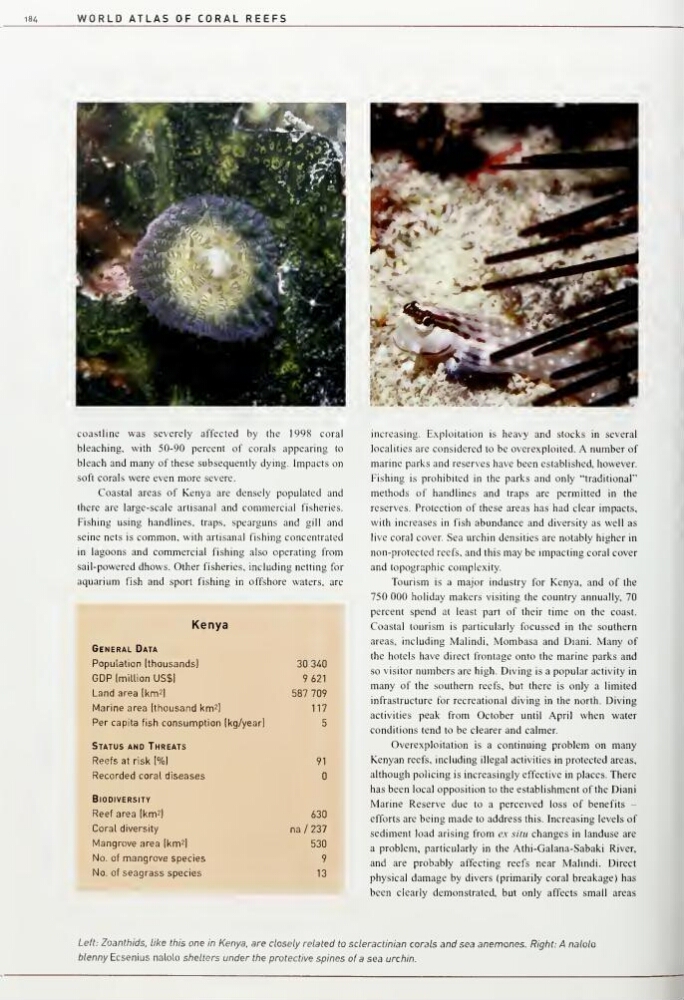
Left: Zoanthids, tike fh/s one in Kenya, are closely related to scleractinian corals and sea anemones. Right: A nalolo
fa/enny Ecsenius nalolo shelters under the protective spines of a sea urchin.
WORLD ATLAS OF CORAL REEFS
coastline was severely affected by the 1998 coral
bleaching, with 50-90 percent of corals appearing to
bleach and many of these subsequently dying. Impacts on
soft corals were even more severe.
Coastal areas of Kenya are densely populated and
there are large-scale artisanal and commercial fisheries.
Fishing using handlines. traps, spearguns and gill and
seine nets is common, with artisanal fishing concentrated
in lagoons and commercial fishing also operating from
sail-powered dhows. Other fisheries, including netting for
aquarium fish and sport fishing in offshore waters, are
Kenya
General Data
Population (thousands]
30 3^0
GDP (million US$1
9 621
Land area (km^j
587 709
Marine area (thousand km^l
117
Per capita fish consumption (kg/yearl
5
Status and Threats
Reefs at risk (%)
91
Recorded coral diseases
Biodiversity
Reef area (km^l
630
Coral diversity
na/237
Mangrove area (km^l
530
No. of mangrove species
9
No. of seagrass species
13
increasing. Exploitation is heavy and stocks in several
localities are considered to be overexploited. A number of
marine parks and reserves have been established, however.
Fishing is prohibited in the parks and only "traditional"
methods of handlines and traps are permitted in the
reserves. Protection of these areas has had clear impacts,
with increases in fish abundance and diversity as well as
live coral cover. Sea urchin densities are notably higher in
non-protected reefs, and this may be impacting coral cover
and topographic complexity.
Tourism is a major industry for Kenya, and of the
750 000 holiday makers visiting the country annually, 70
percent spend at least part of their time on the coast.
Coastal tourism is particularly focussed in the southern
areas, including Malindi, Mombasa and Diani. Many of
the hotels have direct frontage onto the marine parks and
so visitor numbers are high. Diving is a popular activity in
many of the southern reefs, but there is only a limited
infrastructure for recreational diving in the north. Diving
activities peak from October until April when water
conditions tend to be clearer and calmer
Overexploitation is a continuing problem on many
Kenyan reefs, including illegal activities in protected areas,
although policing is increasingly effective in places. There
has been local opposition to the establishment of the Diani
Marine Reserve due to a perceived loss of benefits -
efforts are being made to address this. Increasing levels of
sediment load arising from ex situ changes in landuse are
a problem, particularly in the Athi-Galana-Sabaki River,
and are probably affecting reefs near Malindi. Direct
physical damage by divers (primarily coral breakage) has
been clearly demonstrated, but only affects small areas
Left: Zoanthids, tike fh/s one in Kenya, are closely related to scleractinian corals and sea anemones. Right: A nalolo
fa/enny Ecsenius nalolo shelters under the protective spines of a sea urchin.