

WORLD ATLAS OF CORAL REEFS
About 7 kilometers west of Saba is a large shallow
platform, the Saba Bank, which may be a submerged atoll.
Although only recently studied it appears to have high
coral cover in places, and is important for lobster and
snapper fisheries.
The entire island of St. Maarten has shown rapid
coastal development in recent years, paralleling fast population growth and a dramatic expansion of tourism. The
reefs of the south and west coasts are seriously threatened
by sewage pollution and siltation. while there is also much
recreational boating and anchor damage. To date, no protected areas have been created.
St. Kitts and Nevis
This small independent state consists of two volcanic
islands with steep mountainous slopes. There are fringing
reefs along much of the coastline, and a number of deeper
submerged reef structures. There is little published information about these reefs. Tourism is an important industry
and there are now a number of dive operators.
Montserrat
This small island - an overseas territory of the UK - is
mountainous and includes considerable forest cover. Since
1995 however, the Soufriere Hills volcano has been active
almost continuously, with major pyroclastic flows into the
sea. Small scattered reefs and coral communities were
originally described along much of the coastline, but it
seems likely that they have been severely impacted by the
massive inputs of sediment, and possibly chemical
influences, associated with volcanic activity. Most of the
island's people have now been evacuated and the capital
Plymouth was itself destroyed in 1997.
Guadeloupe and dependencies
Guadeloupe is an overseas territory of France, consisting
of the twin islands of Grande Terre and Basse Terre which
make up Guadeloupe proper, together with the nearby
lies des Saintes and Marie-Galante. The territory also
administers the island of St. Barthelemy (St. Earths) and
the northern half of St. Martin (see above). Basse Terre
is high and volcanic, while Grande Terre is flat and
calcareous. The western coast of Basse Terre has coral
communities but no major reef structures. There are some
fringing and bank barrier reef structures, particularly on
the southern coastline of Grande Terre, while the northern
and eastern coast of this island have well developed algal
ridges. The best developed reefs are in the Grand Cul-deSac Marin, a shallow embayment fringed with extensive
mangrove areas and dominated by seagrasses. There are
several patch reefs within this bay, while its outer edge is
bounded by a barrier reef with spur and groove formations
and a reef slope with coral growth down to a depth of 55
meters. Discontinuous fringing reefs are found in a few
parts of the other islands, notably on the southern shores of
Marie-Galante. St. Barthelemy and St. Martin have limited
coral reef development. Mass bleaching was reported in
1998 at Guadeloupe, but some bleaching occurs every year
in September when water temperatures reach 29°C.
Fishing is an important activity in Guadeloupe, and in
1998 there were more than 2 000 professional fishermen,
with a further 1 000 also thought to be fishing regularly.
These have a considerable impact on the nearshore
communities, most of which are considered to be
overexploited. The annual catch was about 8 500 tons
from these islands in 2000. Tourism, a major activity for
the islands, is further driving the problems caused by
coastal development and pollution. Diving is a popular
activity. The Pigeon Islets (to the west of Grande Terre)
are a popular dive site, but there is evidence of damage
being caused by an estimated 80 000 divers per year.
Donninica
Dominica, a high volcanic island with steep topography,
is an independent state. There is only limited reef development on the narrow coastal shelves, although there
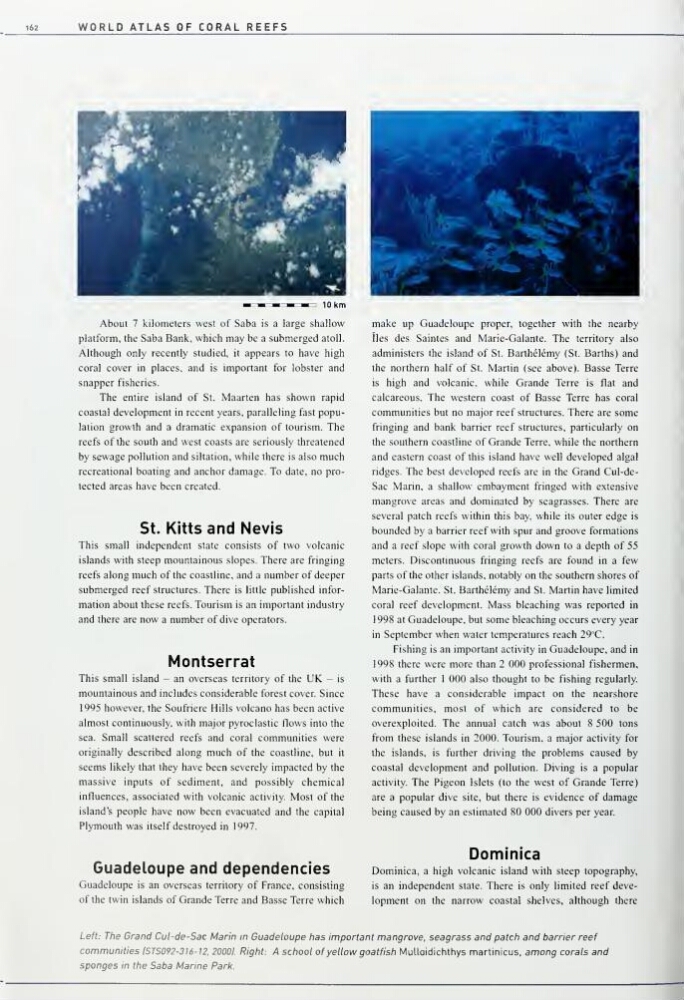
Left: The Grand Cul-de-Sac Marin in Guadeloupe has important mangrove, seagrass and patch and barrier reef
communities ISTS092-316-U. 20001. Right: A school of yellow goatfish MuUoidichthys martmicus, among corals and
sponges in the Saba Marine Park.
About 7 kilometers west of Saba is a large shallow
platform, the Saba Bank, which may be a submerged atoll.
Although only recently studied it appears to have high
coral cover in places, and is important for lobster and
snapper fisheries.
The entire island of St. Maarten has shown rapid
coastal development in recent years, paralleling fast population growth and a dramatic expansion of tourism. The
reefs of the south and west coasts are seriously threatened
by sewage pollution and siltation. while there is also much
recreational boating and anchor damage. To date, no protected areas have been created.
St. Kitts and Nevis
This small independent state consists of two volcanic
islands with steep mountainous slopes. There are fringing
reefs along much of the coastline, and a number of deeper
submerged reef structures. There is little published information about these reefs. Tourism is an important industry
and there are now a number of dive operators.
Montserrat
This small island - an overseas territory of the UK - is
mountainous and includes considerable forest cover. Since
1995 however, the Soufriere Hills volcano has been active
almost continuously, with major pyroclastic flows into the
sea. Small scattered reefs and coral communities were
originally described along much of the coastline, but it
seems likely that they have been severely impacted by the
massive inputs of sediment, and possibly chemical
influences, associated with volcanic activity. Most of the
island's people have now been evacuated and the capital
Plymouth was itself destroyed in 1997.
Guadeloupe and dependencies
Guadeloupe is an overseas territory of France, consisting
of the twin islands of Grande Terre and Basse Terre which
make up Guadeloupe proper, together with the nearby
lies des Saintes and Marie-Galante. The territory also
administers the island of St. Barthelemy (St. Earths) and
the northern half of St. Martin (see above). Basse Terre
is high and volcanic, while Grande Terre is flat and
calcareous. The western coast of Basse Terre has coral
communities but no major reef structures. There are some
fringing and bank barrier reef structures, particularly on
the southern coastline of Grande Terre, while the northern
and eastern coast of this island have well developed algal
ridges. The best developed reefs are in the Grand Cul-deSac Marin, a shallow embayment fringed with extensive
mangrove areas and dominated by seagrasses. There are
several patch reefs within this bay, while its outer edge is
bounded by a barrier reef with spur and groove formations
and a reef slope with coral growth down to a depth of 55
meters. Discontinuous fringing reefs are found in a few
parts of the other islands, notably on the southern shores of
Marie-Galante. St. Barthelemy and St. Martin have limited
coral reef development. Mass bleaching was reported in
1998 at Guadeloupe, but some bleaching occurs every year
in September when water temperatures reach 29°C.
Fishing is an important activity in Guadeloupe, and in
1998 there were more than 2 000 professional fishermen,
with a further 1 000 also thought to be fishing regularly.
These have a considerable impact on the nearshore
communities, most of which are considered to be
overexploited. The annual catch was about 8 500 tons
from these islands in 2000. Tourism, a major activity for
the islands, is further driving the problems caused by
coastal development and pollution. Diving is a popular
activity. The Pigeon Islets (to the west of Grande Terre)
are a popular dive site, but there is evidence of damage
being caused by an estimated 80 000 divers per year.
Donninica
Dominica, a high volcanic island with steep topography,
is an independent state. There is only limited reef development on the narrow coastal shelves, although there
Left: The Grand Cul-de-Sac Marin in Guadeloupe has important mangrove, seagrass and patch and barrier reef
communities ISTS092-316-U. 20001. Right: A school of yellow goatfish MuUoidichthys martmicus, among corals and
sponges in the Saba Marine Park.