

Eastern Caribbean and Atlantic
163
although south of Presqu'ile de la Caravelle a barrier reef
continues along the shore for about 25 kilometers. The
lagoon behind this reef is up to 30 meters deep in places and
there are extensive seagrass communities. Fringing reefs
have developed along the coast behind the barrier reef
Algae, including Sargassum, Turbinaria and Dictyota. have
proliferated on the reefs of Martinique since the Diadema
die-off. Eutrophication from the city of Fort-de-France
may be combining with the lack of grazing organisms in
maintaining this situation. Overfishing is a problem, with
about 900 registered fishers in 1997, but many others
operating. There were an estimated 50 000 wire-mesh fish
traps around the island in 2000.
are several important coral communities, particularly
on the south, west and northwest coasts. Several species
of whale and dolphin are found in the waters around
Dominica, which is fast positioning itself as the leading
whale-watching destination in the region. The small
population and minimal coastal development mean that
the corals have not been severely impacted by human
activities, and Dominica has been spared from a direct
hurricane since Hurricane David in 1979.
Martinique
Martinique, like Guadeloupe, is an overseas territory of
France. Reefs are absent on the leeward northern, northwest
and west coasts, because the shelf is narrow and there is a
high sediment load from the erosion of Mount Pelee. There
are, however, some coral communities along this coastline.
Similarly, there are no true reefs along the northeast coast.
St. Lucia
St. Lucia is another high volcanic island. Coral reefs are
generally poorly developed, often only forming a thin
veneer over the underlying volcanic substrates. The best
developed reefs are in the south and east, although the
best studied and most heavily utilized coral communities
occur along the west coast. Certain reefs around Soufriere
showed up to 50 percent live coral cover, but these sites
were strongly impacted by Hurricane Lenny in 1999,
which brought strong wave action on the leeward coast.
Fishing is a very important activity around the island
and overexploitation is a problem. Concerted efforts
have recently been undertaken to manage the nearshore
fisheries, and in the Soufriere Marine Management Area
a number of no-take reserves have been established,
interspersed with other use zones. Studies have shown
huge increases in fish biomass in the reserves, while
IV
fll Montserrat Guadeloupe*
Dominica
Martinique
General Data
Population (thousands)
6
426
72
415^
GDP (million US$1
40
2 085
191
2 65^1
Land area (km^l
105
1 735
732
101^1
Marine area (thousand km^l
7
90
29
4^H
Per capita fish consumption
(kg/year)
na
28
35
2^
Status and Threats
fl
Reefs at risk (%)
na
100
100
locH
Recorded coral diseases
1
V
Biodiversity
J
Reef area (km?)
250
<100
240
^
1. Coral diversity
na / na
na/57
na/57
34/57fl
1 Mangrove area (km?)
>0.02
40
2
'm
f No. of mangrove species
na
na
na
naS
No. of seagrass species
na
na
na
na
^ * Including St. Martin and St. Barthel.emy
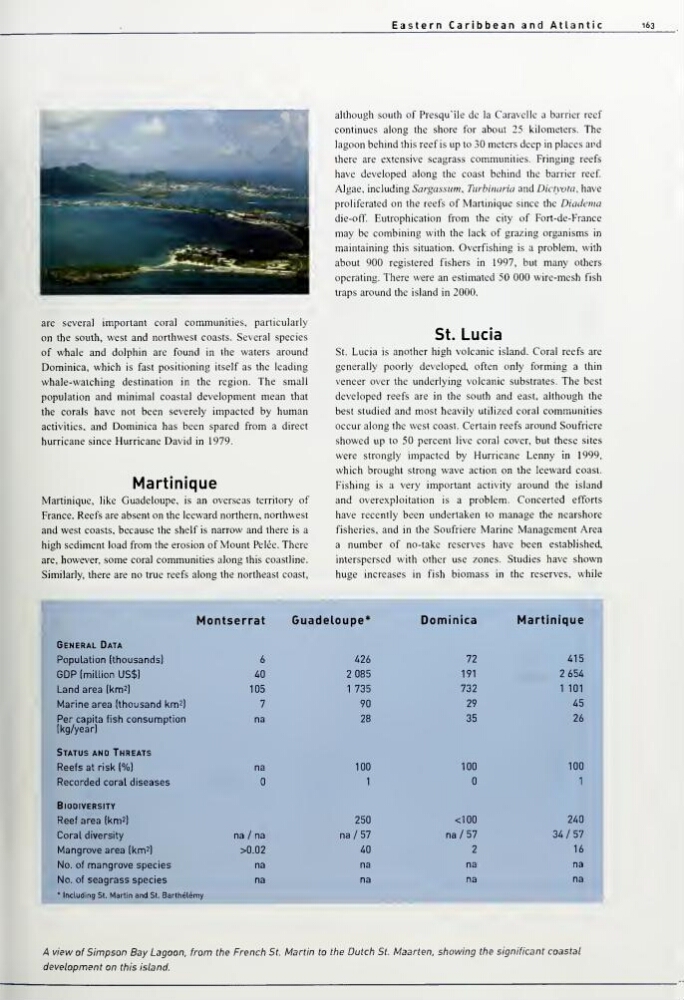
A view of Simpson Bay Lagoon, from f/ie French St. Martin to f/ie Dutcli St. Maarten, showing the significant coastal
development on this island.
163
although south of Presqu'ile de la Caravelle a barrier reef
continues along the shore for about 25 kilometers. The
lagoon behind this reef is up to 30 meters deep in places and
there are extensive seagrass communities. Fringing reefs
have developed along the coast behind the barrier reef
Algae, including Sargassum, Turbinaria and Dictyota. have
proliferated on the reefs of Martinique since the Diadema
die-off. Eutrophication from the city of Fort-de-France
may be combining with the lack of grazing organisms in
maintaining this situation. Overfishing is a problem, with
about 900 registered fishers in 1997, but many others
operating. There were an estimated 50 000 wire-mesh fish
traps around the island in 2000.
are several important coral communities, particularly
on the south, west and northwest coasts. Several species
of whale and dolphin are found in the waters around
Dominica, which is fast positioning itself as the leading
whale-watching destination in the region. The small
population and minimal coastal development mean that
the corals have not been severely impacted by human
activities, and Dominica has been spared from a direct
hurricane since Hurricane David in 1979.
Martinique
Martinique, like Guadeloupe, is an overseas territory of
France. Reefs are absent on the leeward northern, northwest
and west coasts, because the shelf is narrow and there is a
high sediment load from the erosion of Mount Pelee. There
are, however, some coral communities along this coastline.
Similarly, there are no true reefs along the northeast coast.
St. Lucia
St. Lucia is another high volcanic island. Coral reefs are
generally poorly developed, often only forming a thin
veneer over the underlying volcanic substrates. The best
developed reefs are in the south and east, although the
best studied and most heavily utilized coral communities
occur along the west coast. Certain reefs around Soufriere
showed up to 50 percent live coral cover, but these sites
were strongly impacted by Hurricane Lenny in 1999,
which brought strong wave action on the leeward coast.
Fishing is a very important activity around the island
and overexploitation is a problem. Concerted efforts
have recently been undertaken to manage the nearshore
fisheries, and in the Soufriere Marine Management Area
a number of no-take reserves have been established,
interspersed with other use zones. Studies have shown
huge increases in fish biomass in the reserves, while
IV
fll Montserrat Guadeloupe*
Dominica
Martinique
General Data
Population (thousands)
6
426
72
415^
GDP (million US$1
40
2 085
191
2 65^1
Land area (km^l
105
1 735
732
101^1
Marine area (thousand km^l
7
90
29
4^H
Per capita fish consumption
(kg/year)
na
28
35
2^
Status and Threats
fl
Reefs at risk (%)
na
100
100
locH
Recorded coral diseases
1
V
Biodiversity
J
Reef area (km?)
250
<100
240
^
1. Coral diversity
na / na
na/57
na/57
34/57fl
1 Mangrove area (km?)
>0.02
40
2
'm
f No. of mangrove species
na
na
na
naS
No. of seagrass species
na
na
na
na
^ * Including St. Martin and St. Barthel.emy
A view of Simpson Bay Lagoon, from f/ie French St. Martin to f/ie Dutcli St. Maarten, showing the significant coastal
development on this island.