

Eastern Caribbean and Atlantic
Antigua and Barbuda
Antigua and Barbuda, together with the tmy uninhabited
island of Redonda, are an independent Caribbean nation.
Coral reefs are relatively widespread in the coastal waters.
Antigua has some fringing reefs, but also more extensive,
though intermittent, bank barrier reef structures offshore.
Barbuda has extensive fringing reefs, particularly along its
eastern coastline, topped by a well developed algal ridge.
The reefs, particularly in nearshore areas, are reported to
have been degraded in recent years, possibly due to increasing sedimentation and nutrient enrichment associated
with coastal development. Offshore reefs and those to the
north of Barbuda generally have higher coral cover and
species richness. Hurricanes Luis and Marilyn caused
further damage when they struck the islands in 1995.
Netherlands Antilles
(Windward Group)
A number of islands in the region make up the dependency
of the Netherlands Antilles. These include two islands close
to Venezuela (Bonaire and Curasao) and the islands of
Saba. St. Eustatius and the southern half of St. Maarten (the
northern part of St. Maarten (St. Martin) is a part of the
French Antilles). Saba and St. Eustatius are both volcanoes,
with steep cliffs and little structural reef development, but
important coral communities. The St. Eustatius Marine
Park was established in 1998 to protect four areas,
including coral reefs and wrecks along the coast. Visitors to
the park are required to pay a small user fee which helps to
offset management costs. Visitor numbers are growing
rapidly, from 3 000 in 1997 to 8 300 in 1999.
Offshore from Saba, there are again extensive coral
communities in many areas. The precipitous coastline
limits coastal development and, although this is a very
popular diving destination, human impacts are minimal.
All benthic communities down to a depth of 60 meters in
Saba are protected in the Saba Marine Park. There were
some 5 000 visitors to the island in 1997. and the park
user fee (US$3 per dive in 1998) together with souvenir
sales and yacht fees generated the majority of the income
for management of the park.
General Data
Population Ithousands)
GDPImiUion US$1
Land area Ikm^l
Marine area (thousand km^l
Per capita fish consumption
Ikg/yearl
Status and Threats
Reefs at risk 1%)
Recorded coral diseases
Biodiversity
Reef area (km^l
Coral diversity
Mangrove area (km^l
No, of mangrove species
No. of seagrass species
WL * Including Bonaire and Curacao
Anguilla
Ant igua and
Neth erlands
St. Kitts
Barbuda
A ntilles*
and Nevis
12
66
210
39
64
450
1813
171
86
462
810
275
90
110
79
10
na
37
22
37
100
100
100
100
1
10
<50
240
420
180
na/57
na/57
40/57
na/57
5
13
11
>0.71
na
na
2
na
na
na
na
^
na
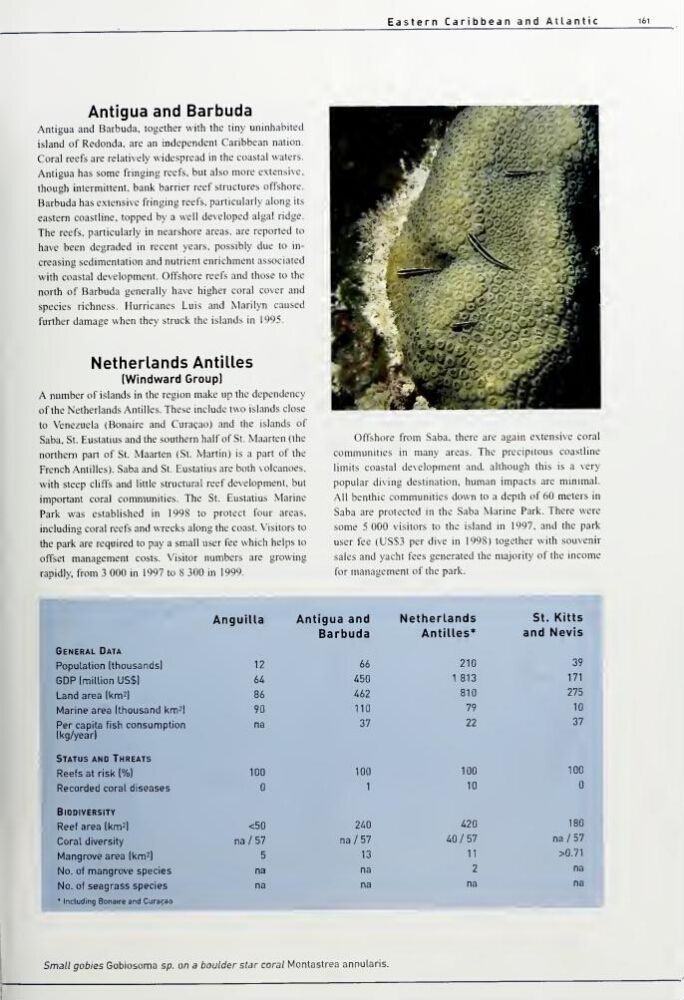
Small gobies Gobiosoma sp. on a boulder star coral Montastrea annularis.
Antigua and Barbuda
Antigua and Barbuda, together with the tmy uninhabited
island of Redonda, are an independent Caribbean nation.
Coral reefs are relatively widespread in the coastal waters.
Antigua has some fringing reefs, but also more extensive,
though intermittent, bank barrier reef structures offshore.
Barbuda has extensive fringing reefs, particularly along its
eastern coastline, topped by a well developed algal ridge.
The reefs, particularly in nearshore areas, are reported to
have been degraded in recent years, possibly due to increasing sedimentation and nutrient enrichment associated
with coastal development. Offshore reefs and those to the
north of Barbuda generally have higher coral cover and
species richness. Hurricanes Luis and Marilyn caused
further damage when they struck the islands in 1995.
Netherlands Antilles
(Windward Group)
A number of islands in the region make up the dependency
of the Netherlands Antilles. These include two islands close
to Venezuela (Bonaire and Curasao) and the islands of
Saba. St. Eustatius and the southern half of St. Maarten (the
northern part of St. Maarten (St. Martin) is a part of the
French Antilles). Saba and St. Eustatius are both volcanoes,
with steep cliffs and little structural reef development, but
important coral communities. The St. Eustatius Marine
Park was established in 1998 to protect four areas,
including coral reefs and wrecks along the coast. Visitors to
the park are required to pay a small user fee which helps to
offset management costs. Visitor numbers are growing
rapidly, from 3 000 in 1997 to 8 300 in 1999.
Offshore from Saba, there are again extensive coral
communities in many areas. The precipitous coastline
limits coastal development and, although this is a very
popular diving destination, human impacts are minimal.
All benthic communities down to a depth of 60 meters in
Saba are protected in the Saba Marine Park. There were
some 5 000 visitors to the island in 1997. and the park
user fee (US$3 per dive in 1998) together with souvenir
sales and yacht fees generated the majority of the income
for management of the park.
General Data
Population Ithousands)
GDPImiUion US$1
Land area Ikm^l
Marine area (thousand km^l
Per capita fish consumption
Ikg/yearl
Status and Threats
Reefs at risk 1%)
Recorded coral diseases
Biodiversity
Reef area (km^l
Coral diversity
Mangrove area (km^l
No, of mangrove species
No. of seagrass species
WL * Including Bonaire and Curacao
Anguilla
Ant igua and
Neth erlands
St. Kitts
Barbuda
A ntilles*
and Nevis
12
66
210
39
64
450
1813
171
86
462
810
275
90
110
79
10
na
37
22
37
100
100
100
100
1
10
<50
240
420
180
na/57
na/57
40/57
na/57
5
13
11
>0.71
na
na
2
na
na
na
na
^
na
Small gobies Gobiosoma sp. on a boulder star coral Montastrea annularis.