

Western Caribbean
121
Honduras, Nicaragua,
Guatemala and El Salvador
'y-'
MAPsd
'"' ...-»' il'^'s'-wi^sr:
H0nuUr3S
has a long mainland coast facing
the Caribbean Sea but dominated by heavy riveiine
inputs and extensive mangrove communities. There
are no recorded coastal coral reefs, although small, poorly
developed coral communities are recorded from Puerto
Cortes, La Ceiba and Trujillo. Important coral reefs occur
around the Bay Islands (Utila, Roatan, Guanaja) and also
the Cayos Cochinos which lie between Roatan and the
mainland. Fringing and patch reefs also occur to the east
associated with the Misquitia Cays and Banks, which are
a continuation of the reef systems on the Nicaraguan shelf
to the south. There are also reefs associated with the
remote Swan Islands (Islas del Cisne) some 150 kilometers northeast of the mainland. These are three raised
coralline islands which lie close to the edge of the Cayman
Trench. They are surrounded by fringing reefs, with the
most extensive reef development on their northern shores.
The Bay Islands lie relatively close to the shore, but
are also near to the deep water of the Cayman Trench, and
are surrounded by well developed fringing reefs. The
typical seaward profile of Roatan s reefs is a gradation
from terrestrial muds to coarse calcareous sand and
seagrass beds (mainly Thalassia tesludimim). Sparse
corals and algae such as Turbinaria and Sargassum occur
on a limestone pavement about 100-200 meters from
shore, eventually merging into a spur and groove zone.
Agaricia tenuifoUa is the principal reef-building species
in these shallow waters, though in higher energy areas
Acropora palmata is more common. On the fore reef, at
10-15 meters, Monlaslrea annularis. ColpophylUa natans
and Diploria spp. are very abundant, with live coral cover
averaging 28 percent on the deep fore reef, but ranging
between 24 and 53 percent in the Sandy Bay/West End
Marine Reserve. The shelf edge is nearly vertical in many
places and also has high coral cover, with species of
Agaricia and colonies of Eusirinlia fastigiata growing
to an unusually large size. In total, 44 species of
coral have been recorded here, but a complete inventory
of marine biodiversity is planned as part of a five-year
natural resources management project for the Bay Islands.
Relatively healthy until 1998, the Bay Islands reefs
experienced extensive bleaching during the El Nino event
and were damaged during Hurricane Mitch. The most
pressing threats to reefs in Honduras are a projected
increase in diving-related tourism and associated migration from the mainland.
The Cayos Cochinos consist of two larger and 12 very
small volcanic islands. The northern coasts of the larger
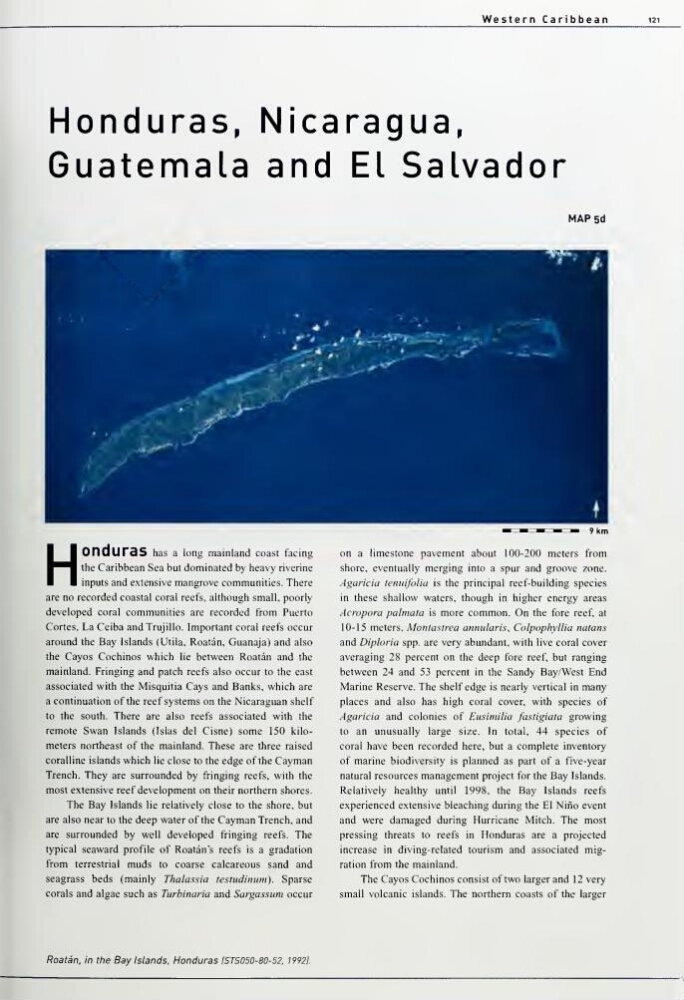
Roatan, in the Bay Islands, Honduras ISTS050-80-52, 19921.
121
Honduras, Nicaragua,
Guatemala and El Salvador
'y-'
MAPsd
'"' ...-»' il'^'s'-wi^sr:
H0nuUr3S
has a long mainland coast facing
the Caribbean Sea but dominated by heavy riveiine
inputs and extensive mangrove communities. There
are no recorded coastal coral reefs, although small, poorly
developed coral communities are recorded from Puerto
Cortes, La Ceiba and Trujillo. Important coral reefs occur
around the Bay Islands (Utila, Roatan, Guanaja) and also
the Cayos Cochinos which lie between Roatan and the
mainland. Fringing and patch reefs also occur to the east
associated with the Misquitia Cays and Banks, which are
a continuation of the reef systems on the Nicaraguan shelf
to the south. There are also reefs associated with the
remote Swan Islands (Islas del Cisne) some 150 kilometers northeast of the mainland. These are three raised
coralline islands which lie close to the edge of the Cayman
Trench. They are surrounded by fringing reefs, with the
most extensive reef development on their northern shores.
The Bay Islands lie relatively close to the shore, but
are also near to the deep water of the Cayman Trench, and
are surrounded by well developed fringing reefs. The
typical seaward profile of Roatan s reefs is a gradation
from terrestrial muds to coarse calcareous sand and
seagrass beds (mainly Thalassia tesludimim). Sparse
corals and algae such as Turbinaria and Sargassum occur
on a limestone pavement about 100-200 meters from
shore, eventually merging into a spur and groove zone.
Agaricia tenuifoUa is the principal reef-building species
in these shallow waters, though in higher energy areas
Acropora palmata is more common. On the fore reef, at
10-15 meters, Monlaslrea annularis. ColpophylUa natans
and Diploria spp. are very abundant, with live coral cover
averaging 28 percent on the deep fore reef, but ranging
between 24 and 53 percent in the Sandy Bay/West End
Marine Reserve. The shelf edge is nearly vertical in many
places and also has high coral cover, with species of
Agaricia and colonies of Eusirinlia fastigiata growing
to an unusually large size. In total, 44 species of
coral have been recorded here, but a complete inventory
of marine biodiversity is planned as part of a five-year
natural resources management project for the Bay Islands.
Relatively healthy until 1998, the Bay Islands reefs
experienced extensive bleaching during the El Nino event
and were damaged during Hurricane Mitch. The most
pressing threats to reefs in Honduras are a projected
increase in diving-related tourism and associated migration from the mainland.
The Cayos Cochinos consist of two larger and 12 very
small volcanic islands. The northern coasts of the larger
Roatan, in the Bay Islands, Honduras ISTS050-80-52, 19921.