

WORLD ATLAS OF CORAL REEFS
Protected areas with coral reefs
1
Site name
Designation
Abbreviat ion
lUCN cat.
Size (km'i
Year 1
Belize
Bacalar Chico
[vlarine Reserve
MR
IV
107.00
1996
Blue Hole
Natural Monument
NM
III
41.00
1986
Gladden Spit
Marine Reserve
MR
IV
na
2000
Glovers Reef
Marine Reserve
MR
IV
308.00
1993
Half Moon Caye
National Monument
NaM
III
39.25
1982
HolCfian
Marine Reserve
MR
IV
4.11
1987
Man-o-war Cay
Bird Sanctuary
BS
IV
0.01
1977
Port Honduras
Marine Reserve
MR
IV
na
2000
Sapodilla Cayes
Marine Reserve
MR
IV
127.00
1996
Soutfi Water Cay
Marine Reserve
MR
IV
298.00
1996
Belize Barrier Reef
Reserve system
World Heritage Site
963.00
1996
BL
^^B iif'ia —
BHHB
finfish, especially higher quality species such as groupers
(Serranidae) and snappers (Lutjanidae), are caught for
local consumption. Shrimp mariculture is now an important industry in Belize. There are considerable concerns
about the impacts this industry may already be having on
coastal fisheries and further expansion is likely to impact
mangrove areas. A number of major fish spawning aggregations are known in Belize, and many are considered to
be overfished. One of the largest of these. Gladden Spit,
has recently been declared a protected area.
The Belize economy is heavily dependent on
agriculture. Sugar, the chief crop, accounts for nearly half
of Belize's exports, while the banana industry is the
country's largest employer. Increased sedimentation from
forest or savannah clearances and eutrophication from
fertilizers are suspected, although few effects on the
marine environment can be directly attributed to agricultural landuse practices. Adjacent to the banana and
citrus growing regions of Belize, shallow marine habitats
such as patch reefs and seagrass beds are located much
further offshore than elsewhere, and there is a higher
growth of algae under certain conditions. This is an area
of intense ongoing research. Belize's trade deficit grew
throughout the 1990s, mostly as a result of low export
prices for sugar and bananas, and so tourism has been
assuming an increasingly important role. This may also
bring a greater range of threats to the reef systems,
although there have been particular efforts to develop Belize
as an environmentally sustainable "ecotourism" destination.
Considerable efforts have also been directed towards
the development of a system of marine protected areas.
The Hoi Chan Marine Reserve in the north of the country
is widely cited as an example of an effective no-take zone,
implemented with the support and collaboration of the
local population. This site has significantly higher fish
numbers and biomass than surrounding areas, but. more
importantly, its protection has demonstrably increased fish
yields from the surrounding areas. For many of the other
marine protected areas the legislation and infrastructure
are largely in place for full and effective reef management,
although further enforcement is still required.
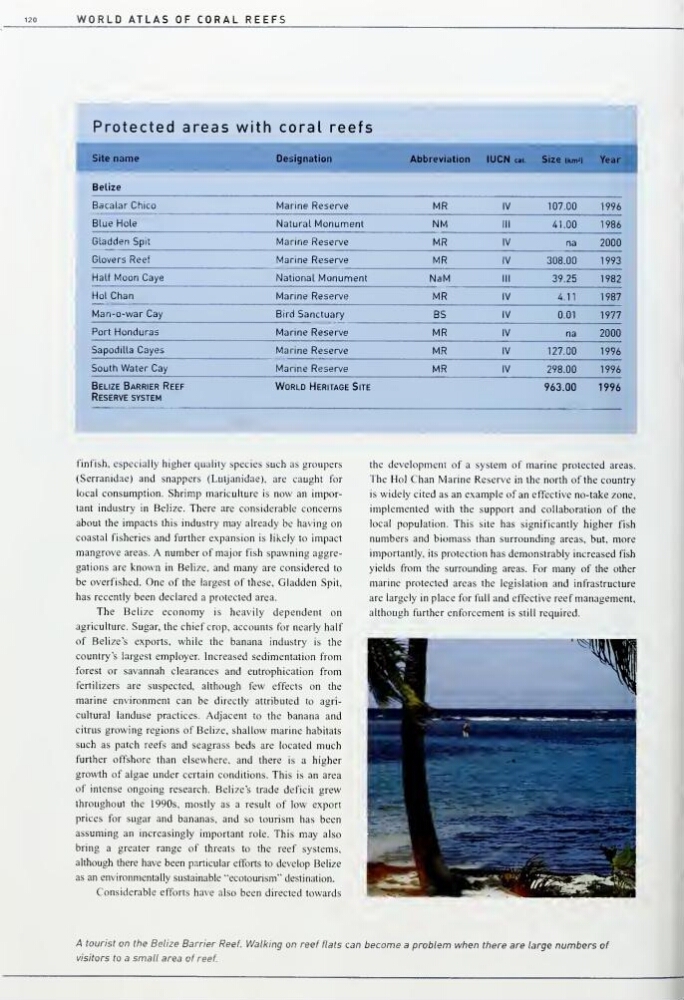
A tourist on the Belize Barrier Reef. Waliang on reef flats can become a problem when there are large numbers of
visitors to a smalt area of reef.
Protected areas with coral reefs
1
Site name
Designation
Abbreviat ion
lUCN cat.
Size (km'i
Year 1
Belize
Bacalar Chico
[vlarine Reserve
MR
IV
107.00
1996
Blue Hole
Natural Monument
NM
III
41.00
1986
Gladden Spit
Marine Reserve
MR
IV
na
2000
Glovers Reef
Marine Reserve
MR
IV
308.00
1993
Half Moon Caye
National Monument
NaM
III
39.25
1982
HolCfian
Marine Reserve
MR
IV
4.11
1987
Man-o-war Cay
Bird Sanctuary
BS
IV
0.01
1977
Port Honduras
Marine Reserve
MR
IV
na
2000
Sapodilla Cayes
Marine Reserve
MR
IV
127.00
1996
Soutfi Water Cay
Marine Reserve
MR
IV
298.00
1996
Belize Barrier Reef
Reserve system
World Heritage Site
963.00
1996
BL
^^B iif'ia —
BHHB
finfish, especially higher quality species such as groupers
(Serranidae) and snappers (Lutjanidae), are caught for
local consumption. Shrimp mariculture is now an important industry in Belize. There are considerable concerns
about the impacts this industry may already be having on
coastal fisheries and further expansion is likely to impact
mangrove areas. A number of major fish spawning aggregations are known in Belize, and many are considered to
be overfished. One of the largest of these. Gladden Spit,
has recently been declared a protected area.
The Belize economy is heavily dependent on
agriculture. Sugar, the chief crop, accounts for nearly half
of Belize's exports, while the banana industry is the
country's largest employer. Increased sedimentation from
forest or savannah clearances and eutrophication from
fertilizers are suspected, although few effects on the
marine environment can be directly attributed to agricultural landuse practices. Adjacent to the banana and
citrus growing regions of Belize, shallow marine habitats
such as patch reefs and seagrass beds are located much
further offshore than elsewhere, and there is a higher
growth of algae under certain conditions. This is an area
of intense ongoing research. Belize's trade deficit grew
throughout the 1990s, mostly as a result of low export
prices for sugar and bananas, and so tourism has been
assuming an increasingly important role. This may also
bring a greater range of threats to the reef systems,
although there have been particular efforts to develop Belize
as an environmentally sustainable "ecotourism" destination.
Considerable efforts have also been directed towards
the development of a system of marine protected areas.
The Hoi Chan Marine Reserve in the north of the country
is widely cited as an example of an effective no-take zone,
implemented with the support and collaboration of the
local population. This site has significantly higher fish
numbers and biomass than surrounding areas, but. more
importantly, its protection has demonstrably increased fish
yields from the surrounding areas. For many of the other
marine protected areas the legislation and infrastructure
are largely in place for full and effective reef management,
although further enforcement is still required.
A tourist on the Belize Barrier Reef. Waliang on reef flats can become a problem when there are large numbers of
visitors to a smalt area of reef.