

WORLD ATLAS OF CORAL REEFS
''
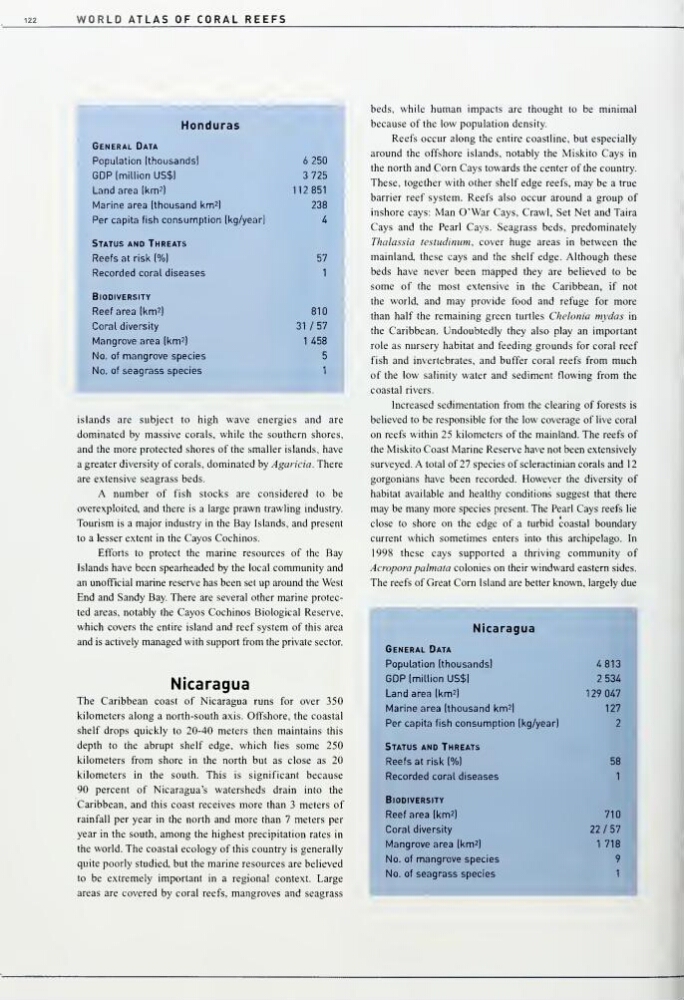
Honduras
~^K
General Data
Population (thousands)
6 250
GDP (million US$1
3 725
Land area (km^l
112851
Marine area (thousand km^l
238
Per capita fish consumption (kg/year)
i
Status and Threats
Reefs at risk (%l
57
Recorded coral diseases
1
Biodiversity
Reef area (km^l
810
Coral diversity
31 /57
Mangrove area (km^l
1 ^58
No. of mangrove species
5
,
No. of seagrass species
r
^M
islands are subject to high wave energies and are
dominated by massive corals, while the southern shores,
and the more protected shores of the smaller islands, have
a greater diversity of corals, dominated by Agaricia. There
are extensive seagrass beds.
A number of fish stocks are considered to be
overexploited, and there is a large prawn trawling industry.
Tourism is a major industry in the Bay Islands, and present
to a lesser extent in the Cayos Cochinos.
Efforts to protect the marine resources of the Bay
Islands have been spearheaded by the local community and
an unofficial marine reserve has been set up around the West
End and Sandy Bay. There are several other marine protected areas, notably the Cayos Cochinos Biological Reserve,
which covers the entire island and reef system of this area
and is actively managed with support from the private sector.
Nicaragua
The Caribbean coast of Nicaragua runs for over 350
kilometers along a north-south axis. Offshore, the coastal
shelf drops quickly to 20-40 meters then maintains this
depth to the abrupt shelf edge, which lies some 250
kilometers from shore in the north but as close as 20
kilometers in the south. This is significant because
90 percent of Nicaragua's watersheds drain into the
Caribbean, and this coast receives more than 3 meters of
rainfall per year in the north and more than 7 meters per
year in the south, among the highest precipitation rates in
the world. The coastal ecology of this country is generally
quite poorly studied, but the marine resources are believed
to be extremely important in a regional context. Large
areas are covered by coral reefs, mangroves and seagrass
beds, while human impacts are thought to be minimal
because of the low population density.
Reefs occur along the entire coastline, but especially
around the offshore islands, notably the Miskito Cays in
the north and Corn Cays towards the center of the country.
These, together with other shelf edge reefs, may be a true
barrier reef system. Reefs also occur around a group of
inshore cays: Man O'War Cays, Crawl, Set Net and Taira
Cays and the Pearl Cays. Seagrass beds, predominately
Thalassia testudinum. cover huge areas in between the
mainland, these cays and the shelf edge. Although these
beds have never been mapped they are believed to be
some of the most extensive in the Caribbean, if not
the world, and may provide food and refuge for more
than half the remaining green turtles Chetonia mydas in
the Caribbean. Undoubtedly they also play an important
role as nursery habitat and feeding grounds for coral reef
fish and invertebrates, and buffer coral reefs from much
of the low salinity water and sediment flowing from the
coastal rivers.
Increased sedimentation from the clearing of forests is
believed to be responsible for the low coverage of live coral
on reefs within 25 kilometers of the mainland. The reefs of
the Miskito Coast Marine Reserve have not been extensively
surveyed. A total of 27 species of scleractinian corals and 12
gorgonians have been recorded. However the diversity of
habitat available and healthy conditions suggest that there
may be many more species present. The Pearl Cays reefs lie
close to shore on the edge of a turbid coastal boundary
current which sometimes enters into this archipelago. In
1998 these cays supported a thriving community of
Acropora palmata colonies on their windward eastern sides.
The reefs of Great Com Island are better known, largely due
Nicaragua
General Data
^n
Population (thousands)
A813
GDP (million US$)
2 534
Land area (km^)
129 047
Marine area (thousand km^)
127
Per capita fish consumption (kg/year)
2
Status and Threats
Reefs at risk (%)
58
Recorded coral diseases
1
Biodiversity
Reef area (km^)
710
Coral diversity
22/57
Mangrove area (km^)
1 718
No. of mangrove species
9
No. of seagrass species
1
J.
''
Honduras
~^K
General Data
Population (thousands)
6 250
GDP (million US$1
3 725
Land area (km^l
112851
Marine area (thousand km^l
238
Per capita fish consumption (kg/year)
i
Status and Threats
Reefs at risk (%l
57
Recorded coral diseases
1
Biodiversity
Reef area (km^l
810
Coral diversity
31 /57
Mangrove area (km^l
1 ^58
No. of mangrove species
5
,
No. of seagrass species
r
^M
islands are subject to high wave energies and are
dominated by massive corals, while the southern shores,
and the more protected shores of the smaller islands, have
a greater diversity of corals, dominated by Agaricia. There
are extensive seagrass beds.
A number of fish stocks are considered to be
overexploited, and there is a large prawn trawling industry.
Tourism is a major industry in the Bay Islands, and present
to a lesser extent in the Cayos Cochinos.
Efforts to protect the marine resources of the Bay
Islands have been spearheaded by the local community and
an unofficial marine reserve has been set up around the West
End and Sandy Bay. There are several other marine protected areas, notably the Cayos Cochinos Biological Reserve,
which covers the entire island and reef system of this area
and is actively managed with support from the private sector.
Nicaragua
The Caribbean coast of Nicaragua runs for over 350
kilometers along a north-south axis. Offshore, the coastal
shelf drops quickly to 20-40 meters then maintains this
depth to the abrupt shelf edge, which lies some 250
kilometers from shore in the north but as close as 20
kilometers in the south. This is significant because
90 percent of Nicaragua's watersheds drain into the
Caribbean, and this coast receives more than 3 meters of
rainfall per year in the north and more than 7 meters per
year in the south, among the highest precipitation rates in
the world. The coastal ecology of this country is generally
quite poorly studied, but the marine resources are believed
to be extremely important in a regional context. Large
areas are covered by coral reefs, mangroves and seagrass
beds, while human impacts are thought to be minimal
because of the low population density.
Reefs occur along the entire coastline, but especially
around the offshore islands, notably the Miskito Cays in
the north and Corn Cays towards the center of the country.
These, together with other shelf edge reefs, may be a true
barrier reef system. Reefs also occur around a group of
inshore cays: Man O'War Cays, Crawl, Set Net and Taira
Cays and the Pearl Cays. Seagrass beds, predominately
Thalassia testudinum. cover huge areas in between the
mainland, these cays and the shelf edge. Although these
beds have never been mapped they are believed to be
some of the most extensive in the Caribbean, if not
the world, and may provide food and refuge for more
than half the remaining green turtles Chetonia mydas in
the Caribbean. Undoubtedly they also play an important
role as nursery habitat and feeding grounds for coral reef
fish and invertebrates, and buffer coral reefs from much
of the low salinity water and sediment flowing from the
coastal rivers.
Increased sedimentation from the clearing of forests is
believed to be responsible for the low coverage of live coral
on reefs within 25 kilometers of the mainland. The reefs of
the Miskito Coast Marine Reserve have not been extensively
surveyed. A total of 27 species of scleractinian corals and 12
gorgonians have been recorded. However the diversity of
habitat available and healthy conditions suggest that there
may be many more species present. The Pearl Cays reefs lie
close to shore on the edge of a turbid coastal boundary
current which sometimes enters into this archipelago. In
1998 these cays supported a thriving community of
Acropora palmata colonies on their windward eastern sides.
The reefs of Great Com Island are better known, largely due
Nicaragua
General Data
^n
Population (thousands)
A813
GDP (million US$)
2 534
Land area (km^)
129 047
Marine area (thousand km^)
127
Per capita fish consumption (kg/year)
2
Status and Threats
Reefs at risk (%)
58
Recorded coral diseases
1
Biodiversity
Reef area (km^)
710
Coral diversity
22/57
Mangrove area (km^)
1 718
No. of mangrove species
9
No. of seagrass species
1
J.