

98
WORLD ATLAS OF CORAL REEFS
Keys National Marine Sanctuary. Another major problem
is the eutrophication and pollution of nearshore waters
associated with the extensive agricultural areas that drain
into the bay, and from sewage. There are some 200 sewage
treatment plants. 22 000 septic tanks, 5 000 cesspools and
139 marinas harboring over 15 000 boats in the Florida
Keys. Fishing pressure is considerable throughout the area,
and many fish stocks are considered overfished.
Although some declines in ecological conditions and
coral growth have been linked back to the construction of
the causeway, far more rapid declines have been observed
since the 1980s. In 1 98 l,.4c/'o/;ora corals covered up to 96
percent of the reef substrate in places, but by 1986 this
cover had fallen to about 3 percent, linked to the impacts
of white band disease. Even since 1996, there have been
declines in both remaining hard coral cover and diversity
at a majority of permanent monitoring sites. More than ten
coral diseases have been observed. Coral bleaching events
have occurred with increasing frequency since the 1980s,
typically when warm weather is further exacerbated by very
calm doldrum-like conditions. The most recent bleaching
was associated with similar calm conditions in 1997, which
continued to a second major warm period with intense
bleaching in 1998, followed by the impacts of Hurricane
Georges and Tropical Storm Mitch. In combination, these
led to considerable losses of coral in shallow areas.
Reefs in Florida are possibly the most intensely
monitored in the world, with 16 programs active in 2000.
All coral reefs in Florida are protected either at the
federal or state level. The Florida Keys National Marine
Sanctuary, designated in 1990. extends over nearly 10 000
square kilometers of critical marine habitat, including coral
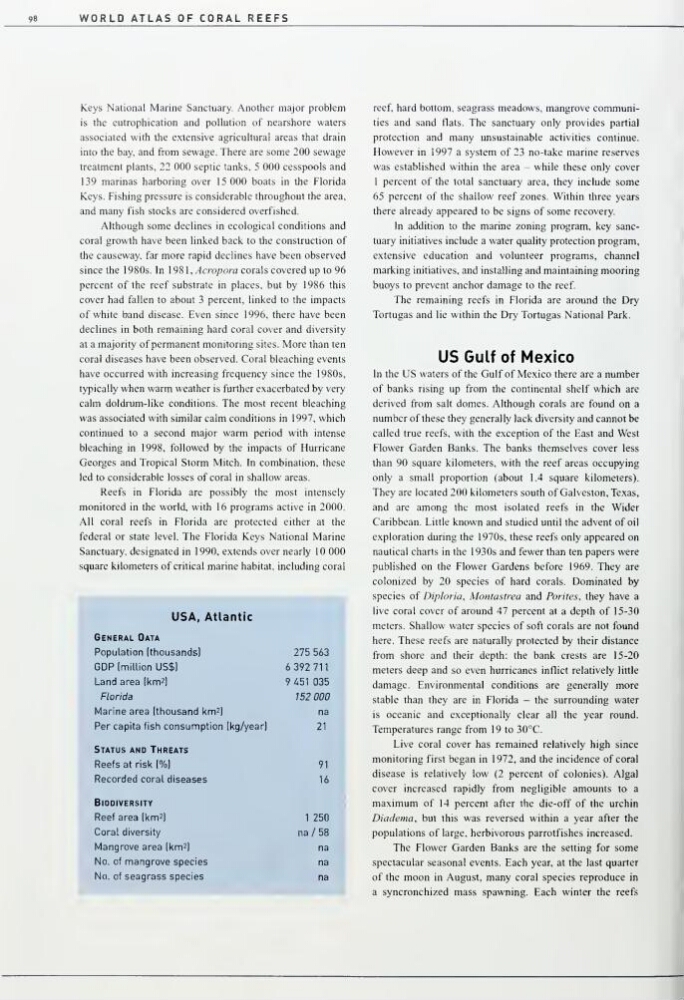
USA, Atlantic
General Data
Population (thousands!
275 563
GDP (million US$)
6 392 711
Land area (km^j
9/151 035
Florida
152 000
Marine area (thousand km^j
na
Per capita fish consumption (kg/year)
21
Status and Threats
Reefs at risk (%1
91
Recorded coral diseases
16
Biodiversity
Reef area (km^l
1 250
Coral diversity
na/58
Mangrove area (km^l
na
No. of mangrove species
na
No. of seagrass species
na
reef, hard bottom, seagrass meadows, mangrove communities and sand flats. The sanctuary only provides partial
protection and many unsustainable activities continue.
However in 1997 a system of 23 no-take marine reserves
was established within the area - while these only cover
1
percent of the total sanctuary area, they include some
65 percent of the shallow reef zones. Within three years
there already appeared to be signs of some recovery.
In addition to the marine zoning program, key sanctuary initiatives include a water quality protection program,
extensive education and volunteer programs, channel
marking initiatives, and installing and maintaining mooring
buoys to prevent anchor damage to the reef
The remaining reefs in Florida are around the Dry
Tortugas and lie within the Dry Tortugas National Park.
US Gulf of Mexico
In the US waters of the Gulf of Mexico there are a nurnber
of banks rising up from the continental shelf which are
derived from salt domes. Although corals are found on a
number of these they generally lack diversity and cannot be
called true reefs, with the exception of the East and West
Flower Garden Banks. The banks themselves cover less
than 90 square kilometers, with the reef areas occupying
only a small proportion (about 1.4 square kilometers).
They are located 200 kilometers south of Galveston, Texas,
and are among the most isolated reefs in the Wider
Caribbean. Little known and studied until the advent of oil
exploration during the 1970s, these reefs only appeared on
nautical charts in the 1930s and fewer than ten papers were
published on the Flower Gardens before 1969. They are
colonized by 20 species of hard corals. Dominated by
species of Diptoria, Montastrea and Poriles, they have a
live coral cover of around 47 percent at a depth of 15-30
meters. Shallow water species of soft corals are not found
here. These reefs are naturally protected by their distance
from shore and their depth: the bank crests are 15-20
meters deep and so even hurricanes inflict relatively little
damage. Environmental conditions are generally more
stable than they are in Florida - the surrounding water
is oceanic and exceptionally clear all the year round.
Temperatures range from 19 to 30°C.
Live coral cover has remained relatively high since
monitoring first began in 1972, and the incidence of coral
disease is relatively low (2 percent of colonies). Algal
cover increased rapidly from negligible amounts to a
maximum of 14 percent after the die-off of the urchin
Diadema, but this was reversed within a year after the
populations of large, herbivorous parrotfishes increased.
The Flower Garden Banks are the setting for some
spectacular seasonal events. Each year, at the last quarter
of the moon in August, many coral species reproduce in
a syncronchized mass spawning. Each winter the reefs
WORLD ATLAS OF CORAL REEFS
Keys National Marine Sanctuary. Another major problem
is the eutrophication and pollution of nearshore waters
associated with the extensive agricultural areas that drain
into the bay, and from sewage. There are some 200 sewage
treatment plants. 22 000 septic tanks, 5 000 cesspools and
139 marinas harboring over 15 000 boats in the Florida
Keys. Fishing pressure is considerable throughout the area,
and many fish stocks are considered overfished.
Although some declines in ecological conditions and
coral growth have been linked back to the construction of
the causeway, far more rapid declines have been observed
since the 1980s. In 1 98 l,.4c/'o/;ora corals covered up to 96
percent of the reef substrate in places, but by 1986 this
cover had fallen to about 3 percent, linked to the impacts
of white band disease. Even since 1996, there have been
declines in both remaining hard coral cover and diversity
at a majority of permanent monitoring sites. More than ten
coral diseases have been observed. Coral bleaching events
have occurred with increasing frequency since the 1980s,
typically when warm weather is further exacerbated by very
calm doldrum-like conditions. The most recent bleaching
was associated with similar calm conditions in 1997, which
continued to a second major warm period with intense
bleaching in 1998, followed by the impacts of Hurricane
Georges and Tropical Storm Mitch. In combination, these
led to considerable losses of coral in shallow areas.
Reefs in Florida are possibly the most intensely
monitored in the world, with 16 programs active in 2000.
All coral reefs in Florida are protected either at the
federal or state level. The Florida Keys National Marine
Sanctuary, designated in 1990. extends over nearly 10 000
square kilometers of critical marine habitat, including coral
USA, Atlantic
General Data
Population (thousands!
275 563
GDP (million US$)
6 392 711
Land area (km^j
9/151 035
Florida
152 000
Marine area (thousand km^j
na
Per capita fish consumption (kg/year)
21
Status and Threats
Reefs at risk (%1
91
Recorded coral diseases
16
Biodiversity
Reef area (km^l
1 250
Coral diversity
na/58
Mangrove area (km^l
na
No. of mangrove species
na
No. of seagrass species
na
reef, hard bottom, seagrass meadows, mangrove communities and sand flats. The sanctuary only provides partial
protection and many unsustainable activities continue.
However in 1997 a system of 23 no-take marine reserves
was established within the area - while these only cover
1
percent of the total sanctuary area, they include some
65 percent of the shallow reef zones. Within three years
there already appeared to be signs of some recovery.
In addition to the marine zoning program, key sanctuary initiatives include a water quality protection program,
extensive education and volunteer programs, channel
marking initiatives, and installing and maintaining mooring
buoys to prevent anchor damage to the reef
The remaining reefs in Florida are around the Dry
Tortugas and lie within the Dry Tortugas National Park.
US Gulf of Mexico
In the US waters of the Gulf of Mexico there are a nurnber
of banks rising up from the continental shelf which are
derived from salt domes. Although corals are found on a
number of these they generally lack diversity and cannot be
called true reefs, with the exception of the East and West
Flower Garden Banks. The banks themselves cover less
than 90 square kilometers, with the reef areas occupying
only a small proportion (about 1.4 square kilometers).
They are located 200 kilometers south of Galveston, Texas,
and are among the most isolated reefs in the Wider
Caribbean. Little known and studied until the advent of oil
exploration during the 1970s, these reefs only appeared on
nautical charts in the 1930s and fewer than ten papers were
published on the Flower Gardens before 1969. They are
colonized by 20 species of hard corals. Dominated by
species of Diptoria, Montastrea and Poriles, they have a
live coral cover of around 47 percent at a depth of 15-30
meters. Shallow water species of soft corals are not found
here. These reefs are naturally protected by their distance
from shore and their depth: the bank crests are 15-20
meters deep and so even hurricanes inflict relatively little
damage. Environmental conditions are generally more
stable than they are in Florida - the surrounding water
is oceanic and exceptionally clear all the year round.
Temperatures range from 19 to 30°C.
Live coral cover has remained relatively high since
monitoring first began in 1972, and the incidence of coral
disease is relatively low (2 percent of colonies). Algal
cover increased rapidly from negligible amounts to a
maximum of 14 percent after the die-off of the urchin
Diadema, but this was reversed within a year after the
populations of large, herbivorous parrotfishes increased.
The Flower Garden Banks are the setting for some
spectacular seasonal events. Each year, at the last quarter
of the moon in August, many coral species reproduce in
a syncronchized mass spawning. Each winter the reefs