

Northern Caribbean
97
Florida and
the US Gulf of Mexico
MAPAa
^^^^^H
.v^HM W^M
^BIP^
Wm
^p
^^ y^'^'WF Pl^!^ Hi^^
^^
^hI
^K
v1 <.U .->-4^LgPlw^
|jBI|
^K.
^H
^^^^^^^^^Hk*
^^^9
1
The
coral reefs of mainland USA are largely
restricted to two areas: the coastline of southern
Florida and a few small but important reef patches
in the Gulf of Mexico.
Florida
The Florida Reef Tract is one of the most extensive reef
systems in the region. Starting directly offshore from
Miami Beach there is a near continuous offshore reef
structure which stretches in a barrier-like formation for
some 260 kilometers. Further west the shallow platform
continues, and there are isolated reef patches, including
the Dry Tortugas and a number of submerged structures.
The reef front has some well developed spur and groove
structures, with coral mounds rising from the bottom
below this. Overall coral cover in the region was typically
14 percent in the late 1990s, reaching 30-40 percent on
some patch reefs behind the reef crest. A slightly deeper
channel lies behind the reef (Hawks Channel). Behind
this there is a chain of islands, the Florida Keys. These are
low-lying (less than 2 meters elevation), and are composed
of Pleistocene limestone, stretching from Soldier Key near
Miami to Key West. Behind the Florida Reef Tract and
into the area of Florida Bay the waters are generally very
shallow and harbor some of the most extensive seagrass
areas in the entire region. Mangroves dominate the
shoreline, both of the Florida Everglades and around many
areas of Biscayne Bay and the Florida Keys. North of
Miami there is some reef development as far as Vero Beach.
Generally these are not major reef structures and coral
cover is low, although on deeper reefs down to 22 meters
staghorn corals are reported to be increasing.
Human impacts on the reefs of Florida have been
apparent for many years. The Florida Keys were first
joined to the mainland by a railway in 1912 and then by
road in 1938. They have now developed into one of the
most popular tourist destinations of continental USA. Over
4 million people visit the Keys annually, joining some
100 000 permanent residents. The majority are attracted to
the area by the marine environment, and sailing, diving and
fishing are critical to the local economy.
The reefs of Florida, afflicted by an enormous range
of impacts, include some of the most degraded in the region.
Initial changes were noted following the construction of
the railway causeway out to the Keys in the early 1900s.
Patterns of water flow from Florida Bay became severely
disrupted, and although channels have subsequently been
re-opened, other impacts have continued and now include
ship groundings, anchor damage and the scouring of seagrass by propellers. Between 1980 and 1993 approximately
500 vessels were reported to have grounded in the Looe
Key and Key Largo Sanctuaries alone, while some 500
ship groundings are now reported annually in the Florida
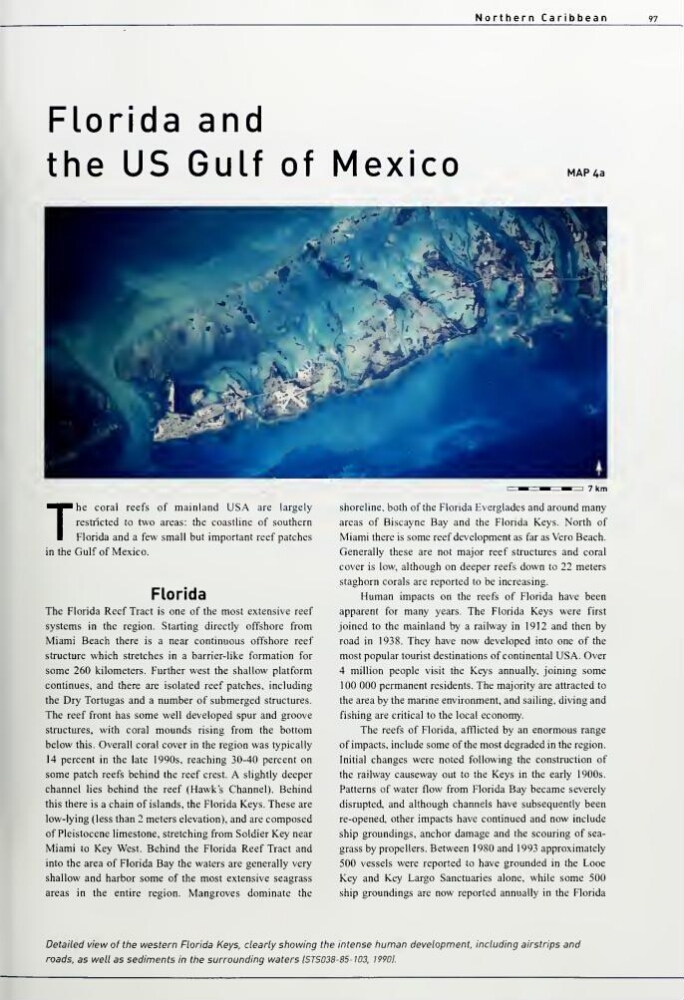
Detailed view of the western Florida Keys, clearly showing the intense human development, including airstrips and
roads, as well as sediments in the surrounding waters ISTS038-85-103, 19901
97
Florida and
the US Gulf of Mexico
MAPAa
^^^^^H
.v^HM W^M
^BIP^
Wm
^p
^^ y^'^'WF Pl^!^ Hi^^
^^
^hI
^K
v1 <.U .->-4^LgPlw^
|jBI|
^K.
^H
^^^^^^^^^Hk*
^^^9
1
The
coral reefs of mainland USA are largely
restricted to two areas: the coastline of southern
Florida and a few small but important reef patches
in the Gulf of Mexico.
Florida
The Florida Reef Tract is one of the most extensive reef
systems in the region. Starting directly offshore from
Miami Beach there is a near continuous offshore reef
structure which stretches in a barrier-like formation for
some 260 kilometers. Further west the shallow platform
continues, and there are isolated reef patches, including
the Dry Tortugas and a number of submerged structures.
The reef front has some well developed spur and groove
structures, with coral mounds rising from the bottom
below this. Overall coral cover in the region was typically
14 percent in the late 1990s, reaching 30-40 percent on
some patch reefs behind the reef crest. A slightly deeper
channel lies behind the reef (Hawks Channel). Behind
this there is a chain of islands, the Florida Keys. These are
low-lying (less than 2 meters elevation), and are composed
of Pleistocene limestone, stretching from Soldier Key near
Miami to Key West. Behind the Florida Reef Tract and
into the area of Florida Bay the waters are generally very
shallow and harbor some of the most extensive seagrass
areas in the entire region. Mangroves dominate the
shoreline, both of the Florida Everglades and around many
areas of Biscayne Bay and the Florida Keys. North of
Miami there is some reef development as far as Vero Beach.
Generally these are not major reef structures and coral
cover is low, although on deeper reefs down to 22 meters
staghorn corals are reported to be increasing.
Human impacts on the reefs of Florida have been
apparent for many years. The Florida Keys were first
joined to the mainland by a railway in 1912 and then by
road in 1938. They have now developed into one of the
most popular tourist destinations of continental USA. Over
4 million people visit the Keys annually, joining some
100 000 permanent residents. The majority are attracted to
the area by the marine environment, and sailing, diving and
fishing are critical to the local economy.
The reefs of Florida, afflicted by an enormous range
of impacts, include some of the most degraded in the region.
Initial changes were noted following the construction of
the railway causeway out to the Keys in the early 1900s.
Patterns of water flow from Florida Bay became severely
disrupted, and although channels have subsequently been
re-opened, other impacts have continued and now include
ship groundings, anchor damage and the scouring of seagrass by propellers. Between 1980 and 1993 approximately
500 vessels were reported to have grounded in the Looe
Key and Key Largo Sanctuaries alone, while some 500
ship groundings are now reported annually in the Florida
Detailed view of the western Florida Keys, clearly showing the intense human development, including airstrips and
roads, as well as sediments in the surrounding waters ISTS038-85-103, 19901