

Northern Caribbean
Protected areas with coral reefs
P
Site name
Designation
Abbreviation
lUCN cat.
Size (km2|
Year
J
Florida and US Gulf of Mexico
Biscayne Bay
National Park
NP
II
729.00
1980
Dry Tortugas
National Park
NP
II
262.03
1992
Everglades
National Park
NP
II
6 066.88
1947
Florida Keys
National Marine Sanctuary
NaMS
IV
9 603.73
1990
John Pennekamp Coral Reef
State Parit
SP
V
226.84
1959
John U Lloyd
State Recreation Area
SRA
V
1.Q2
1973
Key Largo
National Marine Sanctuary
NaMS
V
323.88
1975
Key West
National Wildlife Refuge
NWR
IV
979.43
1908
Looe Key
National Marine Sanctuary
NaMS
V
15.54
1981
Flower Garden Banks
National Marine Sanctuary
NaMS
V
U5.04
1992
Everglades and Dry Tortugas
National Parks
UNESCO Biosphere Reserve
8 716.59
1976
witness gatherings of large schools of hammerhead
sharks. Manta rays can be seen throughout the year -
juveniles in the summer: adults in the winter Whale
sharks are periodically abundant.
The Flower Gardens were declared a US National
Marine Sanctuary in 1992. An additional smaller bank.
Stetson Bank, which lies further north in an area of greater
temperature variation and higher turbidity, was added to
this designation in 1996. While there is some coral growth
on Stetson Bank there is no active reef accretion. The
marine sanctuary has ensured that there has been remarkably little impact from the petroleum industry, although
there are about 4 000 hydrocarbon production facilities
and over 35 000 kilometers of pipeline in the northwestern
Gulf of Me.xico. Harvesting of reef organisms is restricted
to hook and line fishing, anchoring by commercial vessels
is prohibited, and mooring buoys for dive boats have been
installed. Some 2 000 divers visit each year.
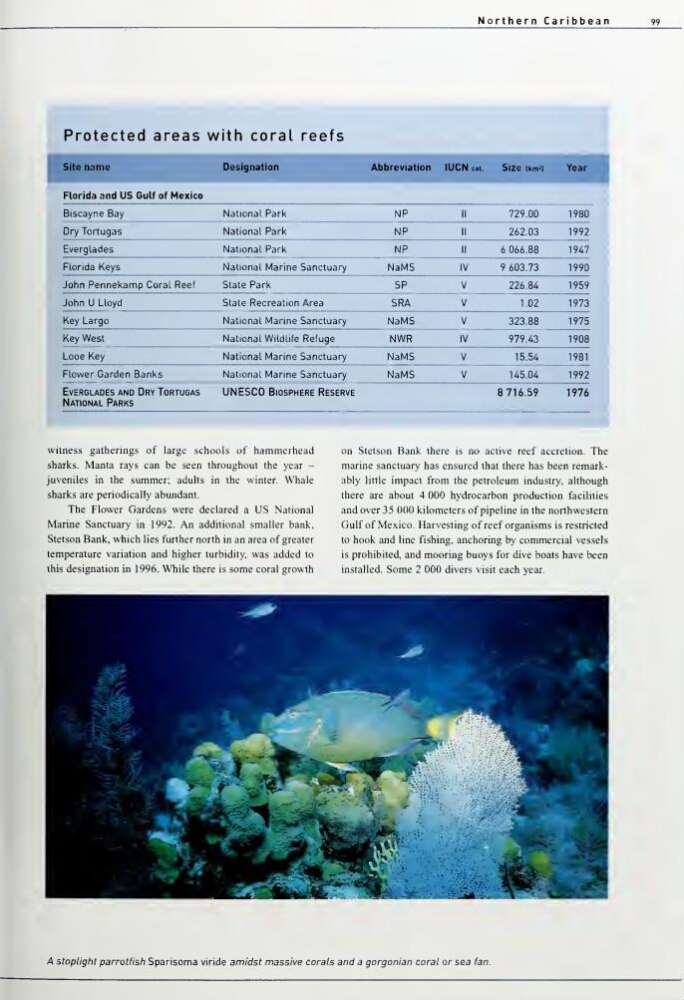
A stoplight parrotfish Sparisoma viride amidst massive corals and a gorgonian coral or sea fan.
Protected areas with coral reefs
P
Site name
Designation
Abbreviation
lUCN cat.
Size (km2|
Year
J
Florida and US Gulf of Mexico
Biscayne Bay
National Park
NP
II
729.00
1980
Dry Tortugas
National Park
NP
II
262.03
1992
Everglades
National Park
NP
II
6 066.88
1947
Florida Keys
National Marine Sanctuary
NaMS
IV
9 603.73
1990
John Pennekamp Coral Reef
State Parit
SP
V
226.84
1959
John U Lloyd
State Recreation Area
SRA
V
1.Q2
1973
Key Largo
National Marine Sanctuary
NaMS
V
323.88
1975
Key West
National Wildlife Refuge
NWR
IV
979.43
1908
Looe Key
National Marine Sanctuary
NaMS
V
15.54
1981
Flower Garden Banks
National Marine Sanctuary
NaMS
V
U5.04
1992
Everglades and Dry Tortugas
National Parks
UNESCO Biosphere Reserve
8 716.59
1976
witness gatherings of large schools of hammerhead
sharks. Manta rays can be seen throughout the year -
juveniles in the summer: adults in the winter Whale
sharks are periodically abundant.
The Flower Gardens were declared a US National
Marine Sanctuary in 1992. An additional smaller bank.
Stetson Bank, which lies further north in an area of greater
temperature variation and higher turbidity, was added to
this designation in 1996. While there is some coral growth
on Stetson Bank there is no active reef accretion. The
marine sanctuary has ensured that there has been remarkably little impact from the petroleum industry, although
there are about 4 000 hydrocarbon production facilities
and over 35 000 kilometers of pipeline in the northwestern
Gulf of Me.xico. Harvesting of reef organisms is restricted
to hook and line fishing, anchoring by commercial vessels
is prohibited, and mooring buoys for dive boats have been
installed. Some 2 000 divers visit each year.
A stoplight parrotfish Sparisoma viride amidst massive corals and a gorgonian coral or sea fan.