

toward the photocatalytic efficiency [9]. pH changes the surface
properties of photocatalyst and chemical structure of TC in the solution.
The behaviors influence the photocatalytic degradation through the
modification of the adsorption properties and the availability of OH•
radicals [39].
It is noteworthy to mention that the pH for which the surface charge
of the elaborate material is zero is called pH point zero of charge
(pH pzc ) and its value is around 5.42 for TiO 2 , 12.5 for CAL and 10.5 for
CAL30. Previous studies reported that pH pzc of the calcite lies within
the range (8–10.9) [42]. Hence, the introduction of TiO 2 onto the raw
material lowered the pH from 12.5 to 10.5. As generally admitted, for
pH < pH pzc , the material surface is charged positively, while for pH
< pH pzc the surface is charged negatively.
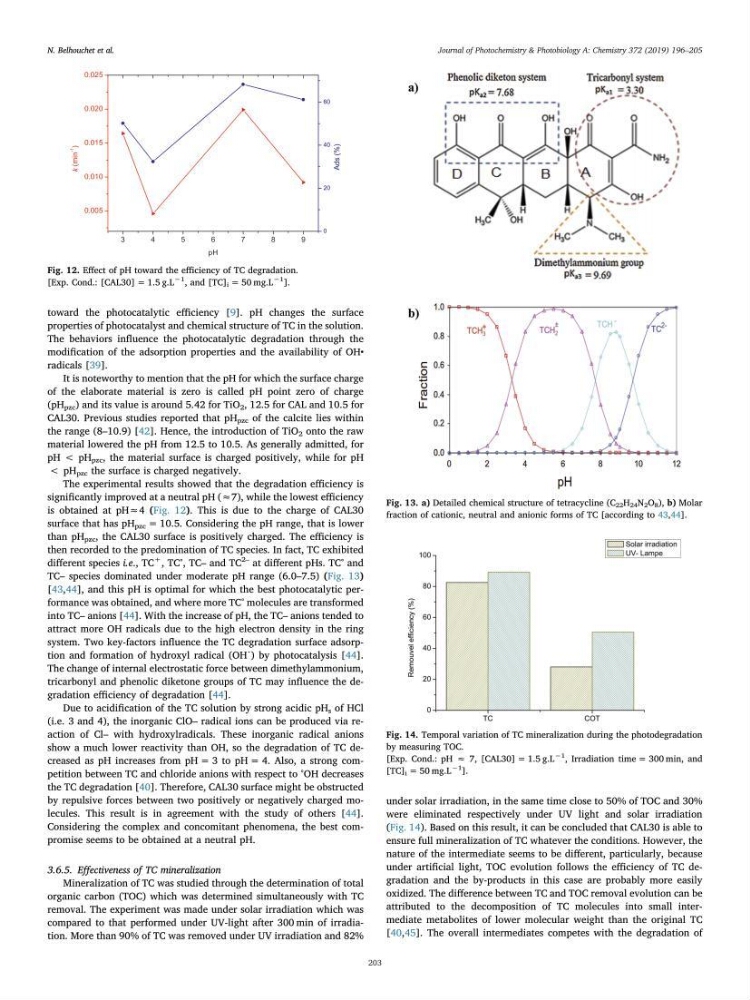
The experimental results showed that the degradation efficiency is
significantly improved at a neutral pH (≈7), while the lowest efficiency
is obtained at pH≈4 (Fig. 12). This is due to the charge of CAL30
surface that has pH pzc = 10.5. Considering the pH range, that is lower
than pH pzc , the CAL30 surface is positively charged. The efficiency is
then recorded to the predomination of TC species. In fact, TC exhibited
different species i.e., TC
+ , TC°, TC– and TC
2– at different pHs. TC° and
TC– species dominated under moderate pH range (6.0–7.5) (Fig. 13)
[43,44], and this pH is optimal for which the best photocatalytic performance was obtained, and where more TC° molecules are transformed
into TC– anions [44]. With the increase of pH, the TC– anions tended to
attract more OH radicals due to the high electron density in the ring
system. Two key-factors influence the TC degradation surface adsorption and formation of hydroxyl radical (OH
%
) by photocatalysis [44].
The change of internal electrostatic force between dimethylammonium,
tricarbonyl and phenolic diketone groups of TC may influence the degradation efficiency of degradation [44].
Due to acidification of the TC solution by strong acidic pH s of HCl
(i.e. 3 and 4), the inorganic ClO– radical ions can be produced via reaction of Cl– with hydroxylradicals. These inorganic radical anions
show a much lower reactivity than OH, so the degradation of TC decreased as pH increases from pH = 3 to pH = 4. Also, a strong competition between TC and chloride anions with respect to °OH decreases
the TC degradation [40]. Therefore, CAL30 surface might be obstructed
by repulsive forces between two positively or negatively charged molecules. This result is in agreement with the study of others [44].
Considering the complex and concomitant phenomena, the best compromise seems to be obtained at a neutral pH.
3.6.5. Effectiveness of TC mineralization
Mineralization of TC was studied through the determination of total
organic carbon (TOC) which was determined simultaneously with TC
removal. The experiment was made under solar irradiation which was
compared to that performed under UV-light after 300 min of irradiation. More than 90% of TC was removed under UV irradiation and 82%
under solar irradiation, in the same time close to 50% of TOC and 30%
were eliminated respectively under UV light and solar irradiation
(Fig. 14). Based on this result, it can be concluded that CAL30 is able to
ensure full mineralization of TC whatever the conditions. However, the
nature of the intermediate seems to be different, particularly, because
under artificial light, TOC evolution follows the efficiency of TC degradation and the by-products in this case are probably more easily
oxidized. The difference between TC and TOC removal evolution can be
attributed to the decomposition of TC molecules into small intermediate metabolites of lower molecular weight than the original TC
[40,45]. The overall intermediates competes with the degradation of
Fig. 12. Effect of pH toward the efficiency of TC degradation.
[Exp. Cond.: [CAL30] = 1.5 g.L
−1 , and [TC] i = 50 mg.L
−1 ].
Fig. 13. a) Detailed chemical structure of tetracycline (C 22 H 24 N 2 O 8 ), b) Molar
fraction of cationic, neutral and anionic forms of TC [according to 43,44].
Fig. 14. Temporal variation of TC mineralization during the photodegradation
by measuring TOC.
[Exp. Cond.: pH ≈ 7, [CAL30] = 1.5 g.L
−1
, Irradiation time = 300 min, and
[TC] i = 50 mg.L
−1
].
N. Belhouchet et al.
Journal of Photochemistry & Photobiology A: Chemistry 372 (2019) 196–205
203
properties of photocatalyst and chemical structure of TC in the solution.
The behaviors influence the photocatalytic degradation through the
modification of the adsorption properties and the availability of OH•
radicals [39].
It is noteworthy to mention that the pH for which the surface charge
of the elaborate material is zero is called pH point zero of charge
(pH pzc ) and its value is around 5.42 for TiO 2 , 12.5 for CAL and 10.5 for
CAL30. Previous studies reported that pH pzc of the calcite lies within
the range (8–10.9) [42]. Hence, the introduction of TiO 2 onto the raw
material lowered the pH from 12.5 to 10.5. As generally admitted, for
pH < pH pzc , the material surface is charged positively, while for pH
< pH pzc the surface is charged negatively.
The experimental results showed that the degradation efficiency is
significantly improved at a neutral pH (≈7), while the lowest efficiency
is obtained at pH≈4 (Fig. 12). This is due to the charge of CAL30
surface that has pH pzc = 10.5. Considering the pH range, that is lower
than pH pzc , the CAL30 surface is positively charged. The efficiency is
then recorded to the predomination of TC species. In fact, TC exhibited
different species i.e., TC
+ , TC°, TC– and TC
2– at different pHs. TC° and
TC– species dominated under moderate pH range (6.0–7.5) (Fig. 13)
[43,44], and this pH is optimal for which the best photocatalytic performance was obtained, and where more TC° molecules are transformed
into TC– anions [44]. With the increase of pH, the TC– anions tended to
attract more OH radicals due to the high electron density in the ring
system. Two key-factors influence the TC degradation surface adsorption and formation of hydroxyl radical (OH
%
) by photocatalysis [44].
The change of internal electrostatic force between dimethylammonium,
tricarbonyl and phenolic diketone groups of TC may influence the degradation efficiency of degradation [44].
Due to acidification of the TC solution by strong acidic pH s of HCl
(i.e. 3 and 4), the inorganic ClO– radical ions can be produced via reaction of Cl– with hydroxylradicals. These inorganic radical anions
show a much lower reactivity than OH, so the degradation of TC decreased as pH increases from pH = 3 to pH = 4. Also, a strong competition between TC and chloride anions with respect to °OH decreases
the TC degradation [40]. Therefore, CAL30 surface might be obstructed
by repulsive forces between two positively or negatively charged molecules. This result is in agreement with the study of others [44].
Considering the complex and concomitant phenomena, the best compromise seems to be obtained at a neutral pH.
3.6.5. Effectiveness of TC mineralization
Mineralization of TC was studied through the determination of total
organic carbon (TOC) which was determined simultaneously with TC
removal. The experiment was made under solar irradiation which was
compared to that performed under UV-light after 300 min of irradiation. More than 90% of TC was removed under UV irradiation and 82%
under solar irradiation, in the same time close to 50% of TOC and 30%
were eliminated respectively under UV light and solar irradiation
(Fig. 14). Based on this result, it can be concluded that CAL30 is able to
ensure full mineralization of TC whatever the conditions. However, the
nature of the intermediate seems to be different, particularly, because
under artificial light, TOC evolution follows the efficiency of TC degradation and the by-products in this case are probably more easily
oxidized. The difference between TC and TOC removal evolution can be
attributed to the decomposition of TC molecules into small intermediate metabolites of lower molecular weight than the original TC
[40,45]. The overall intermediates competes with the degradation of
Fig. 12. Effect of pH toward the efficiency of TC degradation.
[Exp. Cond.: [CAL30] = 1.5 g.L
−1 , and [TC] i = 50 mg.L
−1 ].
Fig. 13. a) Detailed chemical structure of tetracycline (C 22 H 24 N 2 O 8 ), b) Molar
fraction of cationic, neutral and anionic forms of TC [according to 43,44].
Fig. 14. Temporal variation of TC mineralization during the photodegradation
by measuring TOC.
[Exp. Cond.: pH ≈ 7, [CAL30] = 1.5 g.L
−1
, Irradiation time = 300 min, and
[TC] i = 50 mg.L
−1
].
N. Belhouchet et al.
Journal of Photochemistry & Photobiology A: Chemistry 372 (2019) 196–205
203