

the starting molecule [46]. These would be responsible for the reduction of only 50% in the initial TOC. Furthermore, the maximal band
absorption of TC was 360 nm, which was originated from aromatic
rings B–D (Fig. 13), comprising the extended chromophores [47]. This
absorption band gradually decreased with the irradiation time, which
suggested that the fragmentation of phenolic groups connected to
aromatic ring B [48].
In other works, it was observed that the mineralization fractions of
TC photolysis and ozonation were only 15% and 5%, respectively, in
spite of rapid removal of TC [49,50]. Accordingly, the oxidation efficiency of CAL30 under UV irradiation is much more attractive since the
final objective is commonly to convert massif organic molecule
(C 22 H 24 N 2 O 8 ) to inorganic small molecules (CO 2 , NH 3 ) [51]. Scheme 1
resumes the photocatalytic process of calcite/titania/TC system.
f) Life time of CAL30
The life time of the catalyst CAL30 was investigated under hard
conditions, i.e, after each run the catalyst was just recovered by centrifugation to be used with a new contaminated solution. In this case,
any process that can help to regenerate the catalyst such as filtration,
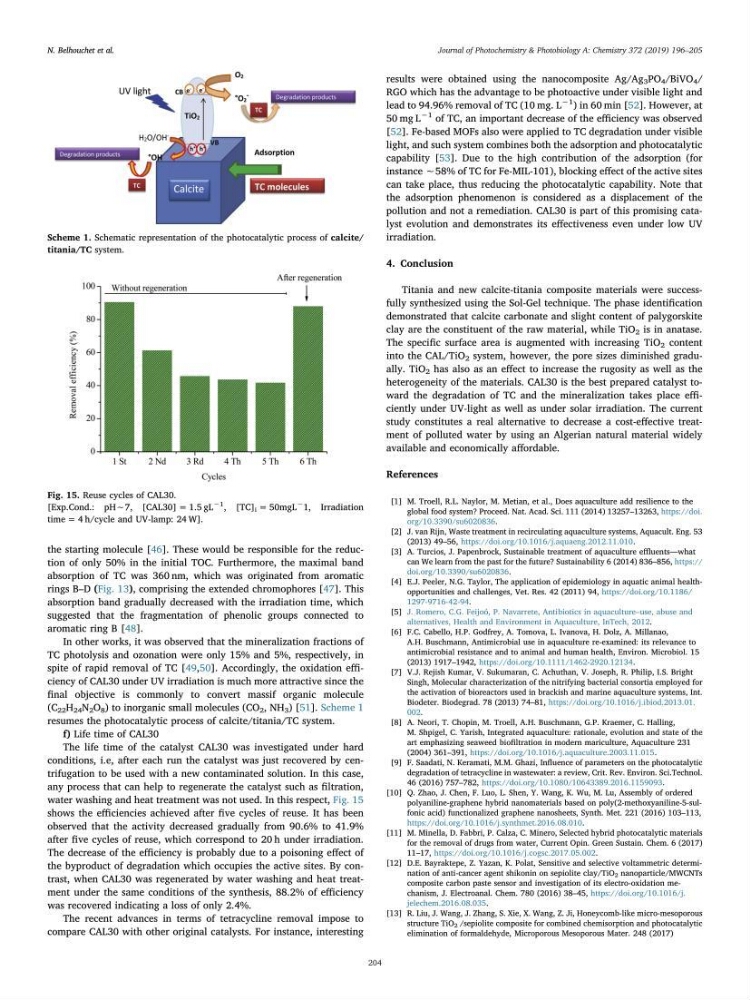
water washing and heat treatment was not used. In this respect, Fig. 15
shows the efficiencies achieved after five cycles of reuse. It has been
observed that the activity decreased gradually from 90.6% to 41.9%
after five cycles of reuse, which correspond to 20 h under irradiation.
The decrease of the efficiency is probably due to a poisoning effect of
the byproduct of degradation which occupies the active sites. By contrast, when CAL30 was regenerated by water washing and heat treatment under the same conditions of the synthesis, 88.2% of efficiency
was recovered indicating a loss of only 2.4%.
The recent advances in terms of tetracycline removal impose to
compare CAL30 with other original catalysts. For instance, interesting
results were obtained using the nanocomposite Ag/Ag 3 PO 4 /BiVO 4 /
RGO which has the advantage to be photoactive under visible light and
lead to 94.96% removal of TC (10 mg. L
−1 ) in 60 min [52]. However, at
50 mg L
−1 of TC, an important decrease of the efficiency was observed
[52]. Fe-based MOFs also were applied to TC degradation under visible
light, and such system combines both the adsorption and photocatalytic
capability [53]. Due to the high contribution of the adsorption (for
instance ∼58% of TC for Fe-MIL-101), blocking effect of the active sites
can take place, thus reducing the photocatalytic capability. Note that
the adsorption phenomenon is considered as a displacement of the
pollution and not a remediation. CAL30 is part of this promising catalyst evolution and demonstrates its effectiveness even under low UV
irradiation.
4. Conclusion
Titania and new calcite-titania composite materials were successfully synthesized using the Sol-Gel technique. The phase identification
demonstrated that calcite carbonate and slight content of palygorskite
clay are the constituent of the raw material, while TiO 2 is in anatase.
The specific surface area is augmented with increasing TiO 2 content
into the CAL/TiO 2 system, however, the pore sizes diminished gradually. TiO 2 has also as an effect to increase the rugosity as well as the
heterogeneity of the materials. CAL30 is the best prepared catalyst toward the degradation of TC and the mineralization takes place efficiently under UV-light as well as under solar irradiation. The current
study constitutes a real alternative to decrease a cost-effective treatment of polluted water by using an Algerian natural material widely
available and economically affordable.
References
[1] M. Troell, R.L. Naylor, M. Metian, et al., Does aquaculture add resilience to the
global food system? Proceed. Nat. Acad. Sci. 111 (2014) 13257–13263, https://doi.
org/10.3390/su6020836.
[2] J. van Rijn, Waste treatment in recirculating aquaculture systems, Aquacult. Eng. 53
(2013) 49–56, https://doi.org/10.1016/j.aquaeng.2012.11.010.
[3] A. Turcios, J. Papenbrock, Sustainable treatment of aquaculture effluents—what
can We learn from the past for the future? Sustainability 6 (2014) 836–856, https://
doi.org/10.3390/su6020836.
[4] E.J. Peeler, N.G. Taylor, The application of epidemiology in aquatic animal healthopportunities and challenges, Vet. Res. 42 (2011) 94, https://doi.org/10.1186/
1297-9716-42-94.
[5] J. Romero, C.G. Feijoó, P. Navarrete, Antibiotics in aquaculture–use, abuse and
alternatives, Health and Environment in Aquaculture, InTech, 2012.
[6] F.C. Cabello, H.P. Godfrey, A. Tomova, L. Ivanova, H. Dolz, A. Millanao,
A.H. Buschmann, Antimicrobial use in aquaculture re-examined: its relevance to
antimicrobial resistance and to animal and human health, Environ. Microbiol. 15
(2013) 1917–1942, https://doi.org/10.1111/1462-2920.12134.
[7] V.J. Rejish Kumar, V. Sukumaran, C. Achuthan, V. Joseph, R. Philip, I.S. Bright
Singh, Molecular characterization of the nitrifying bacterial consortia employed for
the activation of bioreactors used in brackish and marine aquaculture systems, Int.
Biodeter. Biodegrad. 78 (2013) 74–81, https://doi.org/10.1016/j.ibiod.2013.01.
002.
[8] A. Neori, T. Chopin, M. Troell, A.H. Buschmann, G.P. Kraemer, C. Halling,
M. Shpigel, C. Yarish, Integrated aquaculture: rationale, evolution and state of the
art emphasizing seaweed biofiltration in modern mariculture, Aquaculture 231
(2004) 361–391, https://doi.org/10.1016/j.aquaculture.2003.11.015.
[9] F. Saadati, N. Keramati, M.M. Ghazi, Influence of parameters on the photocatalytic
degradation of tetracycline in wastewater: a review, Crit. Rev. Environ. Sci.Technol.
46 (2016) 757–782, https://doi.org/10.1080/10643389.2016.1159093.
[10] Q. Zhao, J. Chen, F. Luo, L. Shen, Y. Wang, K. Wu, M. Lu, Assembly of ordered
polyaniline-graphene hybrid nanomaterials based on poly(2-methoxyaniline-5-sulfonic acid) functionalized graphene nanosheets, Synth. Met. 221 (2016) 103–113,
https://doi.org/10.1016/j.synthmet.2016.08.010.
[11] M. Minella, D. Fabbri, P. Calza, C. Minero, Selected hybrid photocatalytic materials
for the removal of drugs from water, Current Opin. Green Sustain. Chem. 6 (2017)
11–17, https://doi.org/10.1016/j.cogsc.2017.05.002.
[12] D.E. Bayraktepe, Z. Yazan, K. Polat, Sensitive and selective voltammetric determination of anti˗cancer agent shikonin on sepiolite clay/TiO 2 nanoparticle/MWCNTs
composite carbon paste sensor and investigation of its electro˗oxidation mechanism, J. Electroanal. Chem. 780 (2016) 38–45, https://doi.org/10.1016/j.
jelechem.2016.08.035.
[13] R. Liu, J. Wang, J. Zhang, S. Xie, X. Wang, Z. Ji, Honeycomb-like micro-mesoporous
structure TiO 2 /sepiolite composite for combined chemisorption and photocatalytic
elimination of formaldehyde, Microporous Mesoporous Mater. 248 (2017)
Scheme 1. Schematic representation of the photocatalytic process of calcite/
titania/TC system.
Fig. 15. Reuse cycles of CAL30.
[Exp.Cond.: pH∼7, [CAL30] = 1.5 gL
−1
, [TC] i = 50mgL
− 1, Irradiation
time = 4 h/cycle and UV-lamp: 24 W].
N. Belhouchet et al.
Journal of Photochemistry & Photobiology A: Chemistry 372 (2019) 196–205
204
absorption of TC was 360 nm, which was originated from aromatic
rings B–D (Fig. 13), comprising the extended chromophores [47]. This
absorption band gradually decreased with the irradiation time, which
suggested that the fragmentation of phenolic groups connected to
aromatic ring B [48].
In other works, it was observed that the mineralization fractions of
TC photolysis and ozonation were only 15% and 5%, respectively, in
spite of rapid removal of TC [49,50]. Accordingly, the oxidation efficiency of CAL30 under UV irradiation is much more attractive since the
final objective is commonly to convert massif organic molecule
(C 22 H 24 N 2 O 8 ) to inorganic small molecules (CO 2 , NH 3 ) [51]. Scheme 1
resumes the photocatalytic process of calcite/titania/TC system.
f) Life time of CAL30
The life time of the catalyst CAL30 was investigated under hard
conditions, i.e, after each run the catalyst was just recovered by centrifugation to be used with a new contaminated solution. In this case,
any process that can help to regenerate the catalyst such as filtration,
water washing and heat treatment was not used. In this respect, Fig. 15
shows the efficiencies achieved after five cycles of reuse. It has been
observed that the activity decreased gradually from 90.6% to 41.9%
after five cycles of reuse, which correspond to 20 h under irradiation.
The decrease of the efficiency is probably due to a poisoning effect of
the byproduct of degradation which occupies the active sites. By contrast, when CAL30 was regenerated by water washing and heat treatment under the same conditions of the synthesis, 88.2% of efficiency
was recovered indicating a loss of only 2.4%.
The recent advances in terms of tetracycline removal impose to
compare CAL30 with other original catalysts. For instance, interesting
results were obtained using the nanocomposite Ag/Ag 3 PO 4 /BiVO 4 /
RGO which has the advantage to be photoactive under visible light and
lead to 94.96% removal of TC (10 mg. L
−1 ) in 60 min [52]. However, at
50 mg L
−1 of TC, an important decrease of the efficiency was observed
[52]. Fe-based MOFs also were applied to TC degradation under visible
light, and such system combines both the adsorption and photocatalytic
capability [53]. Due to the high contribution of the adsorption (for
instance ∼58% of TC for Fe-MIL-101), blocking effect of the active sites
can take place, thus reducing the photocatalytic capability. Note that
the adsorption phenomenon is considered as a displacement of the
pollution and not a remediation. CAL30 is part of this promising catalyst evolution and demonstrates its effectiveness even under low UV
irradiation.
4. Conclusion
Titania and new calcite-titania composite materials were successfully synthesized using the Sol-Gel technique. The phase identification
demonstrated that calcite carbonate and slight content of palygorskite
clay are the constituent of the raw material, while TiO 2 is in anatase.
The specific surface area is augmented with increasing TiO 2 content
into the CAL/TiO 2 system, however, the pore sizes diminished gradually. TiO 2 has also as an effect to increase the rugosity as well as the
heterogeneity of the materials. CAL30 is the best prepared catalyst toward the degradation of TC and the mineralization takes place efficiently under UV-light as well as under solar irradiation. The current
study constitutes a real alternative to decrease a cost-effective treatment of polluted water by using an Algerian natural material widely
available and economically affordable.
References
[1] M. Troell, R.L. Naylor, M. Metian, et al., Does aquaculture add resilience to the
global food system? Proceed. Nat. Acad. Sci. 111 (2014) 13257–13263, https://doi.
org/10.3390/su6020836.
[2] J. van Rijn, Waste treatment in recirculating aquaculture systems, Aquacult. Eng. 53
(2013) 49–56, https://doi.org/10.1016/j.aquaeng.2012.11.010.
[3] A. Turcios, J. Papenbrock, Sustainable treatment of aquaculture effluents—what
can We learn from the past for the future? Sustainability 6 (2014) 836–856, https://
doi.org/10.3390/su6020836.
[4] E.J. Peeler, N.G. Taylor, The application of epidemiology in aquatic animal healthopportunities and challenges, Vet. Res. 42 (2011) 94, https://doi.org/10.1186/
1297-9716-42-94.
[5] J. Romero, C.G. Feijoó, P. Navarrete, Antibiotics in aquaculture–use, abuse and
alternatives, Health and Environment in Aquaculture, InTech, 2012.
[6] F.C. Cabello, H.P. Godfrey, A. Tomova, L. Ivanova, H. Dolz, A. Millanao,
A.H. Buschmann, Antimicrobial use in aquaculture re-examined: its relevance to
antimicrobial resistance and to animal and human health, Environ. Microbiol. 15
(2013) 1917–1942, https://doi.org/10.1111/1462-2920.12134.
[7] V.J. Rejish Kumar, V. Sukumaran, C. Achuthan, V. Joseph, R. Philip, I.S. Bright
Singh, Molecular characterization of the nitrifying bacterial consortia employed for
the activation of bioreactors used in brackish and marine aquaculture systems, Int.
Biodeter. Biodegrad. 78 (2013) 74–81, https://doi.org/10.1016/j.ibiod.2013.01.
002.
[8] A. Neori, T. Chopin, M. Troell, A.H. Buschmann, G.P. Kraemer, C. Halling,
M. Shpigel, C. Yarish, Integrated aquaculture: rationale, evolution and state of the
art emphasizing seaweed biofiltration in modern mariculture, Aquaculture 231
(2004) 361–391, https://doi.org/10.1016/j.aquaculture.2003.11.015.
[9] F. Saadati, N. Keramati, M.M. Ghazi, Influence of parameters on the photocatalytic
degradation of tetracycline in wastewater: a review, Crit. Rev. Environ. Sci.Technol.
46 (2016) 757–782, https://doi.org/10.1080/10643389.2016.1159093.
[10] Q. Zhao, J. Chen, F. Luo, L. Shen, Y. Wang, K. Wu, M. Lu, Assembly of ordered
polyaniline-graphene hybrid nanomaterials based on poly(2-methoxyaniline-5-sulfonic acid) functionalized graphene nanosheets, Synth. Met. 221 (2016) 103–113,
https://doi.org/10.1016/j.synthmet.2016.08.010.
[11] M. Minella, D. Fabbri, P. Calza, C. Minero, Selected hybrid photocatalytic materials
for the removal of drugs from water, Current Opin. Green Sustain. Chem. 6 (2017)
11–17, https://doi.org/10.1016/j.cogsc.2017.05.002.
[12] D.E. Bayraktepe, Z. Yazan, K. Polat, Sensitive and selective voltammetric determination of anti˗cancer agent shikonin on sepiolite clay/TiO 2 nanoparticle/MWCNTs
composite carbon paste sensor and investigation of its electro˗oxidation mechanism, J. Electroanal. Chem. 780 (2016) 38–45, https://doi.org/10.1016/j.
jelechem.2016.08.035.
[13] R. Liu, J. Wang, J. Zhang, S. Xie, X. Wang, Z. Ji, Honeycomb-like micro-mesoporous
structure TiO 2 /sepiolite composite for combined chemisorption and photocatalytic
elimination of formaldehyde, Microporous Mesoporous Mater. 248 (2017)
Scheme 1. Schematic representation of the photocatalytic process of calcite/
titania/TC system.
Fig. 15. Reuse cycles of CAL30.
[Exp.Cond.: pH∼7, [CAL30] = 1.5 gL
−1
, [TC] i = 50mgL
− 1, Irradiation
time = 4 h/cycle and UV-lamp: 24 W].
N. Belhouchet et al.
Journal of Photochemistry & Photobiology A: Chemistry 372 (2019) 196–205
204