

394
J.F. Muir
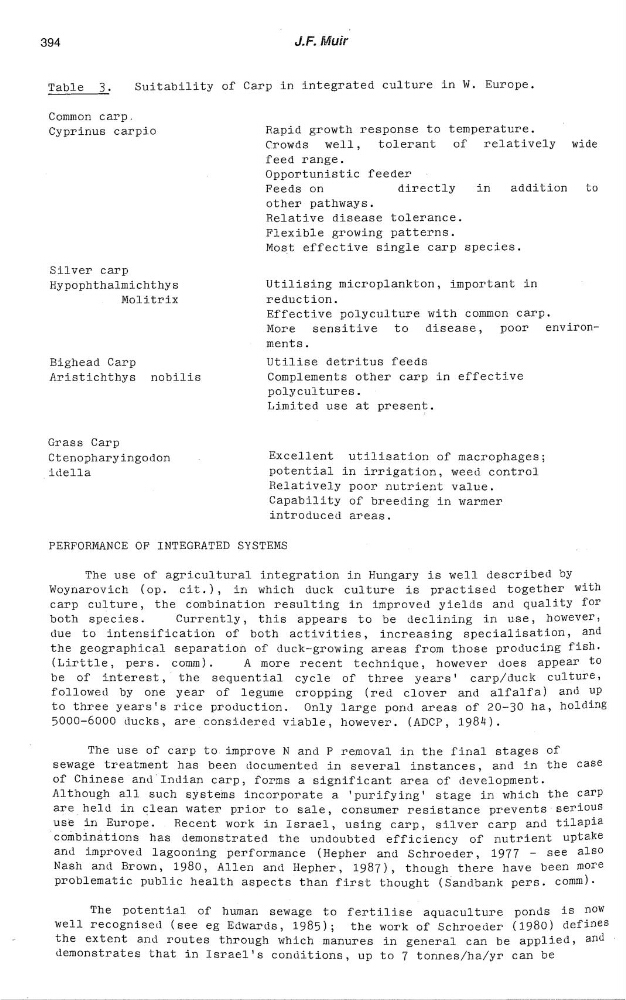
Table
3.
Suitability of Carp in integrated culture in w. Europe.
Common carp.
Cyprinus carpio
Rapid growth response to temperature.
Crowds
well,
tolerant
of
relatively
wide
feed range.
Opportunistic feeder
Feeds
on
directly
in
addition
to
other
pathways.
Relative
disease
tolerance.
Flexible growing patterns.
Most effective single carp species.
Silver
carp
Hypophthalmichthys
Utilising microplankton, important in
'
Molitrix
reduction.
Effective
polyculture with common carp.
More
sensitive
to
disease,
poor
environ—
ments.
Bighead Carp
Utilise
detritus
feeds
Aristichthys
nobilis
Complements other carp in effective
polycultures.
Limited use
at
present.
Grass
Carp
Ctenopharyingodon
,
Excellent
utilisation of macrophages;
potential in irrigation, weed control
Relatively poor nutrient value.
Capability of breeding in warmer
introduced areas.
PERFORMANCE OF INTEGRATED SYSTEMS
The
use
of
agricultural integration in Hungary is well described by
Woynarovich
(op.
cit.),
in
which
duck
culture
is
practised
together with
carp
culture,
the
combination
resulting in improved yields and quality for
both
species.
Currently,
this
appears
to
be
declining
in
use,
however,
due
to
intensificatidn
of
both
activities,
increasing
specialisation,
and
the
geographical separation of duck—growing areas from those producing fiSh—
(Lirttle,
pers.
comm).
A
more
recent
technique,
however
does
appear
to
be
of
the
sequential
cycle
of
three
years‘
carp/duck
culture,
followed
by
one
year
of
legume
cropping
(red
clover
and
alfalfa)
and
UP
to
three
years's rice production.
Only large pond areas of 20—30 ha, holding
5000—6000 ducks, are considered viable, however.
(ADCP, 198H).
The use
of
carp
to
improve N and P removal in the final stages of
sewage
treatment
has
been
documented
in
several
instances,
and
in
the
case
of Chinese
and Indian
carp,
forms a significant area of development.
Although all such systems incorporate a
'purifying‘
stage in which the carP
are
held
in
clean water prior to sale, consumer resistance prevents serious
in Europe.
Recent
work
in
Israel,
using carp,
silver
carp
and
tilaPia
combinàtions
has
demonstrated
the
undoubted
efficiency
of
nutrient
uptake
and
improved
lagooning performance
(Hepher and Schroeder,
1977
—
see
also
Nash
and
Brown,
1980, Allen and Hepher, 1987), though there have been mOi“e
problematic public health aspects than first thought (Sandbank pers. comm)The
potential
of
human
sewage
to
fertilise
aquaculture
ponds
is
now
well recognised (see eg Edwards, 1985);
the work of
Schroeder
(1980) defines
»
the
extent
and
routes
through which manures
in
general
can
be
applied,
and
demonstrates that
in Israel‘s
conditions, up to ? tonnes/ha/yr can be
J.F. Muir
Table
3.
Suitability of Carp in integrated culture in w. Europe.
Common carp.
Cyprinus carpio
Rapid growth response to temperature.
Crowds
well,
tolerant
of
relatively
wide
feed range.
Opportunistic feeder
Feeds
on
directly
in
addition
to
other
pathways.
Relative
disease
tolerance.
Flexible growing patterns.
Most effective single carp species.
Silver
carp
Hypophthalmichthys
Utilising microplankton, important in
'
Molitrix
reduction.
Effective
polyculture with common carp.
More
sensitive
to
disease,
poor
environ—
ments.
Bighead Carp
Utilise
detritus
feeds
Aristichthys
nobilis
Complements other carp in effective
polycultures.
Limited use
at
present.
Grass
Carp
Ctenopharyingodon
,
Excellent
utilisation of macrophages;
potential in irrigation, weed control
Relatively poor nutrient value.
Capability of breeding in warmer
introduced areas.
PERFORMANCE OF INTEGRATED SYSTEMS
The
use
of
agricultural integration in Hungary is well described by
Woynarovich
(op.
cit.),
in
which
duck
culture
is
practised
together with
carp
culture,
the
combination
resulting in improved yields and quality for
both
species.
Currently,
this
appears
to
be
declining
in
use,
however,
due
to
intensificatidn
of
both
activities,
increasing
specialisation,
and
the
geographical separation of duck—growing areas from those producing fiSh—
(Lirttle,
pers.
comm).
A
more
recent
technique,
however
does
appear
to
be
of
the
sequential
cycle
of
three
years‘
carp/duck
culture,
followed
by
one
year
of
legume
cropping
(red
clover
and
alfalfa)
and
UP
to
three
years's rice production.
Only large pond areas of 20—30 ha, holding
5000—6000 ducks, are considered viable, however.
(ADCP, 198H).
The use
of
carp
to
improve N and P removal in the final stages of
sewage
treatment
has
been
documented
in
several
instances,
and
in
the
case
of Chinese
and Indian
carp,
forms a significant area of development.
Although all such systems incorporate a
'purifying‘
stage in which the carP
are
held
in
clean water prior to sale, consumer resistance prevents serious
in Europe.
Recent
work
in
Israel,
using carp,
silver
carp
and
tilaPia
combinàtions
has
demonstrated
the
undoubted
efficiency
of
nutrient
uptake
and
improved
lagooning performance
(Hepher and Schroeder,
1977
—
see
also
Nash
and
Brown,
1980, Allen and Hepher, 1987), though there have been mOi“e
problematic public health aspects than first thought (Sandbank pers. comm)The
potential
of
human
sewage
to
fertilise
aquaculture
ponds
is
now
well recognised (see eg Edwards, 1985);
the work of
Schroeder
(1980) defines
»
the
extent
and
routes
through which manures
in
general
can
be
applied,
and
demonstrates that
in Israel‘s
conditions, up to ? tonnes/ha/yr can be