

Integrated carp farming
393
Table
1.
Integrated Aquaculture Systems.
AGRICULTURAL:
Vegetable
Rice, Cassava, Wheat, Crop Leaves
Palm, Rubber, Ipil—Ipil
Animal
Pigs, Ducks, Chickens, Sheep, Goats
Cows, Buffalo, Rabbits, Geese
INDUSTRIAL:
Space
Use
of
land, shelter, security
Water
Reservoirs, Process water, irrigation
Channels
Heat
Power
stations, Furnaces/ovens,
Breweries Distilleries
Byproducts
Breweries, Distilleries, Agricultural
Processers
SANITATION:
Sewage
Nutrients, Floc, Organic matter
Waterways
Aquatic vegetation
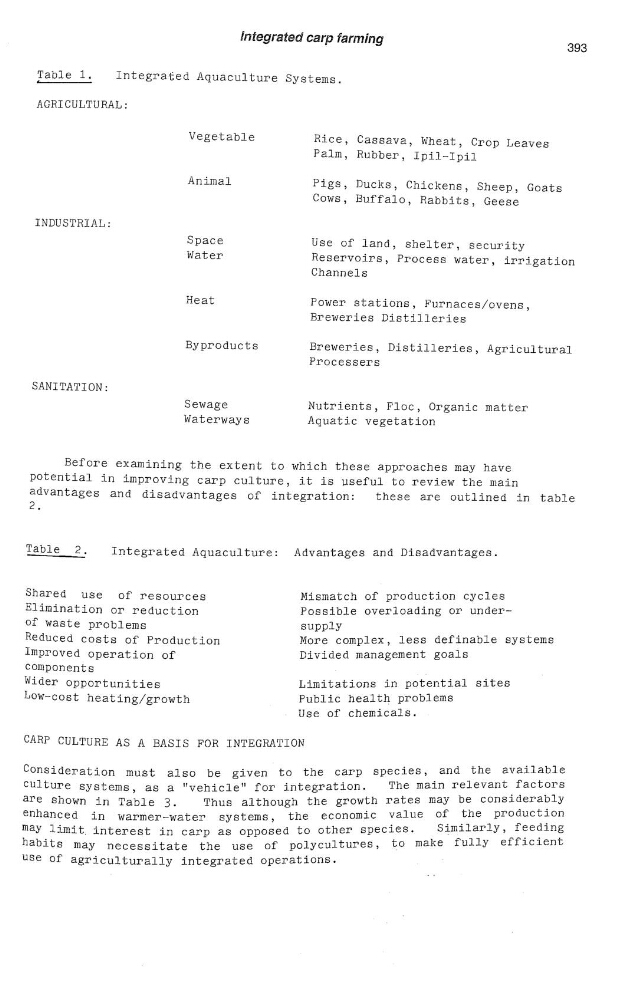
Before examining the extent to which these approaches may have
potential in improving carp culture, it is useful to review the main
advantages and disadvantages of integration:
these
are
outlined
in
table
2.
.
‘sadvanta es.
Table
2.
Integrated Aquaculture.
Advantages and D1
g
Shared
use
of resources
Mismatch of production cycles
Elimination or reduction
Possible
overloading OT under—
of waste
problems
supply
Reduced costs of Production
More
less
definable
systems
Improved operation of
Divided management goals
components
_
.
wider opportunities
Limitations
in
potential Sites
Low—cost heating/growth
Public health pf0blems
Use
of
chemicals.
CARP CULTURE AS A BASIS FOR INTEGRATION
—
'Iable
Consideration must
also
be
given
to
the
carp
spec1es,
lthe ÎVÊâctors
Culture systems, as a "vehicle" for integration'
The main
rÊ evansiderably
are
shown
in
Table
3.
Thus
although the growth rates may
e
con
—
mic
value
of
the
production
enhanced
in
warmer—water
systems,
the
econo
_
_
.
.
.
th r
s
scies.
Slmllarlÿ» feeding
may 11m1t_1nterest in carp as opposed to 0
e
p
ke
fully
efficient
habits
may
necessitate
the
use
of
P01YCU1tures’
to ma
use
of
agriculturally integrated operatlons-
393
Table
1.
Integrated Aquaculture Systems.
AGRICULTURAL:
Vegetable
Rice, Cassava, Wheat, Crop Leaves
Palm, Rubber, Ipil—Ipil
Animal
Pigs, Ducks, Chickens, Sheep, Goats
Cows, Buffalo, Rabbits, Geese
INDUSTRIAL:
Space
Use
of
land, shelter, security
Water
Reservoirs, Process water, irrigation
Channels
Heat
Power
stations, Furnaces/ovens,
Breweries Distilleries
Byproducts
Breweries, Distilleries, Agricultural
Processers
SANITATION:
Sewage
Nutrients, Floc, Organic matter
Waterways
Aquatic vegetation
Before examining the extent to which these approaches may have
potential in improving carp culture, it is useful to review the main
advantages and disadvantages of integration:
these
are
outlined
in
table
2.
.
‘sadvanta es.
Table
2.
Integrated Aquaculture.
Advantages and D1
g
Shared
use
of resources
Mismatch of production cycles
Elimination or reduction
Possible
overloading OT under—
of waste
problems
supply
Reduced costs of Production
More
less
definable
systems
Improved operation of
Divided management goals
components
_
.
wider opportunities
Limitations
in
potential Sites
Low—cost heating/growth
Public health pf0blems
Use
of
chemicals.
CARP CULTURE AS A BASIS FOR INTEGRATION
—
'Iable
Consideration must
also
be
given
to
the
carp
spec1es,
lthe ÎVÊâctors
Culture systems, as a "vehicle" for integration'
The main
rÊ evansiderably
are
shown
in
Table
3.
Thus
although the growth rates may
e
con
—
mic
value
of
the
production
enhanced
in
warmer—water
systems,
the
econo
_
_
.
.
.
th r
s
scies.
Slmllarlÿ» feeding
may 11m1t_1nterest in carp as opposed to 0
e
p
ke
fully
efficient
habits
may
necessitate
the
use
of
P01YCU1tures’
to ma
use
of
agriculturally integrated operatlons-