

G0!dsh {Camesñus auratus L.) farming in Italy
375
Fish culture in Italy is concentrated in the provinces of Bologna, Fer—
rara,
and Modena.
The Communes, within this area involved in fish culture are
given in tab. 1. The Commune of Cento (FE) has the largest number of farmers,
which was constant during the whole period considered, and S. Giovanni Persiceto has the second largest concentration. However the largest production in
1980 was in the Commune of Bentivoglio, followed by S. Giovanni Persiceto,
Cent0 and Minerbio which had a joint total production of over 8 million fish.
As far as the unitary surface areas used in farming in 1980 are concerned, the
average dimensions are about 8 ha with a total, referring to about 21 farmers,
of 165 ha (tab. 2). Goldfish, in monocu1ture, are bred in 572 of the total of
the farms with average unitary production ranging from 65,000 to 200,000 fish
per
ha.
The unitary production of goldfish bred in polyculture With catfish,
carp and tench is much lower.
In the case of breeding with catfish, in parti—
cular, unitary production shows a marked decline, both quantitative1y and
qualitative1y, since goldfish is preyed upon by this species and is also dama
ged by the catfish spines when they are harvested together. The product aims
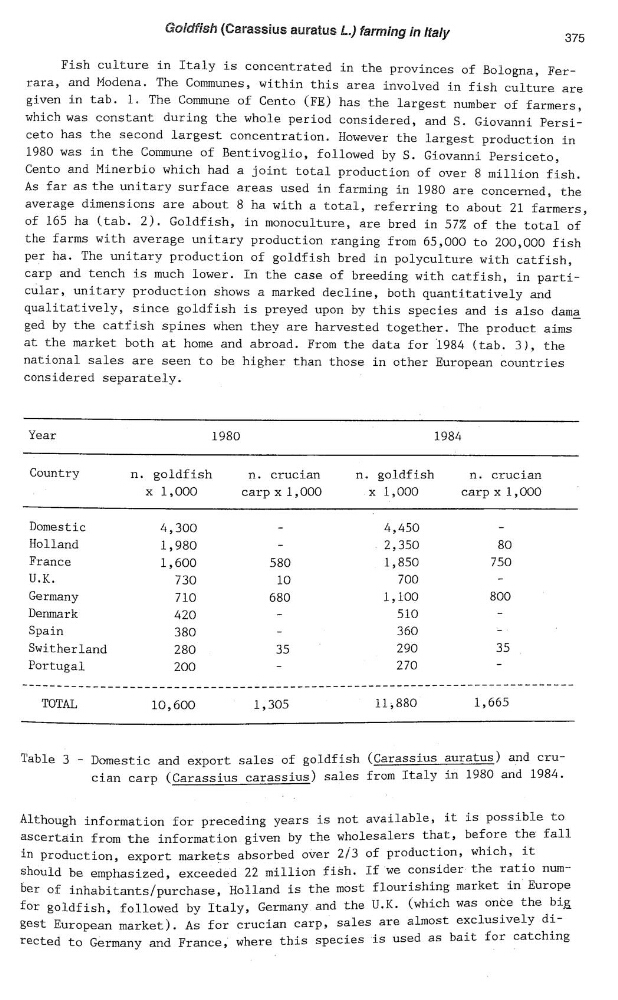
at the market both at home and abroad. From the data for 1984 (tab. 3), the
national sales are seen to be higher than those in other European countries
considered separate1y.
_
___________________________________________________________________________
Year
1980
1984
________________________________________________________________________
Country
n.
goldfish
n.
crucian
n.
goldfish
n.
crucian
.
x
1,000
carp:
1,000
carp>
Domestic
4,300
-
4,450
-
Holland
1,980
—
.
2,350
80
France
1,600
580
1,850
750
U.K.
730
10
700
'
Germany
710
680
1,100
800
Denmark
420
-
510
'
Spain
380
—
360
'
'
Switherland
280
35
290
35
Portugal
200
'
270
'
TOTAL
10, 600
1,305
11 s 880
1
» 665
_____________________________________________________________________________________
Table 3 — Domestic and export sales of goldfish (Êê£âÊâÊEË.ËEËËËEÊ> and cru—
cian carp (QËEËÊËÈEË_EËEÊÊËÊËË)
sales from Italy in 1980 and 1984.
Although information for preceding years is not available, it is POSSible t°
ascertain from the information given by the wholesalers that, before the
fall
in production, export markets absorbed oVer 2/3 Of Pr0dUCtion’ WhiCh’
Should be emphasized, exceeded 22 million fish. If we consider-the ratio
num—
ber of inhabitants/purchase, Holland is the most flourishig
market in Europe
for goldfish, followed by Italy, Germany and the U'K' (WhiCh was once
the
gest European market). As for crucian carp, sales are almost
di—
rected to Germany and France, where this Species is used as ba1t
catch1ng
375
Fish culture in Italy is concentrated in the provinces of Bologna, Fer—
rara,
and Modena.
The Communes, within this area involved in fish culture are
given in tab. 1. The Commune of Cento (FE) has the largest number of farmers,
which was constant during the whole period considered, and S. Giovanni Persiceto has the second largest concentration. However the largest production in
1980 was in the Commune of Bentivoglio, followed by S. Giovanni Persiceto,
Cent0 and Minerbio which had a joint total production of over 8 million fish.
As far as the unitary surface areas used in farming in 1980 are concerned, the
average dimensions are about 8 ha with a total, referring to about 21 farmers,
of 165 ha (tab. 2). Goldfish, in monocu1ture, are bred in 572 of the total of
the farms with average unitary production ranging from 65,000 to 200,000 fish
per
ha.
The unitary production of goldfish bred in polyculture With catfish,
carp and tench is much lower.
In the case of breeding with catfish, in parti—
cular, unitary production shows a marked decline, both quantitative1y and
qualitative1y, since goldfish is preyed upon by this species and is also dama
ged by the catfish spines when they are harvested together. The product aims
at the market both at home and abroad. From the data for 1984 (tab. 3), the
national sales are seen to be higher than those in other European countries
considered separate1y.
_
___________________________________________________________________________
Year
1980
1984
________________________________________________________________________
Country
n.
goldfish
n.
crucian
n.
goldfish
n.
crucian
.
x
1,000
carp:
1,000
carp>
Domestic
4,300
-
4,450
-
Holland
1,980
—
.
2,350
80
France
1,600
580
1,850
750
U.K.
730
10
700
'
Germany
710
680
1,100
800
Denmark
420
-
510
'
Spain
380
—
360
'
'
Switherland
280
35
290
35
Portugal
200
'
270
'
TOTAL
10, 600
1,305
11 s 880
1
» 665
_____________________________________________________________________________________
Table 3 — Domestic and export sales of goldfish (Êê£âÊâÊEË.ËEËËËEÊ> and cru—
cian carp (QËEËÊËÈEË_EËEÊÊËÊËË)
sales from Italy in 1980 and 1984.
Although information for preceding years is not available, it is POSSible t°
ascertain from the information given by the wholesalers that, before the
fall
in production, export markets absorbed oVer 2/3 Of Pr0dUCtion’ WhiCh’
Should be emphasized, exceeded 22 million fish. If we consider-the ratio
num—
ber of inhabitants/purchase, Holland is the most flourishig
market in Europe
for goldfish, followed by Italy, Germany and the U'K' (WhiCh was once
the
gest European market). As for crucian carp, sales are almost
di—
rected to Germany and France, where this Species is used as ba1t
catch1ng