

328
R.Suzuki
INTRODUCTION
The
technique of intensive rearing of carp is highly advanced in Japan.
Until about 1949, however, carp were cultured mainly in the rice fields, with
or
without
supplemental feeding, as an additional source of income for
farmers.
In 1943,
the annual carp production in Japan from rice fields was 4
400 tons
(Japan, Agriculture and Forestry Statistics, 1944). This production
declined when insecticides and herbicides were first used in rice fields,
after
the Second World War (Suzuki,
With the almost total cessation of carp culture in rice fields by 1973,
intensive culture was started in floating—net cages, in farm (or irrigation )
ponds, and running—water ponds. By 1982, 24,000 tons of carp was produced by
intensive rearing, and more than 90% of this total, by new methods.
I — FRY PRODUCTION
Selected breeders are raised separately from fish to be marketed. Until
recently, fertilized eggs were obtained from naturally spawning females which
were
stocked
together with males in a spawning pond. The batch rates by this
method are very low,
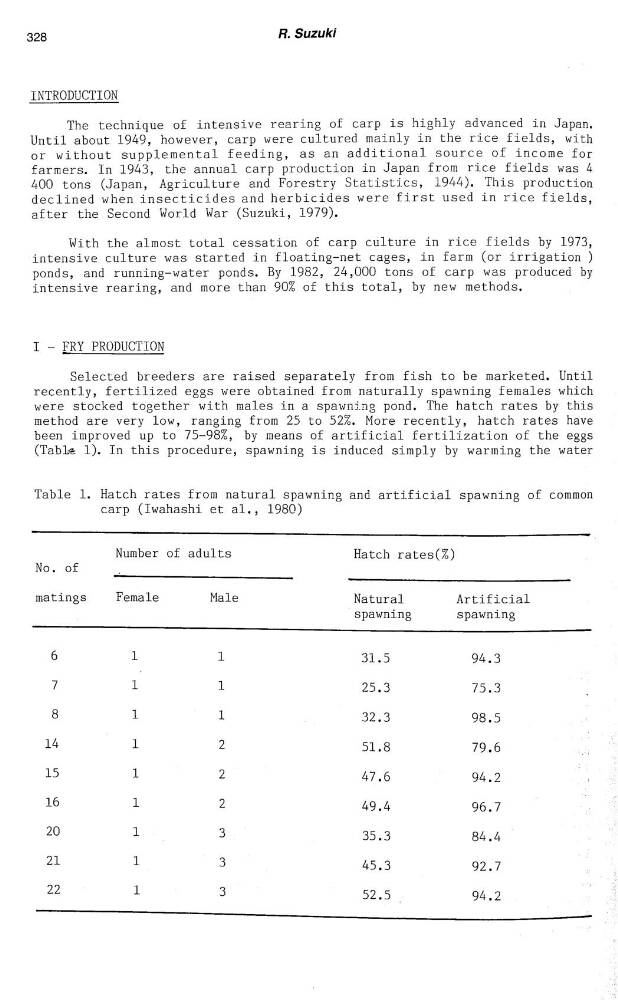
ranging from 25 to 52%. More recently, hatch rates have
been
improved up to 75—98Z, by means of artificial fertilization of the eggs
(TabLe 1) In this procedure, spawning is induced simply by warming the water
Table 1.
Hatch rates from natural spawning and artificial spawning of common
carp
(Iwahashi et al., 1980)
—_—_——_—_—_-___.
Number of adults
Hatch rates(%)
No. of
,
.________________________
_______________________________
matings
Female
Male
Natural
Artificial
_
spawning
spawning
.________________________________________________________________________
6
1
1
31.5
94.3
7
1
1
25.3
75.3
8
1
1
32.3
98.5
14
l
2
51.8
79.6
15
1
2
47.6
94.2
16
1
2
49.4
96.7
Ï
Ï
20
1
,
3
35.3
84.4
21
1
3
45.3
92.7
Ï
22
1
3
94.2
É
R.Suzuki
INTRODUCTION
The
technique of intensive rearing of carp is highly advanced in Japan.
Until about 1949, however, carp were cultured mainly in the rice fields, with
or
without
supplemental feeding, as an additional source of income for
farmers.
In 1943,
the annual carp production in Japan from rice fields was 4
400 tons
(Japan, Agriculture and Forestry Statistics, 1944). This production
declined when insecticides and herbicides were first used in rice fields,
after
the Second World War (Suzuki,
With the almost total cessation of carp culture in rice fields by 1973,
intensive culture was started in floating—net cages, in farm (or irrigation )
ponds, and running—water ponds. By 1982, 24,000 tons of carp was produced by
intensive rearing, and more than 90% of this total, by new methods.
I — FRY PRODUCTION
Selected breeders are raised separately from fish to be marketed. Until
recently, fertilized eggs were obtained from naturally spawning females which
were
stocked
together with males in a spawning pond. The batch rates by this
method are very low,
ranging from 25 to 52%. More recently, hatch rates have
been
improved up to 75—98Z, by means of artificial fertilization of the eggs
(TabLe 1) In this procedure, spawning is induced simply by warming the water
Table 1.
Hatch rates from natural spawning and artificial spawning of common
carp
(Iwahashi et al., 1980)
—_—_——_—_—_-___.
Number of adults
Hatch rates(%)
No. of
,
.________________________
_______________________________
matings
Female
Male
Natural
Artificial
_
spawning
spawning
.________________________________________________________________________
6
1
1
31.5
94.3
7
1
1
25.3
75.3
8
1
1
32.3
98.5
14
l
2
51.8
79.6
15
1
2
47.6
94.2
16
1
2
49.4
96.7
Ï
Ï
20
1
,
3
35.3
84.4
21
1
3
45.3
92.7
Ï
22
1
3
94.2
É