

Intehsivereäring
329
from 16 to 23°C; this causes almost all females to spawn within the next 8—11
hours
(Ishikawa,
1982).
The eggs are artificially stripped into a vaseline—
coated jar,
mixed with spermatozoa diluted X10'3 with M/7.5 Ringer's solution
(100 parts of M/7.5 NaCl.+ 2.0 parts of M/7.5 KCl + 2.1 parts of M/11 CaC12),
and then transferred into fresh water in incubation tanks fitted with egg
collectors. The fertilized eggs are treated with a 2 to 3—ppm solution Of
zinc—free malachite green for 30 min to prevent fungal infection. Usually, 3
or
4—day—old fry
raised in fertilized farm ponds
receive
additional clad0—
cerans
for about a month and artificial feeds afterwards.
Il — CURRENT METHODS OF INTENSIVE REARING
A — Ëet cage culture
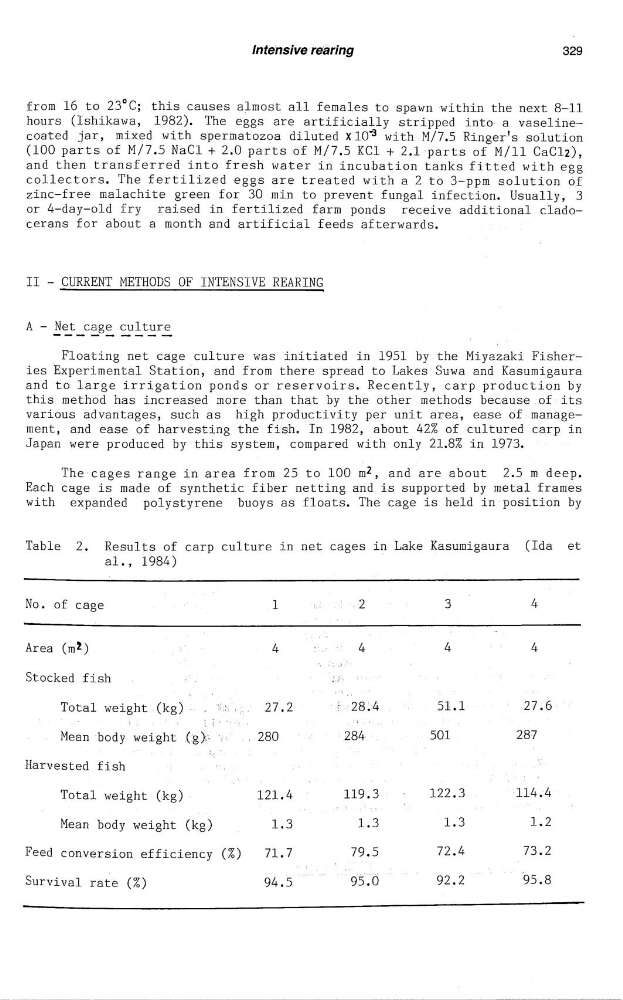
Floating net cage culture was initiated in 1951 by the Miyazaki Fisher—
ies Experimental StatiOn, and from there spread to Lakes Suwa and Kasumigaura
and to large irrigation ponds or reservoirs. Recently, carp production by
this method has increased more than that by the other methods because of its
various advantages, such as
high productivity per unit area, ease of manage—
ment,
and ease of harvesting the fish. In 1982, about 42% of cultured carp in
Japan were produced by this system, compared with only 21…8% in 1973.
The cages range in area from 25 to 100 m2, and are about
2.5 m deep.
Each cage is made of synthetic fiber netting and is supported by metal frames
with
expanded
polystyrene
buoys as floats. The cage is held in position by
Table
2.
Results of carp culture in net cages in Lake Kasumigaura
(Ida
et
al., 1984)
No. of cage
1
‘
3
4
Area (m2)
:
4
-
4
4
'
4
Stocked fish
.
‘
‘
‘
‘
Total weight.(kg). …
27.2
%w28.4
51.1
27.6
‘
Mean body weight (g)}
280
284
501
287
Harvested fish
-
‘
Total weight
121.4
119.3
122.3
,
114.4
Mean body weight (kg)
1.3
1.3
1.3
1.2
Feed conversion efficiency (%)
71.7
_79.5
72.4
_73'2
Survival rate (2)
94.5
"
'
95.0
‘
'
92.2
’
‘
95.8
____________________________________________________________________________
329
from 16 to 23°C; this causes almost all females to spawn within the next 8—11
hours
(Ishikawa,
1982).
The eggs are artificially stripped into a vaseline—
coated jar,
mixed with spermatozoa diluted X10'3 with M/7.5 Ringer's solution
(100 parts of M/7.5 NaCl.+ 2.0 parts of M/7.5 KCl + 2.1 parts of M/11 CaC12),
and then transferred into fresh water in incubation tanks fitted with egg
collectors. The fertilized eggs are treated with a 2 to 3—ppm solution Of
zinc—free malachite green for 30 min to prevent fungal infection. Usually, 3
or
4—day—old fry
raised in fertilized farm ponds
receive
additional clad0—
cerans
for about a month and artificial feeds afterwards.
Il — CURRENT METHODS OF INTENSIVE REARING
A — Ëet cage culture
Floating net cage culture was initiated in 1951 by the Miyazaki Fisher—
ies Experimental StatiOn, and from there spread to Lakes Suwa and Kasumigaura
and to large irrigation ponds or reservoirs. Recently, carp production by
this method has increased more than that by the other methods because of its
various advantages, such as
high productivity per unit area, ease of manage—
ment,
and ease of harvesting the fish. In 1982, about 42% of cultured carp in
Japan were produced by this system, compared with only 21…8% in 1973.
The cages range in area from 25 to 100 m2, and are about
2.5 m deep.
Each cage is made of synthetic fiber netting and is supported by metal frames
with
expanded
polystyrene
buoys as floats. The cage is held in position by
Table
2.
Results of carp culture in net cages in Lake Kasumigaura
(Ida
et
al., 1984)
No. of cage
1
‘
3
4
Area (m2)
:
4
-
4
4
'
4
Stocked fish
.
‘
‘
‘
‘
Total weight.(kg). …
27.2
%w28.4
51.1
27.6
‘
Mean body weight (g)}
280
284
501
287
Harvested fish
-
‘
Total weight
121.4
119.3
122.3
,
114.4
Mean body weight (kg)
1.3
1.3
1.3
1.2
Feed conversion efficiency (%)
71.7
_79.5
72.4
_73'2
Survival rate (2)
94.5
"
'
95.0
‘
'
92.2
’
‘
95.8
____________________________________________________________________________