

Fish harvesting in pond
31 1
The
greater part of sorting in a carp farm is still manual.
This
operation
requires the largest number of workers and is the bottleneck of the harves—
ting process.
Although
total
mechanization
of
sorting by species
cannot
be
solved,
partial mechanization can make the work easier and increase sorting capaci—
ty.
A
horizontal
conveyor
belt,
usually built into the sorting table,
can
convey
the
dominant fish of the polyculture through the table into a collec—
:ing tank or directly into the transporting tank, and only the other species
have
to
be
handled.
în
Hungary,
where
there
are
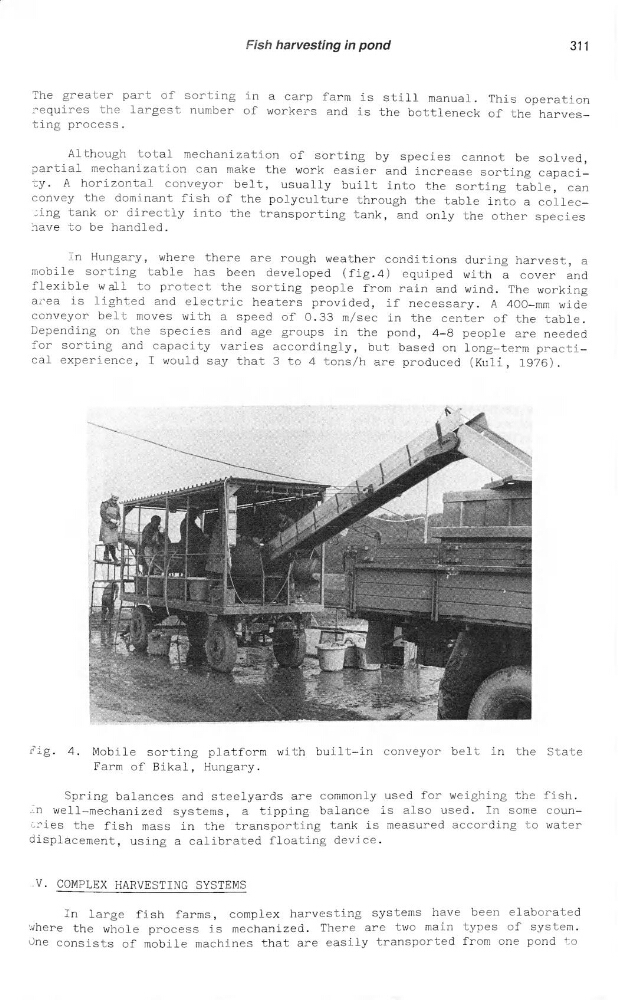
rough weather conditions during harvest, a
mobile
sorting
table
has
been
developed
(fig.4)
equiped
with
a
cover
and
flexible
wall
to
protect the
sorting people from rain and wind. The working
area
is
lighted and electric heaters provided,
if
necessary.
A
ADO—mm
wide
conveyor
belt
moves
with
a
speed of 0.33 m/sec in the center of the table.
Depending on the species and age groups in the pond,
4—8
people are needed
for
sorting and capacity varies accordingly,
but
based on long—term practi—
cal
experience,
I
would
say
that
3
to 4
tons/h are produced (Kuli, 1976).
Fig.
4.
Mobile
sorting platform with built—in conveyor belt
in
the
State
Farm of Bikal, Hungary.
Spring balances and steelyards are commonly used for weighing the fish.
Ln
well—mechanized
systems,
a
tipping balance
is
also
used.
In
some
coun—
tries
the
fish
mass
in
the
transporting tank is measured according to water
displacement, using a calibrated floating device.
…V.
COMPLEX HARVESTING SYSTEMS
In
large
fish
farms,
complex harvesting systems
have
been
elaborated
where
the
wh0le
process
is
mechanized.
There
are
two
main
types of system.
One consists
of mobile machines
that
are
easily transported from one pond to
31 1
The
greater part of sorting in a carp farm is still manual.
This
operation
requires the largest number of workers and is the bottleneck of the harves—
ting process.
Although
total
mechanization
of
sorting by species
cannot
be
solved,
partial mechanization can make the work easier and increase sorting capaci—
ty.
A
horizontal
conveyor
belt,
usually built into the sorting table,
can
convey
the
dominant fish of the polyculture through the table into a collec—
:ing tank or directly into the transporting tank, and only the other species
have
to
be
handled.
în
Hungary,
where
there
are
rough weather conditions during harvest, a
mobile
sorting
table
has
been
developed
(fig.4)
equiped
with
a
cover
and
flexible
wall
to
protect the
sorting people from rain and wind. The working
area
is
lighted and electric heaters provided,
if
necessary.
A
ADO—mm
wide
conveyor
belt
moves
with
a
speed of 0.33 m/sec in the center of the table.
Depending on the species and age groups in the pond,
4—8
people are needed
for
sorting and capacity varies accordingly,
but
based on long—term practi—
cal
experience,
I
would
say
that
3
to 4
tons/h are produced (Kuli, 1976).
Fig.
4.
Mobile
sorting platform with built—in conveyor belt
in
the
State
Farm of Bikal, Hungary.
Spring balances and steelyards are commonly used for weighing the fish.
Ln
well—mechanized
systems,
a
tipping balance
is
also
used.
In
some
coun—
tries
the
fish
mass
in
the
transporting tank is measured according to water
displacement, using a calibrated floating device.
…V.
COMPLEX HARVESTING SYSTEMS
In
large
fish
farms,
complex harvesting systems
have
been
elaborated
where
the
wh0le
process
is
mechanized.
There
are
two
main
types of system.
One consists
of mobile machines
that
are
easily transported from one pond to