

310
L. Vâl‘âdi
.
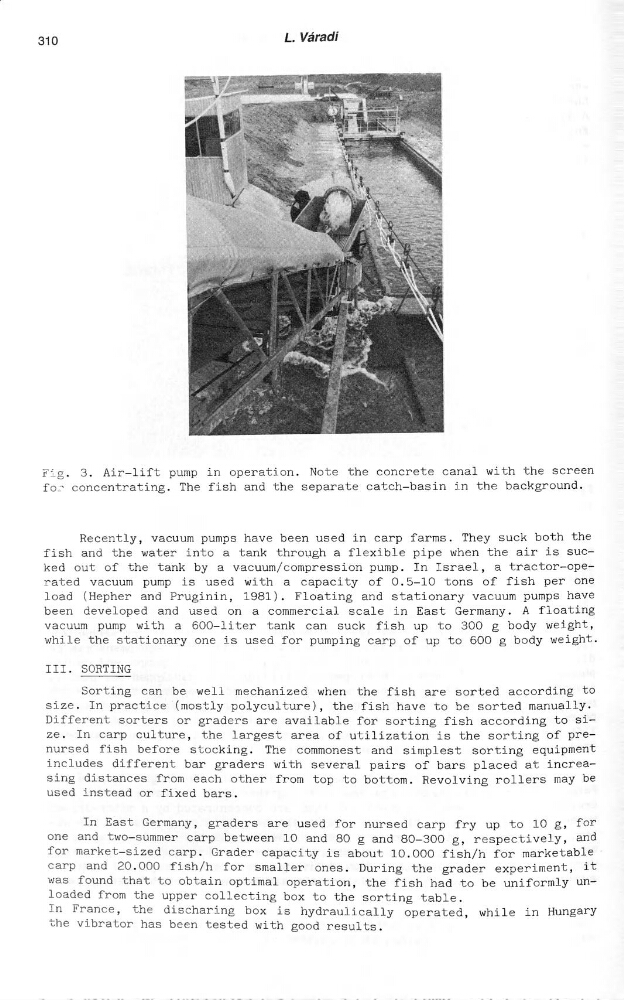
Fig.
3.
Air—lift
pump
in
operation.
Note
the
concrete
canal with the
screen
for
concentrating. The fish and the separate catch—basin in the background.
Recently, vacuum pumps have been used in carp farms. They suck both the
fish
and
the
water
into
a
tank
through a flexible pipe when the air is suc—
ked
out
of
the
tank
by a vacuum/compression pump. In Israel, a tractor—ope—
rated
vacuum
pump
is
used
with
a
capacity of 0.5—10 tons of fish per one
load
(Hepher and Pruginin,
1981).
Floating and stationary vacuum pumps have
been
developed and used on
a
commercial
scale
in
East
Germany.
A
floating
vacuum
pump
with
a
GOO—liter
tank
can
suck
fish
up
to
300
g
body weight,
while the
stationary one is used for pumping carp of up to 600 g body weightIII.
SORTING
-
Sorting can be well mechanized when the fish are sorted according to
size.
In practice (mostly polyculture), the fish have to be sorted manually.
Different
sorters
or
graders are available for sorting fish according to si—
ze.
In
carp
culture,
the
largest area of utilization is the sorting of pre—
nursed
fish
before
stocking.
The
commonest
and
simplest
sorting equipment
includes
different bar
graders with several pairs of bars placed at increa—
sing distances from each other from top to bottom. Revolving rollers may be
used instead or fixed bars.
In
East Germany,
graders are used for nursed carp fry up to 10 g, for
one
and
two—summer
carp
between
10
and
80 g and 80—300 g,
respectively, and
for market—sized carp.
Grader capacity is about 10.000 fish/h for marketable'
carp
and
20.000
fish/h for smaller
ones.
During the grader experiment, it
was
found
that to obtain optimal operation, the fish had to be uniformly un—
loaded from the upper collecting box to the sorting table.
In
France,
the
discharing box is hydraulically operated, while in Hungary
the vibrator has been tested with good results.
—
L. Vâl‘âdi
.
Fig.
3.
Air—lift
pump
in
operation.
Note
the
concrete
canal with the
screen
for
concentrating. The fish and the separate catch—basin in the background.
Recently, vacuum pumps have been used in carp farms. They suck both the
fish
and
the
water
into
a
tank
through a flexible pipe when the air is suc—
ked
out
of
the
tank
by a vacuum/compression pump. In Israel, a tractor—ope—
rated
vacuum
pump
is
used
with
a
capacity of 0.5—10 tons of fish per one
load
(Hepher and Pruginin,
1981).
Floating and stationary vacuum pumps have
been
developed and used on
a
commercial
scale
in
East
Germany.
A
floating
vacuum
pump
with
a
GOO—liter
tank
can
suck
fish
up
to
300
g
body weight,
while the
stationary one is used for pumping carp of up to 600 g body weightIII.
SORTING
-
Sorting can be well mechanized when the fish are sorted according to
size.
In practice (mostly polyculture), the fish have to be sorted manually.
Different
sorters
or
graders are available for sorting fish according to si—
ze.
In
carp
culture,
the
largest area of utilization is the sorting of pre—
nursed
fish
before
stocking.
The
commonest
and
simplest
sorting equipment
includes
different bar
graders with several pairs of bars placed at increa—
sing distances from each other from top to bottom. Revolving rollers may be
used instead or fixed bars.
In
East Germany,
graders are used for nursed carp fry up to 10 g, for
one
and
two—summer
carp
between
10
and
80 g and 80—300 g,
respectively, and
for market—sized carp.
Grader capacity is about 10.000 fish/h for marketable'
carp
and
20.000
fish/h for smaller
ones.
During the grader experiment, it
was
found
that to obtain optimal operation, the fish had to be uniformly un—
loaded from the upper collecting box to the sorting table.
In
France,
the
discharing box is hydraulically operated, while in Hungary
the vibrator has been tested with good results.
—