

Fish harvesting in pond
309
for
lifting. The inner screw amd outer pipe housing are fixed toge—
;her
and
when
revolving the fish are gently-lifted together with the water.
_A
type of screw conveyor with an outer diameter of 400 mm has been success—
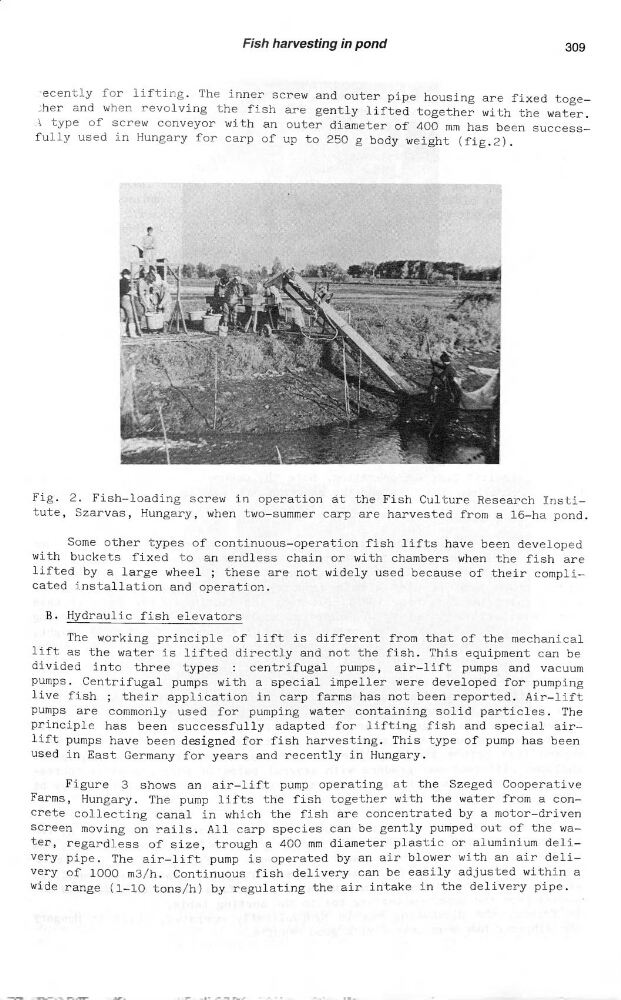
fully used in Hungary for carp of up to 250 g body weight (fig.2).
€5
‘
?
.
_
“:
'
_
.
_
i
Fig.
2.
Fish—loading screw in operation at the Fish Culture Research Insti—
tute, Szarvas, Hungary, when two—summer carp are harvested from a lô—ha pond.
Some other types of continuous—operation fish lifts have been developed
with
buckets
fixed
to
an
endless
chain
or
with
chambers
when
the
fish
are
lifted by a large wheel ; these are not widely used because of their compli—
cated installation and operation.
’
B.
Hydraulic fish elevators
-
'
The
working principle of lift is different from that of the mechanical
lift as the water is lifted directly and not the fish. This equipment can be
divided
into
three
types
:
centrifugal
pumps,
air—lift
pumps
and
vacuum
pumps.
Centrifugal pumps with a special impeller were developed for pumping
live
fish
;
their
application in carp farms has not been reported. Air—lift
Pumps
are
commonly used
for
pumping water containing solid particles.
The
principle has been successfully adapted for lifting fish and special air—
lift pumps have been designed for fish harvesting. This type of pump has been
used in East Germany for years and recently in Hungary.
Figure
3
shows
an
air—lift
pump
operating at the Szeged Cooperative
Farm3, Hungary. The pump lifts the fish together with the water from a con—
crete
collecting canal in which the fish are concentrated by a motor—driven
screen
moving on rails. All carp species can be gently pumped out of the wa—
ter, regardless of size, trough a 400 mm diameter plastic or aluminium deli—
-V€Fy pipe.
The
air—lift
pump
is
operated by an air blower with an air delivery of 1000
m3/h.
Continuous
fish
delivery can be easily adjusted within a
wide range
(l—10 tons/h) by regulating the air intake in the delivery pipe.
309
for
lifting. The inner screw amd outer pipe housing are fixed toge—
;her
and
when
revolving the fish are gently-lifted together with the water.
_A
type of screw conveyor with an outer diameter of 400 mm has been success—
fully used in Hungary for carp of up to 250 g body weight (fig.2).
€5
‘
?
.
_
“:
'
_
.
_
i
Fig.
2.
Fish—loading screw in operation at the Fish Culture Research Insti—
tute, Szarvas, Hungary, when two—summer carp are harvested from a lô—ha pond.
Some other types of continuous—operation fish lifts have been developed
with
buckets
fixed
to
an
endless
chain
or
with
chambers
when
the
fish
are
lifted by a large wheel ; these are not widely used because of their compli—
cated installation and operation.
’
B.
Hydraulic fish elevators
-
'
The
working principle of lift is different from that of the mechanical
lift as the water is lifted directly and not the fish. This equipment can be
divided
into
three
types
:
centrifugal
pumps,
air—lift
pumps
and
vacuum
pumps.
Centrifugal pumps with a special impeller were developed for pumping
live
fish
;
their
application in carp farms has not been reported. Air—lift
Pumps
are
commonly used
for
pumping water containing solid particles.
The
principle has been successfully adapted for lifting fish and special air—
lift pumps have been designed for fish harvesting. This type of pump has been
used in East Germany for years and recently in Hungary.
Figure
3
shows
an
air—lift
pump
operating at the Szeged Cooperative
Farm3, Hungary. The pump lifts the fish together with the water from a con—
crete
collecting canal in which the fish are concentrated by a motor—driven
screen
moving on rails. All carp species can be gently pumped out of the wa—
ter, regardless of size, trough a 400 mm diameter plastic or aluminium deli—
-V€Fy pipe.
The
air—lift
pump
is
operated by an air blower with an air delivery of 1000
m3/h.
Continuous
fish
delivery can be easily adjusted within a
wide range
(l—10 tons/h) by regulating the air intake in the delivery pipe.