

114
L.1orvab
In Central Europe there are about 100-120 days in a year when the average
daily water temperature reaches or exceeds the minimal spawning temperatures
(15°C) of carp. A more precise approach is to say that the average daily water
temperature of this period is about 20°C. During this period, the total heat
is 2000—2500 degree—days (100—120 days X 20°C). With this mode of calculation,
it is seen that fish in nature receive a heat quantity of about 8—10 000
degree—days in the four growing seasons from birth to puberty (Fig. 1).
Tabl.
2. Propagation data on 2 females reared in continuous warm
conditions
(20—24°C). Ovulation: 12—14 h after Second pi—
tuitary injection.
Time of
°days
%. egîî”äî
ËÎZËÏ.ËïÊÊË
z
treatment
0
Y W
g
r
treatments
28 Nov.
45
—
—
21
Jan.
55%
54
1188
1
31
March
—
68
1496
11
July
69
72
1584
(8 kg)
11
Sept.
96X
92
2024
18 Nov.
—
67
‘
1474
4 Jan.
22
47
1034
27 Jan.
46
—
—
‘
2
31
March
80
63
1386
11
June
15
72
1584
(5 kg)
11
Sept.
25X
92
2024
27 Oct.
—
46
1012
4 Jan.
88
69
1518
à unsuccessful hormonal treatment.
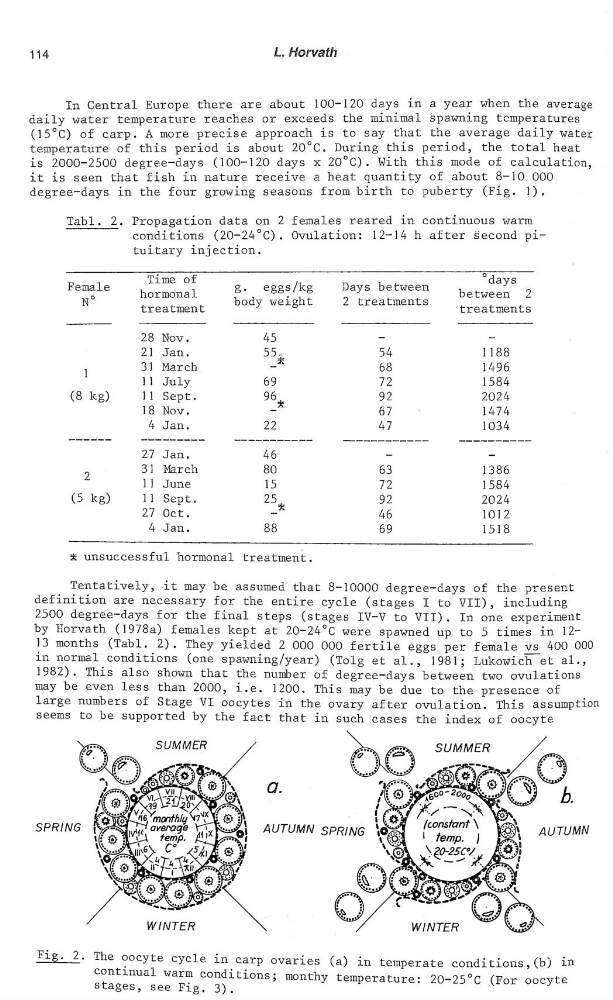
Tentatively,-it may be assumed that 8—10000 degree—days of the present
definition are necessary for the entire cycle (stages I to VII), including
2500 degree—days for the final steps (stages IV—V to VII). In one eXperiment
by Horvath (1978a) females kept at 20—24°C were spawned up to 5 times in 12—
13
months
(Tabl. 2). They yielded 2 000 000 fertile eggs per female YË.4OO
000
in
normal conditions
(one spawning/year) (Tolg et al., 1981; Lukowich et al.,
1982). This also shown that the number of degree—days between two ovulations
may be even less than 2000, i.e. 1200. This may be due to the presence of
large numbers of Stage VI oocytes in the ovary after ovulation. This aSSUŒPtiOn
seems
to be supported by the fact that in such cases the index of oocyte
@
SUMMER
SUMMER
/
'
’
\
,\
a
' __.….__
«IË®
. :. @5
/"'"”
.
V‘l
1
.
IE. @ °
.
A“N'"
b
I:{_@
v
.
.
...-'
'
.
.\
..
.
._
'Œlmnüw
|
0
k7f
\
SPRING
‘‘;—__ @}
AUTUMN SPRING
(‘Æmp’f \} \ AUTUMN
«1\5
C°
% "
\@ \â0‘256‘7
\°.—" -. \5 k u,
-“
\ ‘/ÂfÏ..'
\. ® :. ||
__
—xn
,
.
,
"
-.'
7—0“:
.
«"
—
"—._ _.-'
'
,
'
'
“.
/
\
(
'-’
WINTER
WINTER
Êlë;_Ê' îËîtŸOCYÎG
CYC1e iÊ
carp 0VâïieS
(a) in temperate conditions,(b) in
inua
warm
con
itionS' month
tem e
t
.
_
0
Stages, see Fig.
»
Y
p ra ure.
20 25 C
(For oocyte
L.1orvab
In Central Europe there are about 100-120 days in a year when the average
daily water temperature reaches or exceeds the minimal spawning temperatures
(15°C) of carp. A more precise approach is to say that the average daily water
temperature of this period is about 20°C. During this period, the total heat
is 2000—2500 degree—days (100—120 days X 20°C). With this mode of calculation,
it is seen that fish in nature receive a heat quantity of about 8—10 000
degree—days in the four growing seasons from birth to puberty (Fig. 1).
Tabl.
2. Propagation data on 2 females reared in continuous warm
conditions
(20—24°C). Ovulation: 12—14 h after Second pi—
tuitary injection.
Time of
°days
%. egîî”äî
ËÎZËÏ.ËïÊÊË
z
treatment
0
Y W
g
r
treatments
28 Nov.
45
—
—
21
Jan.
55%
54
1188
1
31
March
—
68
1496
11
July
69
72
1584
(8 kg)
11
Sept.
96X
92
2024
18 Nov.
—
67
‘
1474
4 Jan.
22
47
1034
27 Jan.
46
—
—
‘
2
31
March
80
63
1386
11
June
15
72
1584
(5 kg)
11
Sept.
25X
92
2024
27 Oct.
—
46
1012
4 Jan.
88
69
1518
à unsuccessful hormonal treatment.
Tentatively,-it may be assumed that 8—10000 degree—days of the present
definition are necessary for the entire cycle (stages I to VII), including
2500 degree—days for the final steps (stages IV—V to VII). In one eXperiment
by Horvath (1978a) females kept at 20—24°C were spawned up to 5 times in 12—
13
months
(Tabl. 2). They yielded 2 000 000 fertile eggs per female YË.4OO
000
in
normal conditions
(one spawning/year) (Tolg et al., 1981; Lukowich et al.,
1982). This also shown that the number of degree—days between two ovulations
may be even less than 2000, i.e. 1200. This may be due to the presence of
large numbers of Stage VI oocytes in the ovary after ovulation. This aSSUŒPtiOn
seems
to be supported by the fact that in such cases the index of oocyte
@
SUMMER
SUMMER
/
'
’
\
,\
a
' __.….__
«IË®
. :. @5
/"'"”
.
V‘l
1
.
IE. @ °
.
A“N'"
b
I:{_@
v
.
.
...-'
'
.
.\
..
.
._
'Œlmnüw
|
0
k7f
\
SPRING
‘‘;—__ @}
AUTUMN SPRING
(‘Æmp’f \} \ AUTUMN
«1\5
C°
% "
\@ \â0‘256‘7
\°.—" -. \5 k u,
-“
\ ‘/ÂfÏ..'
\. ® :. ||
__
—xn
,
.
,
"
-.'
7—0“:
.
«"
—
"—._ _.-'
'
,
'
'
“.
/
\
(
'-’
WINTER
WINTER
Êlë;_Ê' îËîtŸOCYÎG
CYC1e iÊ
carp 0VâïieS
(a) in temperate conditions,(b) in
inua
warm
con
itionS' month
tem e
t
.
_
0
Stages, see Fig.
»
Y
p ra ure.
20 25 C
(For oocyte