

Carp oogenesis and the environment
115
maturation was relatively low for the previous ovulation and the ovary was not
emptied. If fish are stimulated too often, ovulation does not take place, as
there are not enough ripe oocytes to obtain the minimal value needed for succes—
sul ovulation.
1000
@
..
“+
900
?“
"o...-'î'
:\
.
500
._
,'
Il
__;sfage: 5118 degreedays 5gmbo/
&
:_ ü '
II
I
ij
Î700
i
Il
/.
8-12
500—2500
@
‘Ë
[
mm}.
II,
12—40
2000-4000
@
E
600
X'
?
4
?
40—200 2500-5000
@
”U
_/
I
aw
CZ
f
/
/
59
,
II
I
II!
200—350 [500—6000
È
‘
I
0
mo
'
f
:
'“
300
.=
-
/
Î
”
/
6500
:
—‘>’
VI.
aaa—you
‘
":
__
95
''
@
,,o —»»o
..
@
//
/’l
100
l
/
,
.
Il
/
..
...-.‘.'.
/
.
8
—
.
'.
_
©_g‘\—‘ ,
VI/.ÿ00 {200
ÎËÎm
V..
Il. '
,u.
,l( .
XI.
v..
Xl.
.
v…
1.gear
2. year
3.gear
4.gean
5. year
of age
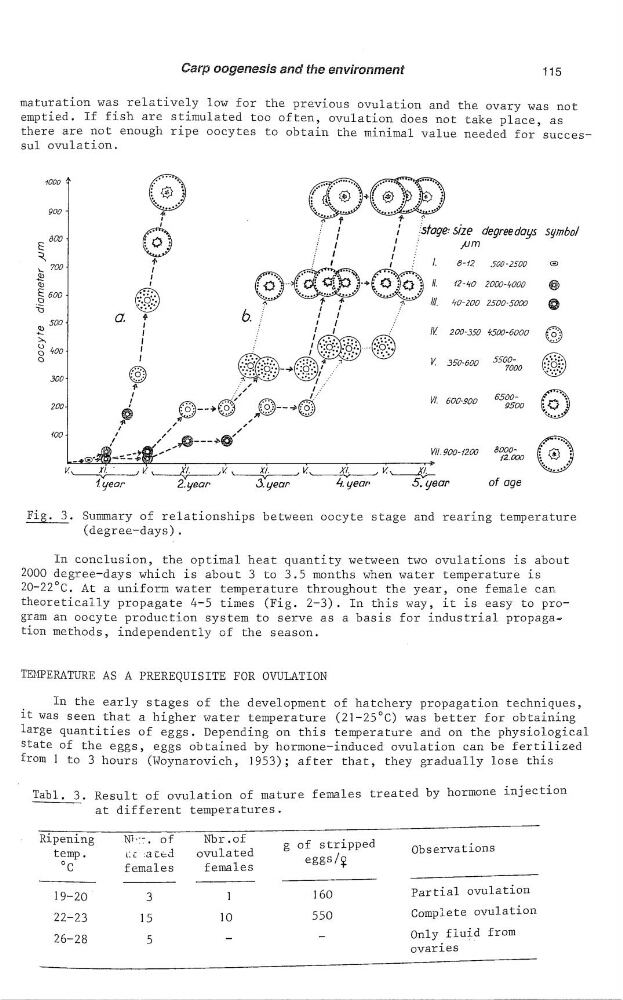
Fig. 3. Summary of relationships between oocyte stage and rearing temperature
(degree—days).
In conclusion, the optimal heat quantity wetween two ovulations is about
2000 degree—days which is about 3 to 3.5 months when water temperature is
20—22°C. At a uniform water temperature throughout the year, one female can
theoretically propagate 4—5 times (Fig. 2—3). In this way, it is easy to pro—
gram an oocyte production system to serve as a basis for industrial propaga«
tion methods, independently of the season.
TEMPERATURE AS A PREREQUISITE FOR OVULATION
In the early stages of the development of hatehery propagation techniques,
lt was
seen
that a higher water temperature (ZI—25°C) was better for obtaining
large quantities of eggs. Depending on this temperature and on the physiological
state of
the eggs,
eggs obtained by hormone—induced ovulation can be fertilized
from 1 to 3 hours
(Woynarovich, 1953); after that, they gradually lose this
Tabl. 3. Result of ovulation of mature females treated by hormone injection
at
different temperatures.
M
»
Ripening
of
Nbr.of
_
'
of str1
ed
-
temp.
tc
ated
ovulated
ë
eggs/gpp
observations
°C
females
females
______________
19_20
3
1
160
Partial ovulation
22—23
15
10
550
Complete ovulation
f
'
from
26—28
5
—
—
On1Y. 1u-ld
ovar1es
115
maturation was relatively low for the previous ovulation and the ovary was not
emptied. If fish are stimulated too often, ovulation does not take place, as
there are not enough ripe oocytes to obtain the minimal value needed for succes—
sul ovulation.
1000
@
..
“+
900
?“
"o...-'î'
:\
.
500
._
,'
Il
__;sfage: 5118 degreedays 5gmbo/
&
:_ ü '
II
I
ij
Î700
i
Il
/.
8-12
500—2500
@
‘Ë
[
mm}.
II,
12—40
2000-4000
@
E
600
X'
?
4
?
40—200 2500-5000
@
”U
_/
I
aw
CZ
f
/
/
59
,
II
I
II!
200—350 [500—6000
È
‘
I
0
mo
'
f
:
'“
300
.=
-
/
Î
”
/
6500
:
—‘>’
VI.
aaa—you
‘
":
__
95
''
@
,,o —»»o
..
@
//
/’l
100
l
/
,
.
Il
/
..
...-.‘.'.
/
.
8
—
.
'.
_
©_g‘\—‘ ,
VI/.ÿ00 {200
ÎËÎm
V..
Il. '
,u.
,l( .
XI.
v..
Xl.
.
v…
1.gear
2. year
3.gear
4.gean
5. year
of age
Fig. 3. Summary of relationships between oocyte stage and rearing temperature
(degree—days).
In conclusion, the optimal heat quantity wetween two ovulations is about
2000 degree—days which is about 3 to 3.5 months when water temperature is
20—22°C. At a uniform water temperature throughout the year, one female can
theoretically propagate 4—5 times (Fig. 2—3). In this way, it is easy to pro—
gram an oocyte production system to serve as a basis for industrial propaga«
tion methods, independently of the season.
TEMPERATURE AS A PREREQUISITE FOR OVULATION
In the early stages of the development of hatehery propagation techniques,
lt was
seen
that a higher water temperature (ZI—25°C) was better for obtaining
large quantities of eggs. Depending on this temperature and on the physiological
state of
the eggs,
eggs obtained by hormone—induced ovulation can be fertilized
from 1 to 3 hours
(Woynarovich, 1953); after that, they gradually lose this
Tabl. 3. Result of ovulation of mature females treated by hormone injection
at
different temperatures.
M
»
Ripening
of
Nbr.of
_
'
of str1
ed
-
temp.
tc
ated
ovulated
ë
eggs/gpp
observations
°C
females
females
______________
19_20
3
1
160
Partial ovulation
22—23
15
10
550
Complete ovulation
f
'
from
26—28
5
—
—
On1Y. 1u-ld
ovar1es