

oogenesis and the environment
113
(vitellogenesis) occurs, resulting in a rapid increase of oocyte size. Kuzmin
observed a similar phenomenon in 1957. The samples were from populations of
recorded age, raised in fish farms. Therefore, there was little risk of in—
exict age determination.
Table
1
gives the most advanced oocyte stage. In the
temperate zone, carp metabolism is active in the late spring and in summer and
early autumn when therweather is warm; in winter there is no increase in body
weight. In the first growing season, carp body weight increases from a few mg
to
10 g, while the gonads develops very slowly (no measurable weight) and
resembles a thin white thread stuck to the peritoneum, along the swim bladder.
At the end of
the first season,
the oocytes reach stage III and increase in
number.
They remain in this state during the first winter until active feeding
begins again. During the second season the original body weight of the carp
increases eight times on an average, and may be as high as 200 to 300 g; most
of the cells
are
still in stages II and III.
During the third growing season, carp body weight increases five times:
up
to
100—1500 g on the average.
Oocytes in stages IV, V and VI contain vitel—
lus and constitute the main mass of the ovaries. Of course, cells in stages II
and III are also found.
Under favourable pond conditions, yolk development may
be so rapid that stage VIIe cells ready for ovulation may appear too. In the
fourth season,
growth is reduced and body weight increases approximately three
times. Ovary weight increases at almost the same ratio. The most advanced
oocytes reach stage VIIa and are ready for ovulation.
The reason for
the lower body weight increase may be the intensified
sexual production. The ripe oocytes of fish in the fourth season remain in the
ovary in the gradually cooling water of autumn. They do not undergo any mor—
phological change and, when they reach the spawning period of the next season
(April—May), ovulation takes place as a result of environmental chenges.
Oocyte development is not a synchronized process in carp; therefore
oocytes at various stages of development are found in the ovary at the same
time. During spawning, the most developed ones (stage VIIb) constitute 40—702
of the ovarian mass;
the rest are in stage V or less. A rapid final development
of cells in stages IV and V into stage VII, achieved within a few months after
spawning, deprives other parts of the organism of a lot of energÿv This may be
why female growth is retarded greatly after the first spawning. In fish which
do not spawn for some reason,
stage VII oocytes ready for ovulation are
bed when spawning time is over. A new batch of oocytes develops and fish which
did not spawn in one year, but may spawn the next year.
The most suitable parameters for judging female maturity are the gonado—
somatic index (GST), rate of egg production or ovary weight/body weight and
the index of residual ovary weight/body weight.
15,000
-
_
.
G.
|
motumhon
b
m
'2500
|
|p-"'
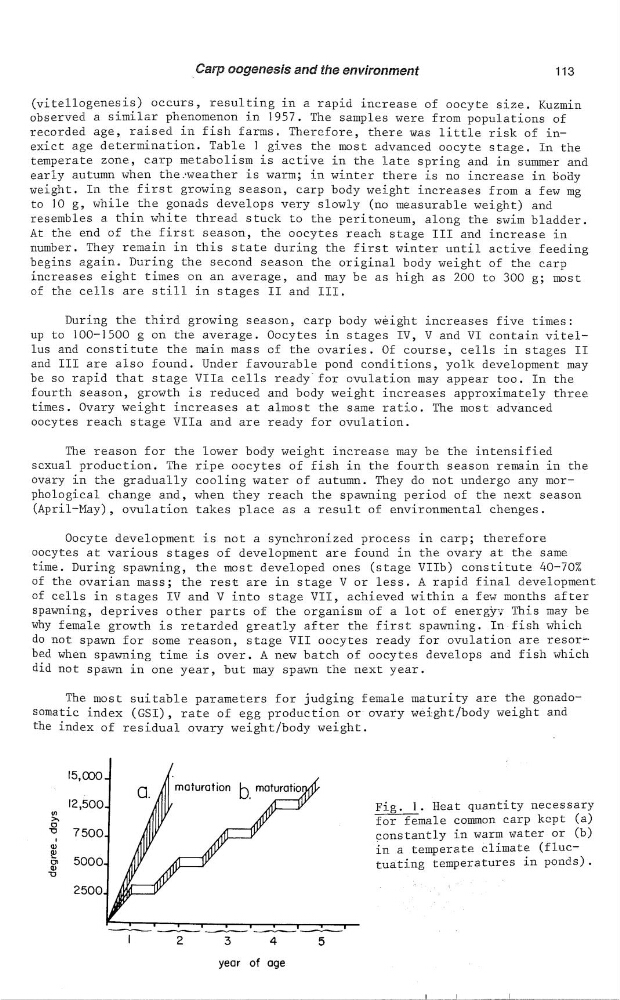
Fig. 1. Heat quantity necessary
@
"
"
for female common carp kept (a)
7500
'“
lII-l
constantly in warm
water
or
(b)
“
|“l
in a temperate climate
(fluc—
5000
||" "|||-|
tuating temperatures in ponds).
2500
"
_
|
2
3
4
5
year
of age
,
,
,__…__i……………………
113
(vitellogenesis) occurs, resulting in a rapid increase of oocyte size. Kuzmin
observed a similar phenomenon in 1957. The samples were from populations of
recorded age, raised in fish farms. Therefore, there was little risk of in—
exict age determination.
Table
1
gives the most advanced oocyte stage. In the
temperate zone, carp metabolism is active in the late spring and in summer and
early autumn when therweather is warm; in winter there is no increase in body
weight. In the first growing season, carp body weight increases from a few mg
to
10 g, while the gonads develops very slowly (no measurable weight) and
resembles a thin white thread stuck to the peritoneum, along the swim bladder.
At the end of
the first season,
the oocytes reach stage III and increase in
number.
They remain in this state during the first winter until active feeding
begins again. During the second season the original body weight of the carp
increases eight times on an average, and may be as high as 200 to 300 g; most
of the cells
are
still in stages II and III.
During the third growing season, carp body weight increases five times:
up
to
100—1500 g on the average.
Oocytes in stages IV, V and VI contain vitel—
lus and constitute the main mass of the ovaries. Of course, cells in stages II
and III are also found.
Under favourable pond conditions, yolk development may
be so rapid that stage VIIe cells ready for ovulation may appear too. In the
fourth season,
growth is reduced and body weight increases approximately three
times. Ovary weight increases at almost the same ratio. The most advanced
oocytes reach stage VIIa and are ready for ovulation.
The reason for
the lower body weight increase may be the intensified
sexual production. The ripe oocytes of fish in the fourth season remain in the
ovary in the gradually cooling water of autumn. They do not undergo any mor—
phological change and, when they reach the spawning period of the next season
(April—May), ovulation takes place as a result of environmental chenges.
Oocyte development is not a synchronized process in carp; therefore
oocytes at various stages of development are found in the ovary at the same
time. During spawning, the most developed ones (stage VIIb) constitute 40—702
of the ovarian mass;
the rest are in stage V or less. A rapid final development
of cells in stages IV and V into stage VII, achieved within a few months after
spawning, deprives other parts of the organism of a lot of energÿv This may be
why female growth is retarded greatly after the first spawning. In fish which
do not spawn for some reason,
stage VII oocytes ready for ovulation are
bed when spawning time is over. A new batch of oocytes develops and fish which
did not spawn in one year, but may spawn the next year.
The most suitable parameters for judging female maturity are the gonado—
somatic index (GST), rate of egg production or ovary weight/body weight and
the index of residual ovary weight/body weight.
15,000
-
_
.
G.
|
motumhon
b
m
'2500
|
|p-"'
Fig. 1. Heat quantity necessary
@
"
"
for female common carp kept (a)
7500
'“
lII-l
constantly in warm
water
or
(b)
“
|“l
in a temperate climate
(fluc—
5000
||" "|||-|
tuating temperatures in ponds).
2500
"
_
|
2
3
4
5
year
of age
,
,
,__…__i……………………