

654 J Gauss surface normal coordinates in geometry and gravity space
The reciprocal polar fl attening is prov ided by
1
α 13
: =
A 1
A 1 − A 3
= 297 .78 1 194 .
(J.8 2)
The polar fl attening is prov ided by
α 13 = 3 .3 5 8 17
× 10
−3 , 1 − α 13 = 0 .996 6 4 3 8 3
.
(J.8 3 )
The reciprocal equatorial fl attening is prov ided by
1
α 12
: =
A 1
A 1 − A 2
= 91 6 5 0
.8 26 .
(J.8 4 )
The equatorial fl attening is prov ided by
α 12 = 1 .091 097 × 10
−3 , 1 − α 12 = 0 .999 98 9 08 9 .
(J.8 5 )
Important!
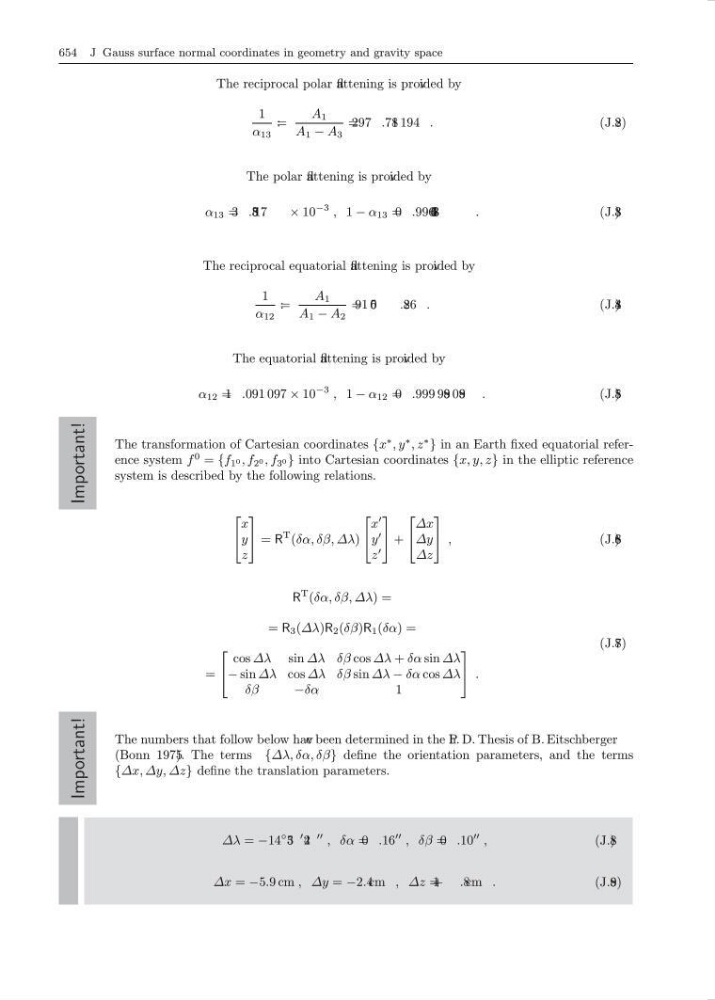
The transformation of Cartesian coordinates {x
∗ , y
∗ , z
∗
} in an Earth fixed equatorial reference system f
0 = {f 1 0 , f 2 0 , f 3 0 } into Cartesian coordinates {x, y, z} in the elliptic reference
system is described by the following relations.
⎡
⎣
x
y
z
⎤
⎦ = R
T (δα, δβ, ∆λ)
⎡
⎣
x
y
z
⎤
⎦ +
⎡
⎣
∆x
∆y
∆z
⎤
⎦ ,
(J.8 6 )
R
T (δα, δβ, ∆λ) =
= R 3 (∆λ)R 2 (δβ)R 1 (δα) =
=
⎡
⎣
cos ∆λ sin ∆λ δβ cos ∆λ + δα sin ∆λ
− sin ∆λ cos ∆λ δβ sin ∆λ − δα cos ∆λ
δβ
−δα
1
⎤
⎦ .
(J.8 7)
Important!
The numbers that follow below hav e been determined in the P h. D. Thesis of B. Eitschberger
(Bonn 1975 ). The terms {∆λ, δα, δβ} define the orientation parameters, and the terms
{∆x, ∆y, ∆z} define the translation parameters.
∆λ = −14
◦ 5 3
4 2
, δα = 0 .16
, δβ = 0 .10
,
(J.8 8 )
∆x = −5.9 cm , ∆y = −2.4 cm , ∆z = + 1
.8 cm .
(J.8 9)